Facts
M/s Wealth Mantra Private Limited, a securities-broking company, operated a branch at Sapru Marg, Lucknow. The applicant, Sanjeev Agarwal, was its Chairman and Managing Director and claimed that his functions were administrative and supervisory, with no involvement in routine branch operations.
Source reference: p.2, para. 2Opposite Party No. 2 alleged that the applicant and the company’s Branch Manager induced him to invest approximately ₹5,63,350 through 13 cheques by promising bonus shares and a doubling of his investment. He further alleged that shares of Orissa and Mineral Development Corporation were fraudulently transferred and that forged documents and signatures were used.
Source reference: pp.4–6, paras. 8–10Opposite Party No. 2 initially sought registration of an FIR under Section 156(3) Cr.P.C. The FIR was registered as Case Crime No. 432 of 2014 under Sections 406, 420, 467, 468, 471, 323, 524 and 506 IPC after the Magistrate’s order dated 20 August 2014.
Source reference: p.2, para. 5The police submitted closure reports twice, including after reinvestigation. On the complainant’s second protest petition, the Magistrate treated the matter as a complaint case under Complaint Case No. 744 of 2018. After recording statements under Sections 200 and 202 Cr.P.C., the Chief Judicial Magistrate summoned the applicant on 1 July 2019.
Source reference: p.3, para. 6The applicant’s criminal revision was dismissed by the Additional District and Sessions Judge on 22 February 2022, leading to the present application under Section 482 Cr.P.C.
Source reference: p.3, para. 6Issues
Whether the summoning order dated 1 July 2019 and the subsequent criminal proceedings disclosed sufficient prima facie material to proceed against the applicant for the alleged offences.
Source reference: p.7, para. 13Whether the High Court, while exercising inherent jurisdiction under Section 482 Cr.P.C., could re-evaluate the complainant’s allegations, documentary material, and the police closure reports through a detailed or “mini-trial” inquiry.
Source reference: p.7, paras. 13–14Whether the revisional court’s order dated 22 February 2022 warranted interference under Section 482 Cr.P.C.
Source reference: p.1, para. 1; p.7, para. 15Law Applied
The Court applied Section 482 Cr.P.C., which confers inherent jurisdiction on the High Court to prevent abuse of the process of court and secure the ends of justice, but does not ordinarily permit a detailed assessment of disputed facts at the pre-trial stage.
Source reference: p.7, para. 14At the stage of summoning, discharge, or quashing, the Court need only determine whether sufficient material exists to proceed against the accused; it is not required to conduct a mini-trial or determine whether the prosecution will ultimately prove its case.
Source reference: p.7, para. 14The Court relied principally on Central Bureau of Investigation v. Aryan Singh, (2023) 18 SCC 399, which holds that the High Court has limited jurisdiction under Section 482 Cr.P.C. and must not evaluate the evidence as if deciding the case after trial.
Source reference: p.7, para. 14The Court also considered the statutory procedure under Sections 200 and 202 Cr.P.C., under which the Magistrate may examine the complainant and witnesses before issuing process.
Source reference: p.3, para. 6Reasoning
The complaint contained specific allegations that the applicant’s company, allegedly acting through its officers, induced the complainant to purchase shares, transferred those shares without authority, and failed to provide the corresponding payment.
Source reference: p.7, para. 13The complainant’s version was supported by the statements of Ashish Tandon and Mukul Verma recorded under Section 202 Cr.P.C., who also supported the allegations of assault by the applicant and company employees.
Source reference: p.7, para. 13Although the police had submitted closure reports, the Magistrate was not precluded from proceeding on the protest petition treated as a complaint after independently recording evidence under Sections 200 and 202 Cr.P.C.
Source reference: p.7, paras. 13–14The applicant’s reliance on the closure reports, alleged contradictions, documentary material, and the complainant’s supposed history of filing similar cases required evaluation of disputed facts and evidence.
Source reference: p.7, paras. 13–14Such an exercise would amount to a roving inquiry or mini-trial, which is impermissible in proceedings under Section 482 Cr.P.C.
Source reference: p.7, paras. 13–14Since prima facie material existed against the applicant, neither the summoning order nor the revisional order called for interference.
Source reference: p.7, paras. 13–15Holding
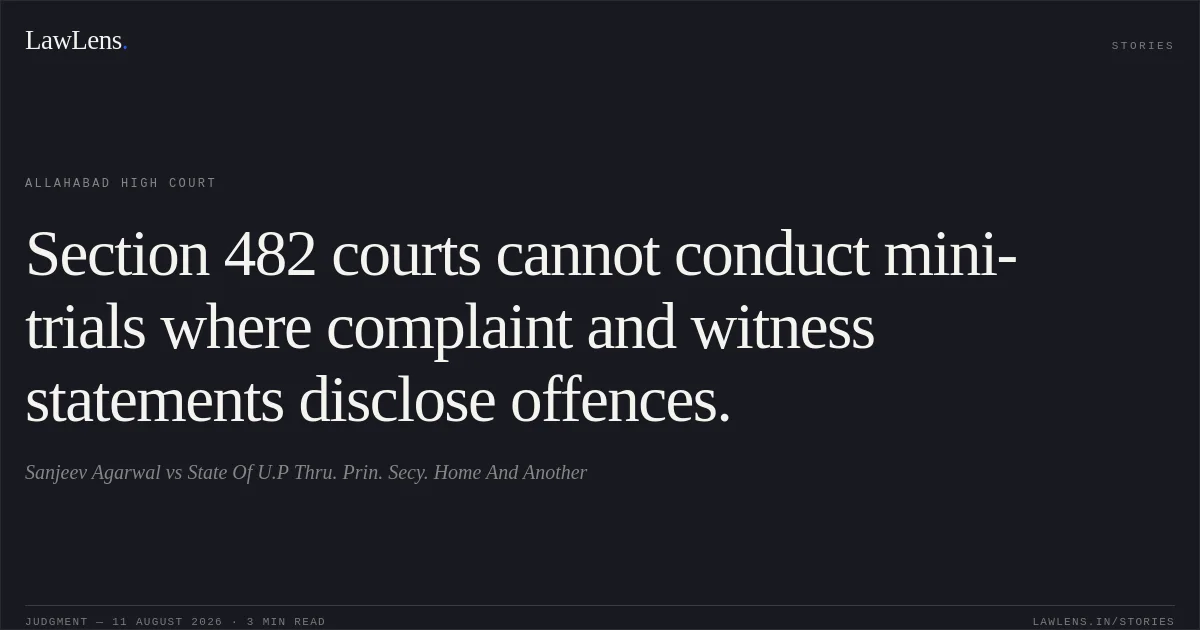
The High Court held that the complaint and supporting witness statements disclosed sufficient prima facie material to proceed against the applicant and that the Court could not determine the truth or falsity of the allegations by undertaking a mini-trial under Section 482 Cr.P.C.
The application was accordingly rejected, the order dated 22 February 2022 passed in Criminal Revision No. 611 of 2019 and the summoning order dated 1 July 2019 were left undisturbed, and any interim order was vacated.
Source reference: p.7, para. 16Acts & Sections Cited
12 provisions across 2 statutes referred to in this judgment. Each provision opens on LawLens.
Code of Criminal Procedure, 19734
Indian Penal Code, 18608
Original Court PDF
Sanjeev AgarwalvsState Of U.P Thru. Prin. Secy. Home And Another
Click to open original judgment
Original judgment, available to read, download and summarize on LawLens.in