Facts
The petitioner was employed as a Salesman at a Government Fair Price Shop in Parakhasa, District Tikamgarh.
Source reference: no citationOn 19 May 2021, the Tehsildar inspected the shop following complaints regarding irregular opening and improper distribution of ration and found that ration stock pertaining to two months had been kept at another storage place.
Source reference: para. 2The shop was sealed and a report was submitted to the Sub-Divisional Officer (Revenue).
Source reference: para. 2After issuing a show-cause notice and considering the petitioner’s reply, the Sub-Divisional Officer, by order dated 30 July 2021, substantially accepted the explanation but imposed a penalty of ₹5,000 and issued a warning.
Source reference: paras. 3–4The petitioner deposited the penalty.
Source reference: no citationSubsequently, on the complaint of the Junior Supply Officer, FIR Crime No. 32/2022 was registered on 28 January 2022 under Sections 3 and 7 of the Essential Commodities Act, 1955.
Source reference: para. 5The petitioner’s earlier writ petition was disposed of with liberty to invoke Section 482 of the Code of Criminal Procedure.
Source reference: para. 6He therefore sought quashing of the FIR and all consequential proceedings.
Source reference: no citationIssues
1. Whether continuation of the criminal prosecution under Sections 3 and 7 of the Essential Commodities Act, 1955, on the same facts already examined in departmental proceedings, amounted to abuse of the process of law.
Source reference: paras. 7–132. Whether the allegations of storing ration at an unauthorised place and other procedural irregularities disclosed the essential ingredients of an offence under the Essential Commodities Act in the absence of any allegation of shortage, diversion, black marketing or embezzlement.
Source reference: paras. 10–133. Whether the High Court ought to exercise its inherent jurisdiction under Section 482 Cr.P.C. to quash the FIR and consequential proceedings.
Source reference: para. 12Law Applied
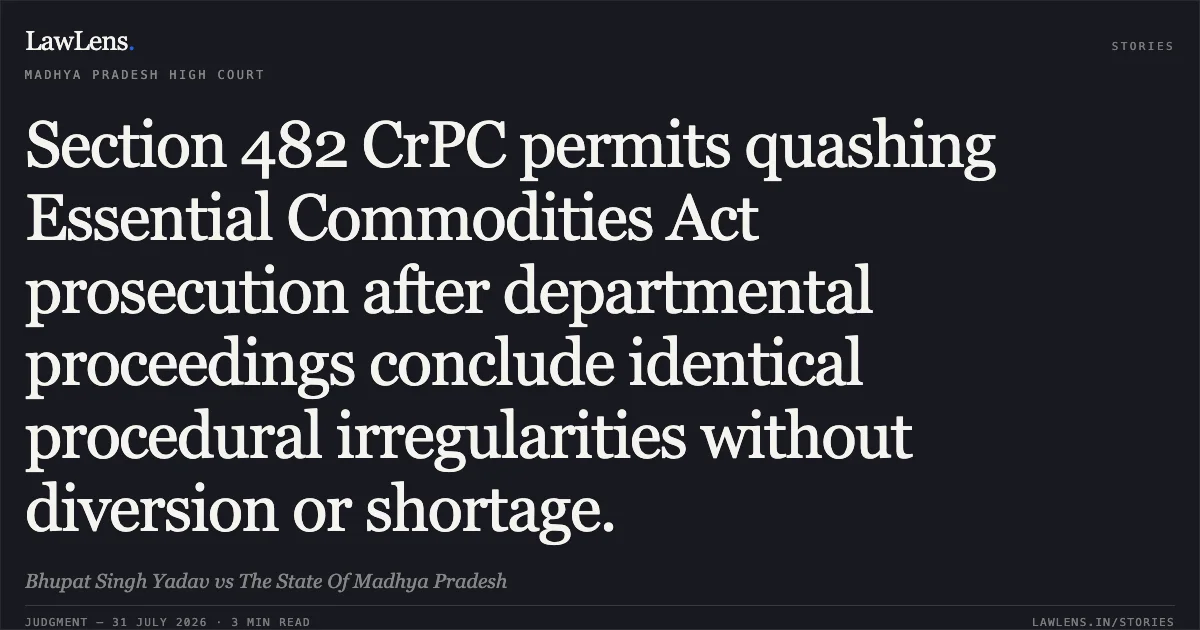
Section 482 Cr.P.C. empowers the High Court to prevent abuse of the process of any court and to secure the ends of justice.
Source reference: para. 12The power may be exercised where the uncontroverted allegations and the material on record do not disclose the essential ingredients of the alleged offence or where continuation of the prosecution would result in unnecessary harassment.
Source reference: para. 12Sections 3 and 7 of the Essential Commodities Act, 1955, require a legally sustainable violation of an applicable control order or statutory restriction; mere administrative or procedural irregularities, without material indicating unlawful diversion, shortage, black marketing or dishonest handling of essential commodities, do not automatically justify criminal prosecution.
Source reference: paras. 10–13The Court also considered the principle against repeated punitive action on the same factual foundation, although its ultimate decision rested principally on abuse of process and failure to disclose the essential ingredients of the alleged offences.
Source reference: paras. 7, 11–13Reasoning
The Court found that the inspection of 19 May 2021, the subsequent show-cause notice, the petitioner’s reply and the order imposing a ₹5,000 penalty constituted a detailed prior examination of the same allegations forming the basis of the FIR.
Source reference: paras. 10–11The departmental order did not record any finding of ration shortage, diversion, black marketing or embezzlement; rather, it substantially accepted the petitioner’s explanation and treated the matter as one warranting only a warning and minor penalty.
Source reference: para. 10No fresh material had emerged after the departmental proceedings to support criminal prosecution.
Source reference: para. 11Since the allegations were confined to procedural irregularities in storage and distribution and did not disclose dishonest or unlawful diversion of essential commodities, the Court held that the essential basis for prosecution under Sections 3 and 7 of the Essential Commodities Act was absent.
Source reference: paras. 11–13Continuing the prosecution in these circumstances would therefore constitute abuse of the process of law warranting intervention under Section 482 Cr.P.C.
Source reference: paras. 11–13Holding
The High Court allowed the petition and held that continuation of the criminal proceedings was unwarranted because the matter had already been dealt with administratively and the material did not disclose shortage, diversion, black marketing or any other substantial violation constituting the alleged offences.
Accordingly, FIR Crime No. 32/2022 registered at Police Station Palera, District Tikamgarh, under Sections 3 and 7 of the Essential Commodities Act, 1955, together with all consequential proceedings, was quashed insofar as the petitioner was concerned.
Source reference: para. 14Acts & Sections Cited
3 provisions across 2 statutes referred to in this judgment. Each provision opens on LawLens.
Code of Criminal Procedure, 19731
Original Court PDF
Bhupat Singh YadavvsThe State Of Madhya Pradesh
Click to open original judgment
Original judgment, available to read, download and summarize on LawLens.in