Facts
The appellant, Karmi Devi, was the mother-in-law of the informant/victim.
Source reference: no citationThe victim alleged that, after her marriage to Rabindra Saha, her matrimonial family demanded an additional ₹20,000 after ₹30,000 had allegedly been paid against an agreed dowry amount of ₹50,000.
Source reference: pp. 2–3, paras. 4–7She further alleged that she was beaten, harassed, and ultimately expelled from her matrimonial home for non-fulfilment of the demand.
Source reference: pp. 2–3, paras. 4–7An FIR was registered under Sections 498A/34 and 376 IPC against the appellant, her husband, the victim’s husband, and two brothers-in-law.
Source reference: pp. 2–3, paras. 4–7The trial court acquitted the victim’s husband of the charge under Section 498A IPC and acquitted Chandradeep Saha of the charge under Section 376 IPC, but convicted Karmi Devi and Deenanath Saha under Sections 498A/34 IPC and sentenced each to one year’s simple imprisonment and a fine of ₹5,000.
Source reference: p. 3, para. 10During the appeal, Deenanath Saha died and the appeal abated as against him; the appeal proceeded against Karmi Devi alone.
Source reference: p. 1, para. 2The prosecution relied principally on the testimony of the victim and her parents.
Source reference: pp. 7–14, paras. 20–40The victim’s father admitted that he had not personally witnessed the alleged cruelty, while several independent witnesses did not support the prosecution.
Source reference: pp. 7–14, paras. 20–40The evidence also disclosed that the victim’s husband had instituted a divorce suit before the criminal case was filed, and that there were conflicting accounts regarding the victim’s alleged marriage with Chandradeep Saha and the duration of her stay in the matrimonial home.
Source reference: pp. 7–14, paras. 20–40Issues
Whether the prosecution proved beyond reasonable doubt that Karmi Devi subjected the victim to “cruelty” within the meaning of Section 498A IPC by demanding ₹20,000 or harassing her for non-fulfilment of that demand?
Source reference: pp. 5–6, paras. 17–18; pp. 10–15, paras. 32–42Whether the evidence against the appellant was sufficiently specific, consistent, and reliable to sustain her conviction under Sections 498A/34 IPC despite the acquittal of the victim’s husband and brother-in-law and the material contradictions in the prosecution case?
Source reference: pp. 9–15, paras. 30–42Law Applied
The Court applied Section 498A IPC, under which the prosecution must establish that the husband or relative of the husband subjected the woman to “cruelty.”
Source reference: pp. 5–6, paras. 17–18Under Explanation (a), cruelty includes wilful conduct likely to drive the woman to suicide or cause grave injury or danger to her life, limb, or health; under Explanation (b), it includes harassment intended to coerce the woman or her relatives to meet an unlawful demand for property or valuable security, or harassment arising from failure to meet such demand.
Source reference: pp. 5–6, paras. 17–18The Court also applied the principle that falsus in uno, falsus in omnibus is not a rule of law in India, but the evidence must nevertheless be carefully sifted and specific allegations against the accused independently assessed.
Source reference: p. 9, paras. 30–31It further relied on Abhishek v. State of M.P., (2023) 16 SCC 666, which holds that wholly insufficient, far-fetched, and inherently improbable allegations cannot sustain criminal proceedings under Section 498A IPC.
Source reference: p. 14, para. 41Reasoning
The Court held that the victim’s testimony did not attribute any specific act of beating, harassment, or cruelty directly to Karmi Devi.
Source reference: p. 10, para. 32Although the victim alleged a collective demand for ₹20,000, the evidence did not establish a clear and reliable overt act by the appellant satisfying either limb of the statutory definition of cruelty.
Source reference: p. 10, para. 32The victim’s father had no personal knowledge of the alleged acts, the mother’s evidence was general, and independent witnesses did not support the prosecution.
Source reference: pp. 8–12, paras. 23–26, 33–35One witness stated that the family members lived separately and that the victim had not been harassed for dowry.
Source reference: pp. 8–12, paras. 23–26, 33–35The Court also found material inconsistencies regarding the duration of the victim’s stay in the matrimonial home: the victim stated that she stayed there for one week during her first visit and three to four months during the second, whereas her father stated that she remained there for approximately one year and five months.
Source reference: pp. 13–14, para. 40The prior institution of the divorce suit by the victim’s husband, followed by the criminal complaint, and the contradictory evidence concerning the alleged marriage or sexual relationship with Chandradeep Saha further weakened the reliability of the prosecution version.
Source reference: pp. 12–14, paras. 36–39In these circumstances, the allegations against the appellant were not sufficiently cogent or consistent to establish guilt beyond reasonable doubt.
Source reference: no citationHolding
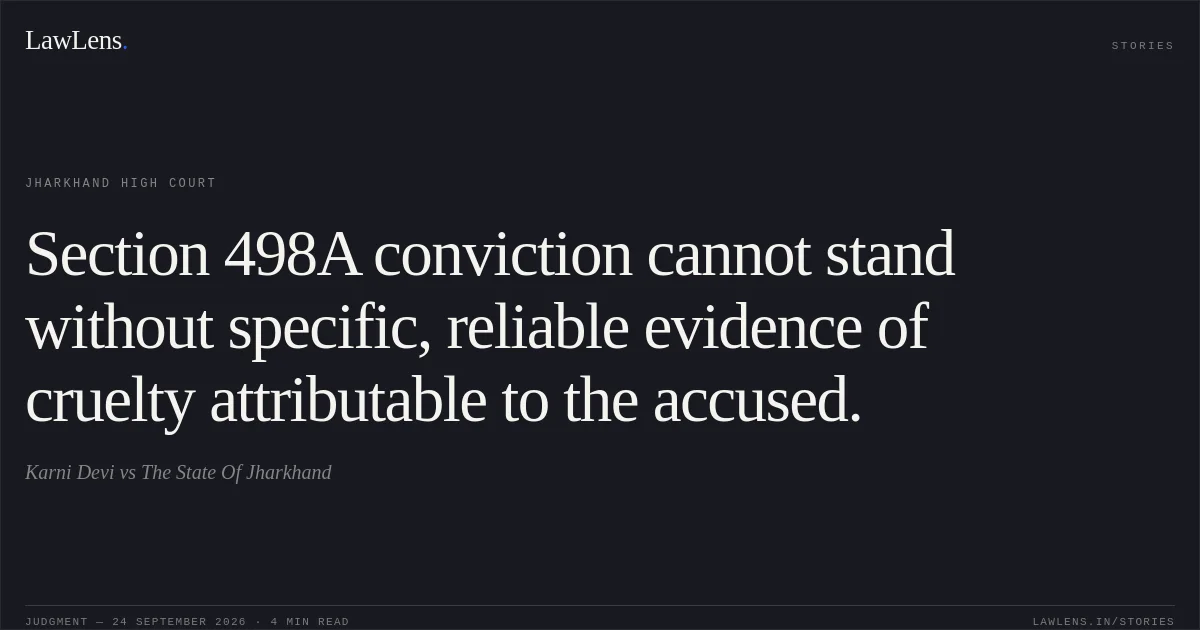
The High Court held that the prosecution failed to prove beyond reasonable doubt that Karmi Devi subjected the victim to cruelty or dowry-related harassment within the meaning of Section 498A IPC.
The appellant was therefore entitled to the benefit of doubt and was acquitted of the charge under Section 498A IPC.
Source reference: p. 15, para. 42The judgment of conviction and order of sentence dated 04.04.2017 were set aside, the appeal was allowed, and, as the appellant was already on bail, she was discharged from the liability of her bail bonds.
Source reference: p. 15, paras. 43–46Acts & Sections Cited
6 provisions across 3 statutes referred to in this judgment. Each provision opens on LawLens.
Indian Penal Code, 18602
Code of Criminal Procedure, 19732
Original Court PDF
Karni DevivsThe State Of Jharkhand
Click to open original judgment
Original judgment, available to read, download and summarize on LawLens.in