Facts
The Petitioner challenged the externment order dated 16.10.2025 passed by the Deputy Commissioner of Police (Respondent No. 2) and the appellate order dated 22.12.2025 passed by the Divisional Commissioner (Respondent No. 1)
Source reference: para 3Proceedings were initiated under Section 57 of the Maharashtra Police Act, 1951, based on the Petitioner's prior conviction under Section 307 of the IPC in 2019
Source reference: para 4, 8Following this conviction, two more crimes were registered: Crime No. 754 of 2024 (under the Bharatiya Nyaya Sanhita) and Crime No. 124 of 2025 (under the NDPS Act)
Source reference: para 8Respondent No. 2 externed the Petitioner from Nagpur District for the maximum permissible period of two years
Source reference: para 11Issues
1. Whether the externing authority correctly exercised its powers under Section 57 of the Maharashtra Police Act by recording subjective satisfaction regarding the likelihood of the Petitioner committing "similar offences" post-conviction.
Source reference: para 8, 102. Whether an externment order for the maximum period of two years is sustainable if the authority fails to record specific reasons for such duration.
Source reference: para 11, 12Law Applied
The Court applied Section 57 of the Maharashtra Police Act, 1951, which empowers authorities to remove previously convicted persons if there is reason to believe they will engage in "similar offences"
Source reference: para 7Section 57 specifically requires a conviction followed by the commission of a similar offence
Source reference: para 8, 10The Court further relied on the Supreme Court’s decision in Deepak s/o Laxman Dongre vs. State of Maharashtra, which mandates that an order for the maximum externment period (two years under Section 58) must disclose subjective satisfaction and application of mind regarding the necessity of that specific duration
Source reference: para 12Reasoning
The Court found that Respondent No. 2 failed to distinguish between the requirements of Sections 56 and 57 of the Act.
Source reference: para 8, 10While Section 57 is restricted to post-conviction conduct of a similar nature, the authority improperly considered the "impact on society" and the Petitioner’s entire criminal history, which are parameters under Section 56
Source reference: para 8, 10The Court observed that Crime No. 754/2024 was a dispute of "individual character" involving a relative and did not reflect a broader threat to society, a fact the authority failed to subjectively assess
Source reference: para 10Crucially, the Court held that the impugned order lacked any justification or reasoning for imposing the maximum externment period of two years.
Source reference: para 11, 12Without recorded satisfaction on why the maximum period was necessary, the order constituted an unreasonable restriction on the Petitioner's fundamental right to move freely under Article 19(1)(d) of the Constitution
Source reference: para 11, 12Holding
The High Court allowed the petition and quashed the orders dated 16.10.2025 and 22.12.2025
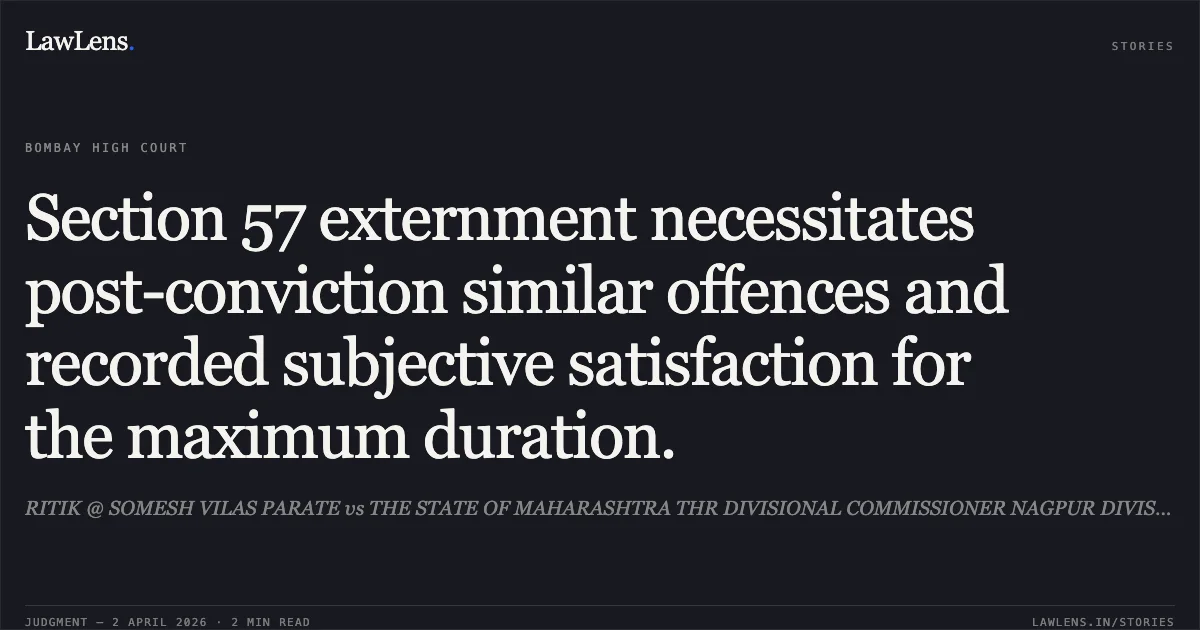
The Court held that an externment order under Section 57 is invalid if it relies on extraneous considerations meant for Section 56 and fails to provide specific material or reasoning to justify the maximum duration of two years
Source reference: para 10, 12Rule was made absolute
Source reference: para 14Acts & Sections Cited
12 provisions across 4 statutes referred to in this judgment. Each provision opens on LawLens.
Indian Penal Code, 18602
Bharatiya Nyaya Sanhita, 20234
Customs Act,19621
Original Court PDF
RITIK @ SOMESH VILAS PARATEvsTHE STATE OF MAHARASHTRA THR DIVISIONAL COMMISSIONER NAGPUR DIVISION, NAGPUR AND OTHERS.
Click to open original judgment
Original judgment, available to read, download and summarize on LawLens.in