Facts
The defendant appealed against concurrent judgments of the courts below granting the plaintiff eviction under Sections 6(1)(j) and 6(1)(l) of the West Bengal Premises Tenancy Act, 1997 (“1997 Act”).
Source reference: para. 5The appellant argued that Section 6(1)(j) required a one-year notice to vacate and that the evidence did not establish the ten-month absence required under Section 6(1)(l), relying in part on electricity bills showing zero consumption for only about seven months.
Source reference: paras. 6–7He also sought to introduce documents under Order XLI Rule 27 CPC to show that he remained in possession until the trial court’s decree.
Source reference: para. 8The High Court first condoned the delay in filing the second appeal.
Source reference: para. 3Issues
1. Whether the one-year moratorium under Section 6(1)(j) of the 1997 Act requires a one-year notice to quit before suit.
Source reference: paras. 6, 10–122. Whether the evidence supported the concurrent finding that the ground for eviction under Section 6(1)(l) was established.
Source reference: paras. 7, 13–153. Whether the appellant could introduce additional evidence for the first time in the second appeal under Order XLI Rule 27 CPC.
Source reference: paras. 8, 164. Whether the concurrent eviction judgments raised a substantial question of law warranting interference in second appeal.
Source reference: para. 17Law Applied
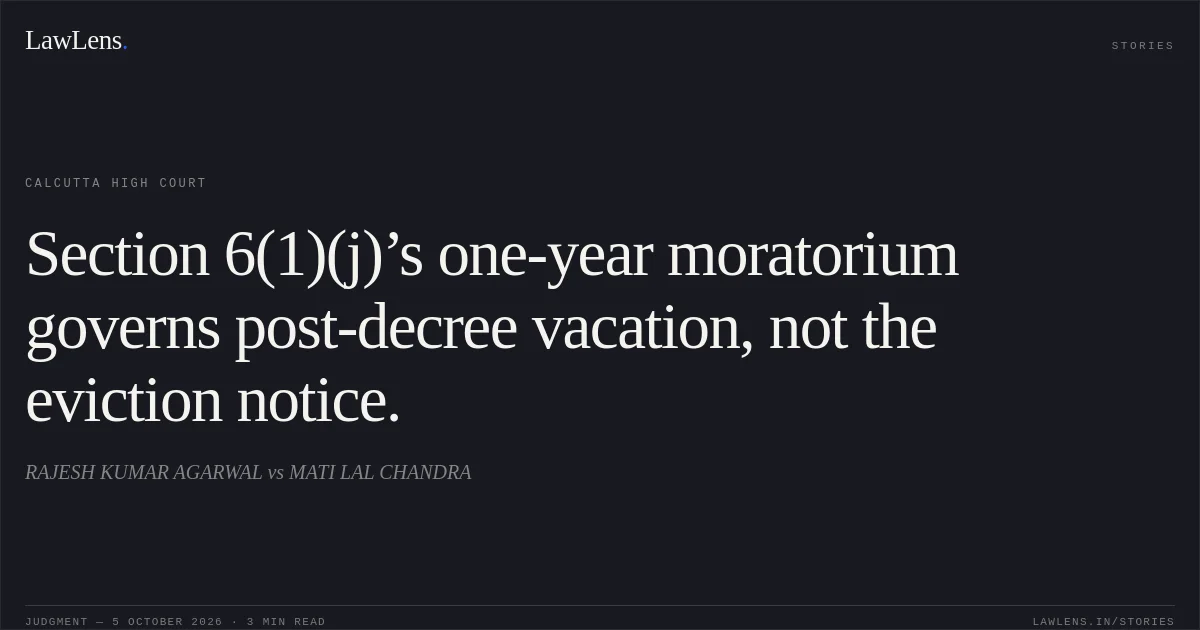
Section 6(1)(j) of the 1997 Act permits eviction where a tenant has acquired, constructed, or been allotted a house or flat, subject to a one-year moratorium for vacating the premises; that moratorium concerns the period for vacating after an eviction decree, not the pre-suit notice period.
Source reference: paras. 10–11Section 6(4) requires one month’s notice, expiring with a month of tenancy, before an eviction suit is instituted on a ground under Section 6.
Source reference: para. 11Section 6(1)(l) was applied as the statutory ground concerning the tenant’s and/or family’s absence from the premises for the stipulated ten-month period.
Source reference: paras. 7, 13–14Order XLI Rule 27(1)(aa) CPC restricts a party from producing additional evidence at the appellate stage where the stated requirements for its earlier non-production are not met.
Source reference: para. 16A second appeal under Order XLI Rule 11 CPC may be dismissed where no substantial question of law arises.
Source reference: para. 19Reasoning
The Court rejected the proposed one-year notice requirement because it would conflict with Section 6(4), which prescribes a one-month notice before suit; it construed the one-year period in Section 6(1)(j) as time to vacate after decree.
Source reference: paras. 10–12On Section 6(1)(l), the Court held that the electricity bills were not the entirety of the evidence: the trial court had also considered the 2015 electoral roll, which listed the defendant and his wife in a different constituency from the suit premises, and the courts below had assessed the evidence as a whole.
Source reference: paras. 13–15The proposed additional documents were not produced before either lower court, and the appellant was therefore precluded from producing them for the first time in the second appeal under Order XLI Rule 27(1)(aa) CPC.
Source reference: para. 16As the concurrent findings disclosed no basis for identifying a substantial question of law, the Court found no ground to interfere.
Source reference: para. 17Holding
The High Court dismissed SAT 111 of 2025 under Order XLI Rule 11 CPC and dismissed CAN 1 of 2025 and CAN 2 of 2025 consequentially.
It held that no further time to vacate was required under Section 6(1)(j), because more than one year had elapsed since the first appellate judgment dated 12 February 2025.
Source reference: para. 18The delay-condonation application, CAN 3 of 2025, had been allowed; there was no order as to costs.
Source reference: paras. 3–4, 20Acts & Sections Cited
1 provisions across 1 statute referred to in this judgment. Each provision opens on LawLens.
West Bengal Premises Tenancy Act, 19971
Original Court PDF
RAJESH KUMAR AGARWALvsMATI LAL CHANDRA
Click to open original judgment
Original judgment, available to read, download and summarize on LawLens.in