01Facts
The three appellants, as plaintiffs, sued the respondent for recovery of Rs. 10,00,000 (CS No. 138/2019), Rs. 20,00,000 (CS No. 137/2019), and Rs. 10,39,000 (CS No. 136/2019).
The claims rested on friendly loans documented by promissory notes and receipts.
The respondent issued cheques in discharge of the liability, which were dishonoured.
¶ 4The District Judges decreed the principal amounts, and those findings were not challenged.
¶ 5–6The plaintiffs claimed pendente lite and future interest at 15% per annum.
¶ 5, 7–8The trial courts instead awarded simple interest at 6% (CS No. 138/2019) and 7% (CS Nos. 137/2019 and 136/2019) from the date of institution till realisation, finding 15% excessive, and in CS Nos. 136/2019 and 137/2019 noting that no evidence supported the claimed rate.
¶ 5, 7–8The promissory notes recorded the interest rate as 0%.
¶ 33An earlier petition (CM(M) 2127/2025) was withdrawn with liberty to file a fresh appeal.
¶ 9–10The appellants contend that s. 80 of the Negotiable Instruments Act, 1881 (NI Act) entitles them to 18% interest from dishonour.
¶ 11–13The respondent contends s. 80 is inapplicable and that an appeal against the s. 138 NI Act conviction is pending.
¶ 15–1702Issues
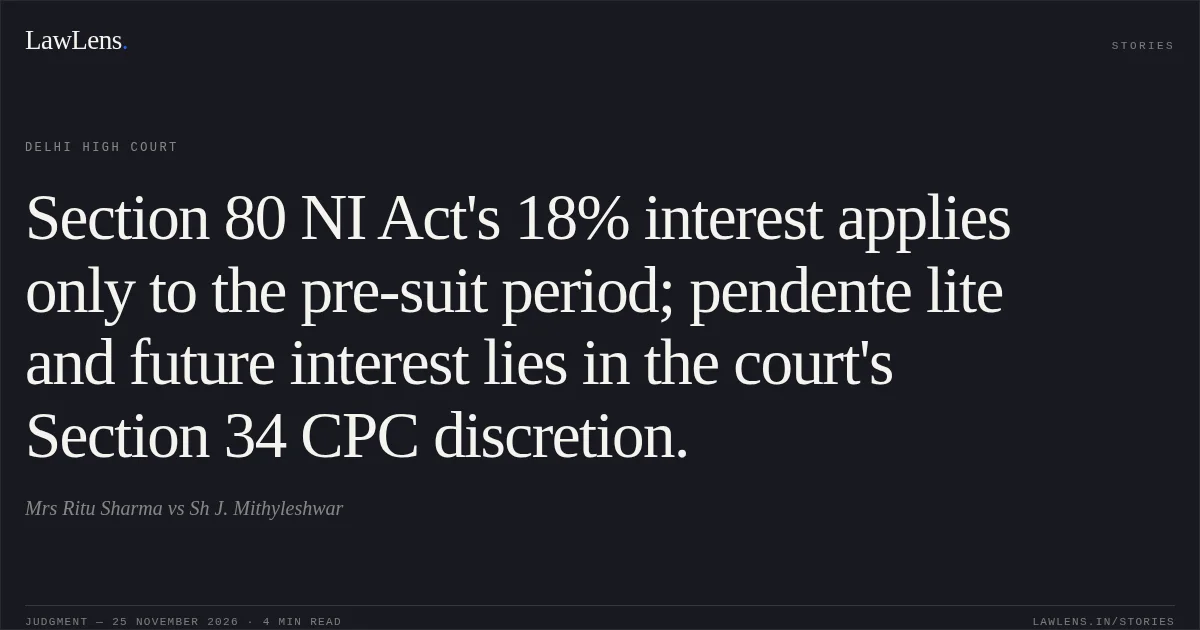
i.1. Whether the plaintiffs are entitled, as of right, to pendente lite and future interest at 15% per annum under s. 80 of the NI Act, or whether the trial court validly exercised its discretion under s. 34 CPC in awarding 6% and 7%.
¶ 18ii.2. Whether pre-suit interest at 18% under s. 80 of the NI Act can be granted in appeal when it was never claimed in the suit.
¶ 3503Law Applied
Section 79 of the NI Act gives effect to an expressly stipulated interest rate on a negotiable instrument.
¶ 19–20Section 80 of the NI Act prescribes a statutory rate of 18% per annum where the instrument specifies no rate, notwithstanding any contrary agreement, running from the date the amount ought to have been paid until realisation or until such date after institution of the suit as the Court directs.
¶ 19, 21–22Section 34 CPC vests the Court with discretion to award pendente lite interest at a reasonable rate and future interest at a rate not exceeding 6% (save for commercial transactions).
¶ 25–26The Constitution Bench in Central Bank of India v. Ravindra, (2002) 1 SCC 367, holds that pre-suit interest is substantive law, whereas pendente lite and post-decree interest are governed by s. 34 CPC and must be exercised judiciously and not arbitrarily.
¶ 28–29C.K. Sasankan v. Dhanalakshmi Bank Ltd., (2009) 11 SCC 60, confirms that s. 34 discretion must be exercised reasonably on sound legal principles.
¶ 30The Court relied on the rule that a relief not claimed in the suit cannot be granted for the first time in appeal.
¶ 35The decisions in Harjinder Pal Singh (CS(OS) 2537/2010) and Enable Technologies Pvt. Ltd. (RFA 496/2018) confirm that s. 80 operates on the pre-suit period only.
¶ 37–38Provisions in the judgment · 5 · Linked ones open on LawLens
Code of Civil Procedure, 1908 Section 34Section 96
Negotiable Instruments Act, 1881 Section 79Section 80Section 138
04Reasoning
The Court held that the 0% rate in the promissory notes bars contractual pre-suit interest under s. 79.
¶ 33The cheques, however, specified no rate, so s. 80 applied to the pre-suit period from dishonour to institution of the suits, notwithstanding the 0% term in the promissory notes.
¶ 34The plaintiffs did not claim pre-suit interest in the plaints, and their claim was confined to pendente lite and future interest at 15%. Relief not sought in the suit could not be granted for the first time in appeal.
¶ 35Post-institution interest falls within the court's s. 34 discretion, so s. 80 does not mandate 18% or 15% for that period.
¶ 23–24, 36The trial courts had reasoned that 15% was excessive and unsupported by evidence, and the appellants did not show that this discretion was exercised arbitrarily or contrary to law.
¶ 7–8, 39The Court therefore found no basis to enhance the rate or award pre-suit interest.
¶ 3905Holding
Section 80 of the NI Act does not entitle the plaintiffs to pendente lite and future interest at 15% or 18% as of right. Post-institution interest is governed by the court's discretion under s. 34 CPC.
¶ 36, 38Pre-suit interest under s. 80 could have been claimed but was not, and cannot be granted in appeal.
¶ 35The trial courts' awards of 6% (CS No. 138/2019) and 7% (CS Nos. 136/2019 and 137/2019), from institution till realisation, were not shown to be arbitrary or contrary to law.
¶ 39All three appeals are dismissed, and the pending applications are disposed of.
¶ 40–41Original Court PDF
Mrs Ritu SharmavsSh J. Mithyleshwar
Click to open original judgment
Original judgment, available to read, download and summarize on LawLens.in