01Facts
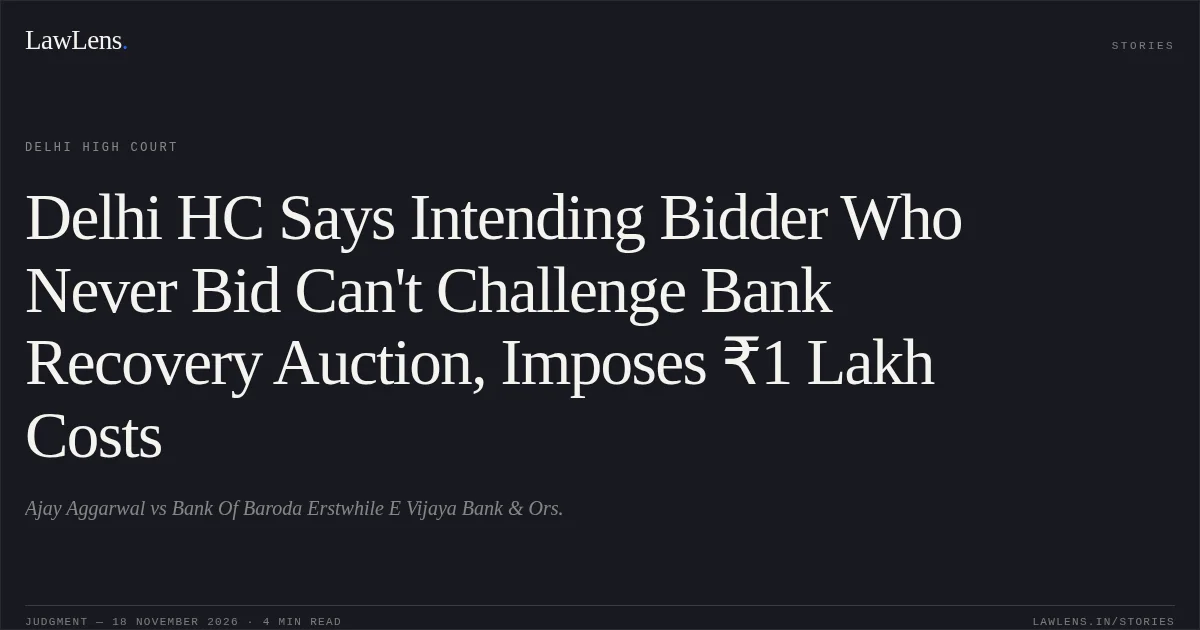
Vijaya Bank (now Bank of Baroda) sought to execute a recovery certificate dated 24.11.2000 in O.A. 79/1998 for Rs. 1,74,09,016.54 under the SARFAESI framework.
¶ 3(a)The subject property, "Baltod" (Survey No. 90/2, Village Melauli), was put up for auction by a sale proclamation dated 12.12.2024.
¶ 3(b)The petitioner, claiming to be an intending purchaser, filed three objections before the Recovery Officer on 23.12.2024, 16.01.2025 and 20.01.2025, alleging partial prior sales and eight co-owners in the survey number, and thus material irregularities in the proclamation.
¶ 3(c)–(e)The e-auction was held on 21.01.2025 before the objections were decided.
¶ 3(g)–(h)By order dated 26.03.2025, the Recovery Officer rejected all three objections.
¶ 3(h)The petitioner's appeal (NCN/575/2025) before the DRT-I was dismissed on 20.08.2025 on the ground that he was not a "person aggrieved" under Section 30 of the RDB Act; the DRT also doubted that he was a proxy for the borrower.
¶ 3(j)–(l)The DRAT dismissed the appeal by order dated 15.05.2026 on the same ground, noting that the petitioner did not participate in the auction and had no right, title or interest in the property.
¶ 3(m)The petitioner then invoked Articles 226 and 227 to challenge the DRAT order and seek quashing of the auction dated 21.01.2025.
¶ 102Issues
i.1. Whether a third party who neither participated in the auction nor holds any right, title or interest in the property qualifies as a "person aggrieved" under Section 30 of the RDB Act and may challenge the sale proclamation and auction.
¶ 4 · ¶ 11 · ¶ 17–18ii.2. Whether the bar under the RDB Act is displaced by the High Court's constitutional jurisdiction, as argued by the petitioner relying on Union of India v. Delhi High Court Bar Association. (The Court did not separately address this contention.)
¶ 703Law Applied
Section 30(1) of the Recovery of Debts and Bankruptcy Act, 1993 permits "any person aggrieved" by an order of the Recovery Officer to appeal to the Tribunal within thirty days.
¶ 4For the meaning of "aggrieved person," the petitioner relied on the Mitra's Legal and Commercial Dictionary definition, which describes a person who has suffered a legal grievance, whose right or interest is affected or jeopardised, and not one who suffers imaginary injury or mere disappointment.
¶ 5The expression is elastic and depends on the statute, the circumstances, and the nature of the petitioner's interest and prejudice, as considered in Jasbhai Motibhai Desai v. Roshan Kumar (AIR 1976 SC 578), cited within that definition.
¶ 5The governing test is whether the person's interests have been prejudicially affected; if not, he is not an aggrieved person.
¶ 17Bar Council of Maharashtra v. M.V. Dabholkar concerned the Bar Council's procedural power over a complaint and did not address standing under the RDB Act, and was therefore distinguished.
¶ 14–16 · ¶ 27–28Union of India v. Delhi High Court Bar Association (2002) 4 SCC 275 was relied upon by the petitioner to contend that the RDB Act does not oust constitutional jurisdiction.
¶ 7Provisions in the judgment · 6 · Linked ones open on LawLens
Recovery Of Debts And Bankruptcy Act, 1993 Section 25Section 26Section 27Section 28Section 29Section 30
04Reasoning
The petitioner had no right, title or interest in the property. He was not a borrower, owner, tenant or participant in the loan transaction, and his mere intention to bid conferred no locus standi.
¶ 11Applying the prejudice-based test, none of the petitioner's interests had been prejudicially affected; his only asserted injury was the hypothetical loss of a higher price had he bid, which cannot justify setting aside an auction.
¶ 18The petitioner's construction would allow every intending purchaser to challenge any sale notice, delaying proceedings and defeating the scheme of the RDB Act.
¶ 12–13The absence of other petitions by the petitioner did not negate the respondents' suggestion that he was set up by others, and he had been delaying the auction of a purchaser who had already paid consideration.
¶ 19Four other bidders had participated, and a bidder had sought to stall the auction on a claimed technical glitch without honouring a higher offer, which on that basis the Court found to be an abuse of process.
¶ 20–21The Court did not expressly rule on the petitioner's constitutional-jurisdiction argument, as the petition failed on locus standi.
¶ 7, 11–1805Holding
The petitioner, an intending purchaser who neither participated in the auction nor had any right, title or interest in the property, is not a "person aggrieved" under Section 30 of the RDB Act and lacks standing to challenge the sale proclamation and auction.
¶ 11, 17–18The petition under Articles 226 and 227 was dismissed for abuse of process. The petitioner was directed to pay costs of Rs. 1,00,000, of which Rs. 50,000 is payable to the Army Welfare War Widows Fund and Rs. 50,000 to the Delhi High Court Bar Association, within three weeks of uploading the order. Pending applications were dismissed.
¶ 21–23Original Court PDF
Ajay AggarwalvsBank Of Baroda Erstwhile E Vijaya Bank & Ors.
Click to open original judgment
Original judgment, available to read, download and summarize on LawLens.in