01Facts
The Respondent Bank filed O.A. No. 596/2018 before the Debts Recovery Tribunal (DRT) against the Petitioner, Respondent No. 2 (Ms. Deepti) and Respondent No. 3, alleging loan default
pp. 1–2After service of summons, the Petitioner engaged counsel, who appeared on 11.09.2019 and 19.11.2019 and filed a Vakalatnama
p. 2On 19.11.2019 the Petitioner was granted four weeks to file a written statement. Owing to COVID-19, the written statement was not filed within that period and was filed only on 23.05.2023
p. 2The Petitioner's application, I.A. No. 4147/2023, seeking condonation of delay was rejected by the DRT on 13.11.2025 on the ground that the written statement was beyond the period under Section 19(5) of the RDB Act
pp. 2–3The Debts Recovery Appellate Tribunal (DRAT) dismissed the Petitioner's appeal (Misc. Appeal No. 28/2026) on 21.04.2026, leading to the present writ petition under Article 226
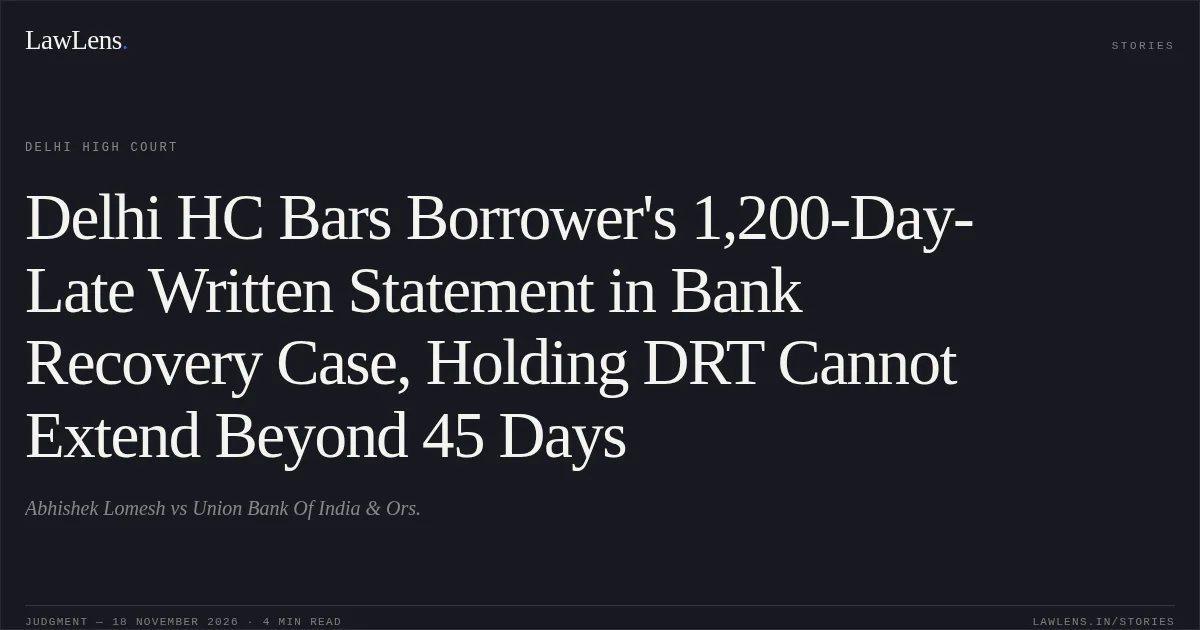
p. 1 · p. 3The written statement was filed with a delay of 1,200 days
p. 27, para 12The Petitioner's counsel did not appear at the hearing
p. 102Issues
i.1. Whether the time prescribed under Section 19(5) of the RDB Act for filing a written statement is directory or mandatory in nature.
p. 3, para 4ii.2. Whether the Court/Tribunal has the power to condone delay in filing a written statement beyond the period prescribed under Section 19(5) of the RDB Act.
p. 3, para 403Law Applied
The Court relied on Section 19(5)(i) of the RDB Act, which requires a written statement within 30 days of service of summons, with a proviso allowing the Presiding Officer to extend time by not more than 15 days in exceptional cases and special circumstances recorded in writing
pp. 3–4, para 5It applied Section 5 of the Limitation Act, 1963, and Section 29(2), which excludes Section 5 where a special law prescribes a different limitation period and expressly or by necessary implication excludes it
pp. 3, para 6–7Section 34 of the RDB Act, giving it overriding effect, was also applied
pp. 18–19, para 7Under J.J. Merchant v. Shrinath Chaturvedi (2002) 6 SCC 635, the 45-day outer limit under analogous Consumer Protection Act provisions is strictly mandatory
¶ 10Union of India v. Popular Construction Co. (2001) 8 SCC 470 held that "but not thereafter" excludes Section 5
¶ 11Singh Enterprises (2008) 3 SCC 70 and Customs & Central Excise v. Hongo India (2009) 5 SCC 791 held that statutory tribunals cannot condone delay beyond statutory limits where the special scheme excludes Section 5
¶ 12–13Druggists Association v. Kalyan Chowdhury (2018) 3 SCC 41 and New India Assurance v. Hili Multipurpose Cold Storage (2020) 5 SCC 757 held that a peremptory outer limit cannot be extended on equitable grounds
¶ 14–15Anita Garg v. State Bank of India, 2021 SCC OnLine Del 4311 (DHC) held that the 15-day extension is a strict, non-extendable limit
¶ 16–17On the Order VIII Rule 1 CPC line of authority (C.N. Ramappa Gowda, (2012) 5 SCC 265; Salem Advocate Bar Association, (2005) 6 SCC 344), the Court held that CPC provisions do not govern the RDB Act
¶ 6–7, 11The Court applied the special-versus-general principles in S. Prakash v. K.M. Kurian (1999) 5 SCC 624 and LIC v. D.J. Bahadur (1981) 1 SCC 315
¶ 8–10It also followed Nikhil Poddar v. Punjab National Bank (W.P.(C) 13671/2026, judgment dated 23.09.2026), which held that delay beyond the Section 19(5) period cannot be condoned
¶ 5Provisions in the judgment · 33 · Linked ones open on LawLens
Recovery Of Debts And Bankruptcy Act, 1993 Section 20Section 19Section 34
Limitation Act, 1963 23 provisions
Section 3Section 4Section 5Section 6Section 7Section 8Section 9Section 10Section 11Section 12Section 13Section 14Section 15Section 16Section 17Section 18Section 19Section 20Section 21Section 22Section 23Section 24Section 29Arbitration and Conciliation Act, 1996 Section 34Section 36
Companies Act, 2013 Section 421Section 433
Life Insurance Corporation Act, 1956 Section 11Section 49Section 58
04Reasoning
The Court first held that the RDB Act is a special code with its own tribunal hierarchy and limitation regime, so Section 29(2) of the Limitation Act applies and Section 5 cannot be invoked
pp. 3–4, para 7It read Section 19 to fix a maximum period of 45 days, inclusive of the 15-day proviso
p. 4, para 8Relying on the Consumer Protection Act analogy and the Supreme Court's construction of the "but not thereafter" formulation, the Court treated the 45-day limit as peremptory
¶ 9–11, 16–17Because the RDB Act overrides inconsistent laws under Section 34 and is special in relation to bank recovery, Order VIII Rule 1 CPC, under which the Supreme Court has held limitation directory, could not be applied
¶ 7, 10–11The Court therefore declined to follow the Punjab & Haryana High Court Division Bench in Shri Shri Ram Gupta (6 March 2026)
¶ 6–7, 11Applying these principles to the facts, the Court noted that the written statement was filed 1,200 days late
p. 27, para 12Even after excluding the period from 15.03.2020 to 28.02.2022 under the Supreme Court's suo motu order dated 10.01.2022 (Suo Motu W.P.(C) 3/2020), the filing remained beyond the statutory limit
p. 27, para 12The COVID-19 explanation therefore could not cure the default.
p. 27, para 1205Holding
The Court answered the first issue by holding that the period under Section 19(5) is mandatory, and the second by holding that no power exists under Section 5 of the Limitation Act to condone delay beyond the 45-day outer limit (30 days plus the 15-day proviso)
¶ 7–8, 17The written statement, filed 1,200 days late, could not be accepted, and the DRAT's dismissal of the appeal was upheld
p. 27, para 12The writ petition is dismissed, along with all pending applications
p. 27, para 13Original Court PDF
Abhishek LomeshvsUnion Bank Of India & Ors.
Click to open original judgment
Original judgment, available to read, download and summarize on LawLens.in