01Facts
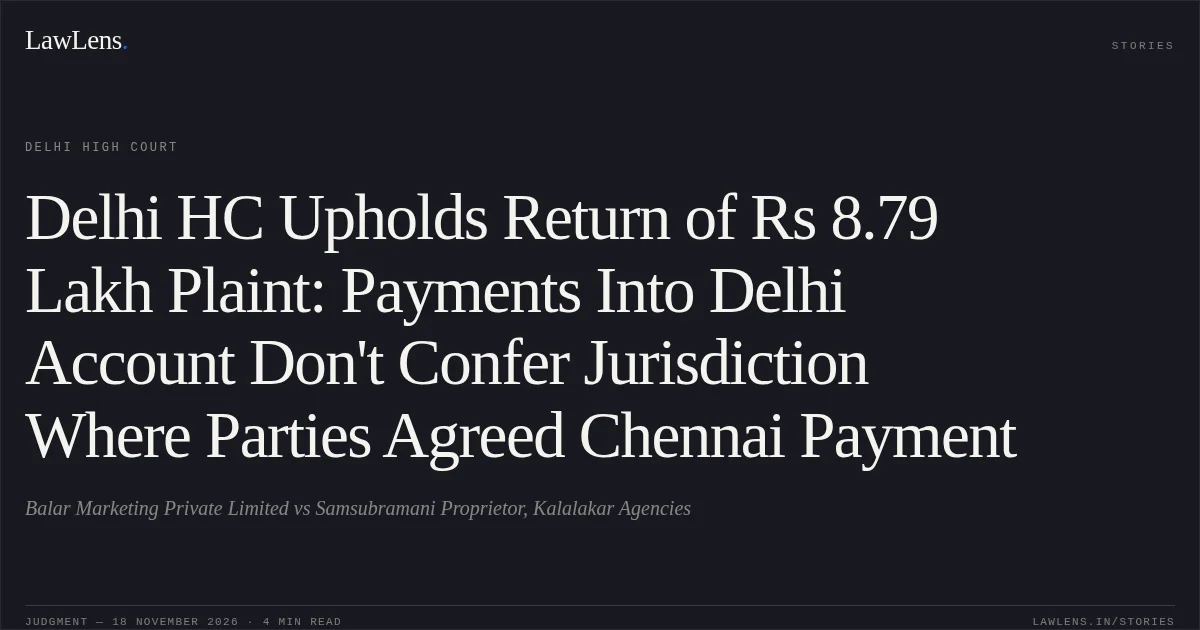
The Appellant, a Delhi-registered company (registered office at Patparganj, New Delhi), supplied household electrical goods to the Respondent, a Chennai-based proprietorship (Chromepet, Chennai), between 2018 and 2024.
pp. 2-3Goods were dispatched from the Appellant's Chennai regional warehouse to the Respondent's Chennai office.
pp. 2-3A balance of Rs. 8,79,206/- allegedly remained unpaid.
p. 3Pre-litigation mediation before the Delhi Legal Services Authority failed, and the Appellant filed CS (COMM.) 177/2026 before the Commercial Court, East District, Karkardooma.
p. 3The Commercial Court returned the plaint under Order VII Rule 10 CPC for want of territorial jurisdiction. It held that the parties operate in Bangalore and Chennai, that the Delhi registered office and bank account did not confer jurisdiction, and that the mere place of part payment did not establish a cause of action in Delhi.
pp. 3-4 · ¶ 7 · pp. 5-6The Appellant contended that (i) the printed invoice terms fixed Delhi courts' jurisdiction, and (ii) the parties agreed to remit payments to its Delhi bank account, into which the Respondent made part payments, including a last payment of Rs. 25,000/-.
pp. 4-502Issues
i.1. Whether the Commercial Court erred in returning the plaint under Order VII Rule 10 CPC for want of territorial jurisdiction.
¶ 6 · p. 6ii.2. Whether a jurisdiction clause in the printed "Terms and Conditions" on the Appellant's invoices, not raised before the Commercial Court, can be entertained in appeal.
¶ 8-10 · pp. 6-8iii.3. Whether part payments made into the Appellant's Delhi bank account confer territorial jurisdiction on Delhi courts under Section 20(c) CPC.
¶ 12-13 · pp. 8-903Law Applied
Section 20(c) CPC, under which a suit must be instituted where the cause of action wholly or in part arises, is the basis for territorial jurisdiction in money recovery suits.
p. 8A.B.C. Laminart (P) Ltd. v. A.P. Agencies, (1989) 2 SCC 163, holds that a cause of action comprises a bundle of material facts, that for contracts it arises where the contract was made, where it was to be performed (delivery of goods), and where payment is expressly or impliedly payable, and that an express agreement on the place of payment controls.
¶ 15-16 · pp. 9-12 · ¶ 19 · pp. 13-14Rama Kant Barman v. Mohd. Mahim Ali, 2024 SCC OnLine SC 4083, bars appellate courts and parties from raising new grounds or creating new cases not pleaded or argued below.
¶ 9 · pp. 6-7Parties may confer exclusive jurisdiction by agreement only among courts already having jurisdiction under Section 20 CPC, and cannot confer it on a court otherwise lacking it.
¶ 11 · p. 8Auto Movers v. Luminous Power Technologies (P) Ltd., 2021 SCC OnLine Del 4387, where no place of payment was fixed and part payment into a Delhi account sustained jurisdiction, is distinguishable.
¶ 20 · pp. 13-14Provisions in the judgment · 3 · Linked ones open on LawLens
Commercial Courts Act, 2015 Section 13
Code of Civil Procedure, 1908 Section 104Section 20
04Reasoning
The Court first held that the invoice jurisdiction clause was raised for the first time in appeal. Under Rama Kant Barman, it could not be considered, and in any event the invoices were not on record.
¶ 9-10 · pp. 6-8The Appellant's own pleaded case was that the invoices specified a Chennai account (Kotak Mahindra Bank, Sowcarpet) for remittance, and that the parties only later orally agreed to Delhi payments. The Court held that a bare, unproven assertion of a changed agreement, supported only by Delhi account entries, could not displace the express Chennai payment stipulation.
¶ 18-19 · pp. 12-14Applying A.B.C. Laminart, the Court found that the contract was performed in Chennai, since goods were dispatched and delivered within Chennai, so the cause of action arose there.
¶ 19 · pp. 13-14The Court distinguished Auto Movers because the place of payment there was not fixed, whereas here it was fixed at Chennai.
¶ 20-21 · pp. 14-15Payments into a Delhi account, absent an agreement on Delhi as the place of payment, could not confer jurisdiction, and the Appellant's position as dominus litis could not justify subjecting the Respondent to a forum never agreed upon.
¶ 19 · pp. 13-14 · ¶ 22 · p. 1505Holding
No part of the cause of action arose in Delhi, because the agreed place of payment was Chennai and the goods were delivered in Chennai. Part payments into a Delhi bank account, absent an agreement fixing Delhi as the place of payment, do not confer territorial jurisdiction, and a new jurisdiction clause raised for the first time in appeal cannot be entertained.
¶ 9-11 · pp. 6-8 · ¶ 21-22 · pp. 14-15The Court found no infirmity in the Impugned Order returning the plaint under Order VII Rule 10 CPC for presentation before the appropriate forum. The appeal under Section 13(1A) of the Commercial Courts Act read with Order XLIII Rule 1(A) CPC was dismissed, along with all pending applications.
¶ 21 · pp. 14-15 · ¶ 23 · p. 15Original Court PDF
Balar Marketing Private LimitedvsSamsubramani Proprietor, Kalalakar Agencies
Click to open original judgment
Original judgment, available to read, download and summarize on LawLens.in