Facts
The appellant (tenant) challenged an eviction decree passed under Section 12(1)(a) of the M.P. Accommodation Control Act on the ground of arrears of rent for Shop Nos. 3 and 4 in Gwalior
Source reference: para. 2-3The landlord alleged arrears from December 15, 1985, to April 14, 1987
Source reference: para. 4The tenant contended he had paid Rs. 4,900 without receiving a receipt and argued that an earnest money deposit of Rs. 10,000 held by the landlord should be adjusted against any arrears
Source reference: para. 5, 9Both the Trial Court and the First Appellate Court (XIIth Additional District Judge, Gwalior) found the tenant in default and decreed eviction
Source reference: para. 6-7During the pendency of the second appeal, the tenant admitted to multiple subsequent defaults in depositing monthly rent as required by law
Source reference: para. 11, 21Issues
Whether the lower courts erred in passing a decree for ejectment under Section 12(1)(a) when an amount of Rs. 10,000 was deposited with the landlord, which was intended to be refunded upon vacating the premises
Source reference: para. 8Law Applied
The court primarily applied Section 12(1)(a) regarding eviction for rent arrears and Section 13(1) of the M.P. Accommodation Control Act, which mandates the timely deposit of rent during litigation
Source reference: para. 2, 22It relied on Section 6 of the Act to distinguish between unlawful charges and adjustable advances
Source reference: para. 14The court applied the precedent of Bhoja @ Bhoja Ram Gupta v. Rameshwar Agarwala, which established that excess rent or deposits do not automatically adjust against arrears absent a specific agreement or statutory provision
Source reference: para. 15Furthermore, it followed Ashok Kumar Mishra v. Goverdhan Bhai, ruling that courts lack the power to condone defaults in monthly rent deposits (by the 15th of each month) occurring after a suit is filed
Source reference: para. 25-26Reasoning
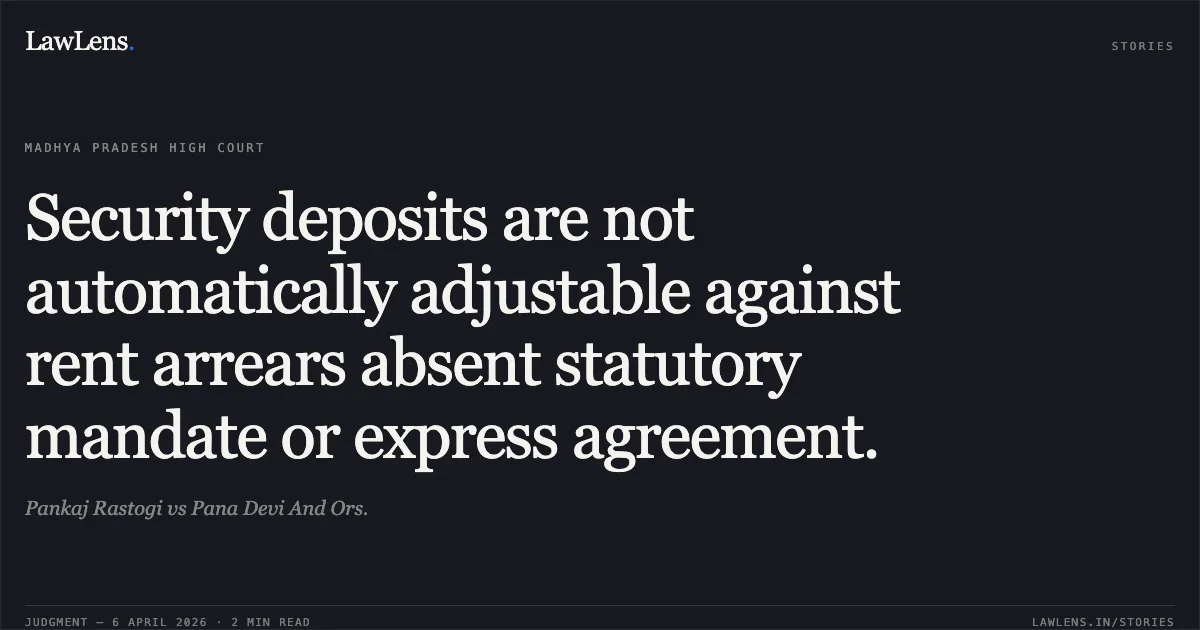
The court found that Section 6 of the M.P. Act, unlike similar statutes in other states, contains no provision for the automatic adjustment of a security deposit or "pugree" against rent arrears
Source reference: para. 15The tenancy agreement (Ex. P.1) specifically stated the Rs. 10,000 was refundable only upon vacating the premises, with no clause for adjustment against rent
Source reference: para. 17Under Section 92 of the Evidence Act, oral evidence could not contradict these written terms
Source reference: para. 17The tenant neither sought adjustment in his reply to the notice nor in his written statement, instead claiming he had already paid the arrears
Source reference: para. 18-19Crucially, the court noted that the tenant failed to comply with the mandatory "second part" of Section 13(1) of the Act, which requires depositing rent by the 15th of every succeeding month during the pendency of the appeal
Source reference: para. 23-24The court held that this statutory obligation applies regardless of whether the initial eviction ground was arrears of rent, and such post-suit defaults cannot be condoned
Source reference: para. 26-27Holding
The High Court answered the substantial question of law in the negative, holding that the advance deposit was not liable for automatic adjustment
The court affirmed the judgments and decrees of the lower courts, dismissing the Second Appeal
Source reference: para. 30, 32The appellant was directed to vacate the shops, and the Executing Court was ordered to conclude proceedings within six months, following the timeline established in Periyammal (D) v. V. Rajamani
Source reference: para. 31Acts & Sections Cited
2 provisions across 2 statutes referred to in this judgment. Each provision opens on LawLens.
Code of Civil Procedure, 19081
Transfer of Property Act, 18821
Original Court PDF
Pankaj RastogivsPana Devi And Ors.
Click to open original judgment
Original judgment, available to read, download and summarize on LawLens.in