Facts
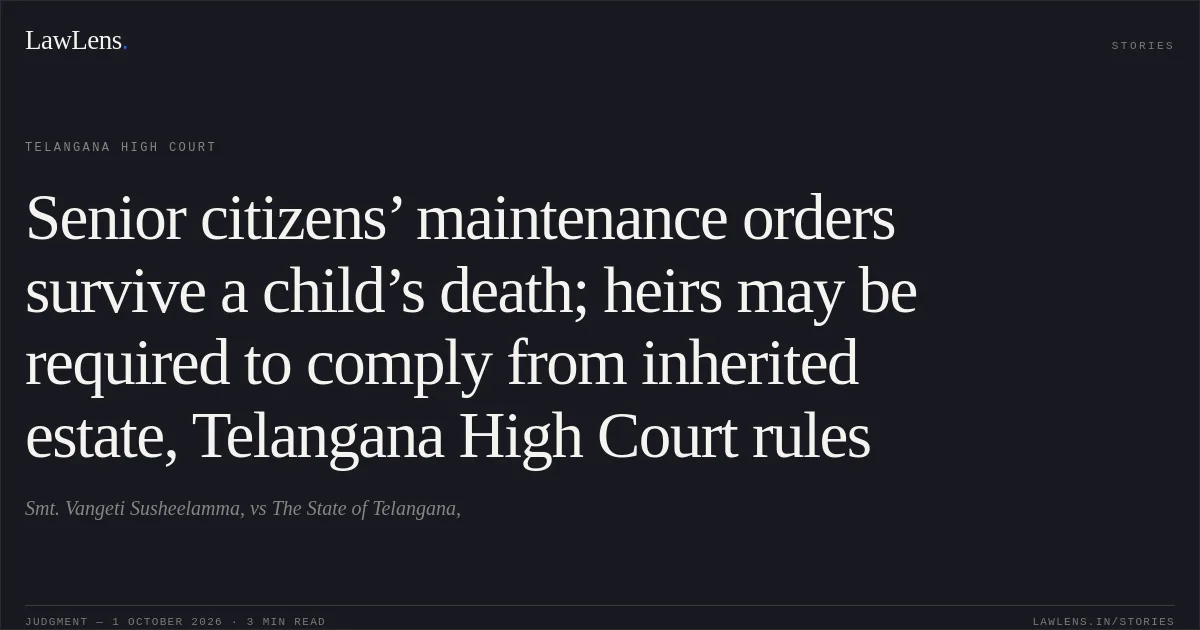
The petitioner, a senior citizen, and her husband had transferred agricultural lands and other properties to their son, daughter-in-law and grandchildren in 2015.
Source reference: paras. 3–6Following a complaint under the Maintenance and Welfare of Parents and Senior Citizens Act, 2007 (“the 2007 Act”), the competent authority, by order dated 9 June 2022, directed the son and daughter-in-law to take specified steps concerning the properties and to provide accommodation, food, necessities and medical care.
Source reference: paras. 3–6The son’s appeal was dismissed on 17 January 2023, and he did not challenge that decision further.
Source reference: paras. 3–6After the petitioner’s requests for implementation were not effectively acted upon, she sought enforcement under Section 11 of the 2007 Act.
Source reference: paras. 7–8, 17–18The son died on 27 October 2025; his wife and children were brought on record as his legal representatives.
Source reference: paras. 7–8, 17–18The daughter-in-law disputed personal liability under the Act, while asserting that some property-related directions had been complied with and that accommodation had been offered.
Source reference: paras. 10, 20Issues
1. Whether respondent No. 3’s failure to take effective action on the petitioner’s Section 11 application to enforce the final order was unlawful.
Source reference: paras. 12–162. Whether, and to what extent, the obligations under the final order could be enforced against the deceased son’s legal representatives, including his daughter-in-law and minor children.
Source reference: paras. 17–29, 32–34Law Applied
Section 11 of the 2007 Act provides for enforcement of maintenance orders, including execution in the manner prescribed for orders under Chapter IX of the Code of Criminal Procedure; Section 3 gives the Act overriding effect over inconsistent laws, instruments, customs or usages; and Section 2(a) defines “children” without including a daughter-in-law.
Source reference: paras. 12, 15, 20Section 23 addresses transfers by senior citizens subject to a transferee’s provision of basic amenities and physical needs, which may be declared voidable in the circumstances specified by that section.
Source reference: para. 25Under Section 50 of the Code of Civil Procedure, a decree may be executed against a judgment-debtor’s legal representatives to the extent of the estate received; Prabhakara Adiga v. Gowri, (2017) 4 SCC 97, supports enforcement of a surviving, heritable obligation against legal representatives.
Source reference: para. 19The Court also relied on Sheetal Devang Shah v. Presiding Officer of the Maintenance and Welfare of Parents and Senior Citizens, W.P. No. 3323 of 2019, for the proposition that a daughter-in-law is not personally liable as a “child” under Section 2(a), and distinguished it where she was herself a party to a final order.
Source reference: paras. 20, 28It referred to Mohamed Dayan v. District Collector, Tiruppur District, 2023 (3) CCC 374, on the interpretation of Section 23, and invoked the Hindu-law principle of a son’s pious obligation to maintain aged parents from his estate.
Source reference: paras. 26–27Reasoning
The Court found that respondent No. 3 had not effectively acted on the petitioner’s Section 11 application despite the earlier direction in W.P. No. 9842 of 2023, undermining the enforcement mechanism of a beneficial statute.
Source reference: paras. 13–16It held that the 2022 order had attained finality and that the son’s death did not extinguish obligations enforceable against his estate.
Source reference: paras. 17–19Although a daughter-in-law is not a “child” under Section 2(a), respondent No. 6 had been a party to the original proceedings, had been specifically directed to provide care and accommodation, and had not challenged that order; the Court therefore treated her as bound by it, while limiting the children’s liability to the estate inherited by them.
Source reference: paras. 20–25, 28–29, 32The offer of accommodation in the existing house did not, by itself, discharge the specific directions concerning additional rooms and ongoing care; an alternative arrangement could be considered consistently with the Court’s earlier directions.
Source reference: paras. 30–33Holding
The Court declared respondent No. 3’s inaction on the Section 11 application unlawful and directed it to consider the application and take effective enforcement steps, preferably within eight weeks.
Respondents 6 to 8 were directed to fulfil the obligations under the 2022 order, subject to the legal limits identified by the Court: respondent No. 6 was held personally bound by the order, while respondents 7 and 8 were liable only to the extent of the estate inherited from the deceased son.
Source reference: para. 35(iii)–(iv)The directions included construction of two rooms or an appropriate alternative arrangement, provision of food, necessities, medical expenses and care, and restrictions on alienating the relevant properties without respondent No. 3’s permission pending compliance.
Source reference: para. 35(iii)–(iv)The writ petition was disposed of without an order as to costs.
Source reference: para. 35Acts & Sections Cited
5 provisions across 2 statutes referred to in this judgment. Each provision opens on LawLens.
Maintenance and Welfare of Parents and Senior Citizens Act, 20074
Code of Civil Procedure, 19081
Original Court PDF
Smt. Vangeti Susheelamma,vsThe State of Telangana,
Click to open original judgment
Original judgment, available to read, download and summarize on LawLens.in