Facts
The State of Gujarat filed an appeal seeking enhancement of the sentence awarded to the respondent by the Special POCSO Court in Special Case No. 74 of 2015.
Source reference: p. 1-2The respondent was convicted under Sections 363, 366, and 376 of the IPC, and Sections 4 and 11 of the POCSO Act, for enticing and committing sexual assault on a 16-year-old minor in 2015.
Source reference: p. 2-3The Trial Court sentenced him to 7 years of rigorous imprisonment (RI) for the offenses under Section 376 IPC and Section 4 POCSO Act, along with lesser concurrent sentences for other charges.
Source reference: p. 1-2The State contended that given the gravity of the crime and the victim's age, the punishment was inadequate and disproportionate.
Source reference: p. 3Issues
1. Whether the sentence of seven years rigorous imprisonment imposed by the Trial Court is grossly inadequate or disproportionate so as to warrant interference and enhancement under Section 418 of the Bharatiya Nagrik Suraksha Sanhita (BNSS), 2023
Source reference: para. 6.1Law Applied
The court applied Section 418 of the BNSS regarding the State’s power to appeal for enhancement.
Source reference: p. 1Section 376 IPC and Section 4 of the POCSO Act both prescribed a minimum sentence of seven years RI at the relevant time.
Source reference: para. 8.1, 8.2The 2019 POCSO Amendment (increasing the minimum to 10 years) is prospective and inapplicable.
Source reference: para. 8.2, 8.3Sentencing discretion must balance proportionality, deterrence, and rehabilitation, as established in Soman v. State of Kerala (2013) and Alister Anthony Pareira v. State of Maharashtra (2012).
Source reference: para. 9Per Bed Raj v. State of Uttar Pradesh (1955), appellate courts should not interfere with a lower court’s sentencing discretion unless the reasons are "very strong" or the punishment is not "substantial".
Source reference: para. 10Reasoning
The court reasoned that although the victim was a minor (16 years), the sentencing must be governed by the statutory limits existing at the time of the offense in 2015.
Source reference: para. 8At that time, the statutory minimum for both Section 376 IPC and Section 4 POCSO Act was seven years RI.
Source reference: para. 8.1 - 8.2The Trial Court had already awarded this minimum mandatory sentence.
Source reference: para. 6The High Court found that the Trial Judge had exercised judicial discretion after appreciating the evidence, including the statement of the victim and medical reports.
Source reference: para. 6Applying the principles of proportionality, the court determined that the seven-year sentence was "just, adequate and proportionate" to the prevailing law and the facts of the case.
Source reference: para. 8.3The State failed to demonstrate any exceptional or compelling circumstances to prove that the Trial Court's discretion was casual or improperly exercised.
Source reference: para. 12Holding
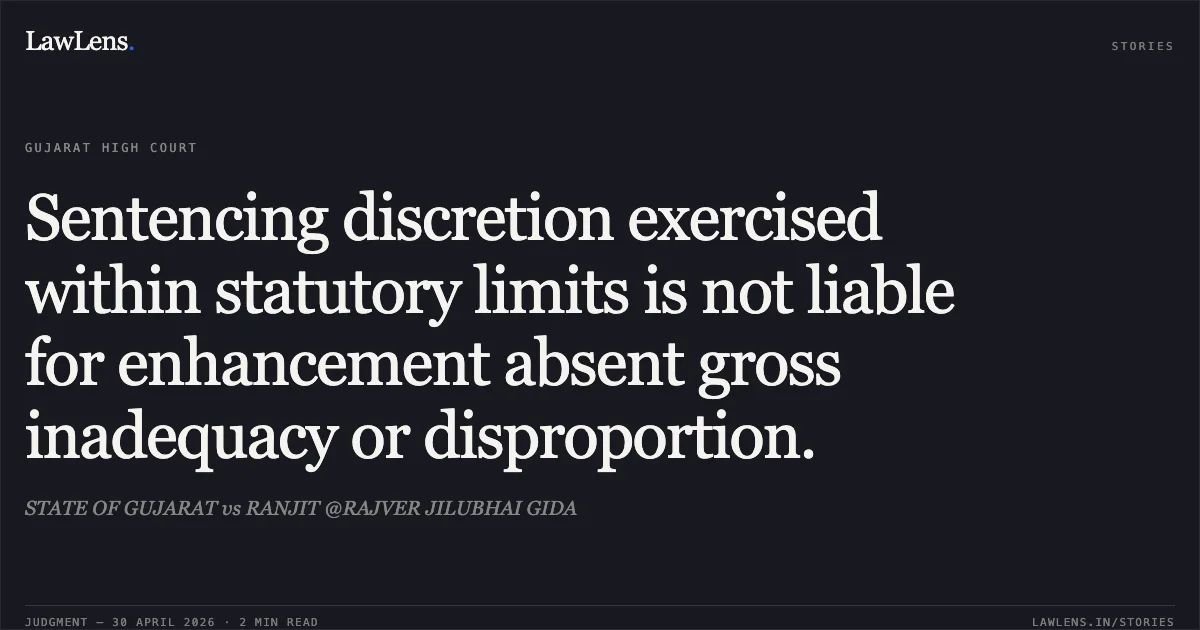
The High Court held that the sentence imposed was neither inadequate nor disproportionate under the statutory framework of 2015.
The court answered the issue in the negative, affirming that when a Trial Court imposes a substantial punishment within the legal limits, the appellate court should be reluctant to interfere.
Source reference: para. 10, 11Consequently, the appeal for enhancement was dismissed, and the original judgment of the 4th Additional Sessions Judge (Special POCSO Court) was upheld.
Source reference: para. 12Acts & Sections Cited
7 provisions across 3 statutes referred to in this judgment. Each provision opens on LawLens.
Bharatiya Nagarik Suraksha Sanhita, 20231
Indian Penal Code, 18604
Protection of Children from Sexual Offences Act, 20122
Original Court PDF
STATE OF GUJARATvsRANJIT @RAJVER JILUBHAI GIDA
Click to open original judgment
Original judgment, available to read, download and summarize on LawLens.in