Facts
The petitioners, employed in non-teaching administrative roles at the respondent unaided private school, challenged orders dated 9 January 2016 terminating their services.
Source reference: paras. 2–5; pp. 3–6They alleged that their employment was terminated without notice or proper enquiry, following allegations of deficient performance and financial loss.
Source reference: paras. 2–5; pp. 3–6They sought quashing of the termination orders and reinstatement with consequential benefits.
Source reference: paras. 2–5; pp. 3–6The school objected that the petitions concerned contractual employment and were not maintainable under Article 226.
Source reference: paras. 2–5; pp. 3–6The Court considered maintainability without examining the merits of the termination.
Source reference: paras. 8–12; pp. 3–6Issues
1. Whether writ petitions under Article 226 are maintainable to challenge the termination of non-teaching employees by an unaided private school, where the dispute arises from their employment.
Source reference: paras. 12–13, 17–19; pp. 6–7, 12–132. Whether the school’s role in imparting education, including its obligations under the Right of Children to Free and Compulsory Education Act, 2009, makes this service dispute amenable to writ jurisdiction.
Source reference: paras. 6, 13–14; pp. 4, 6–7Law Applied
Article 226 provides a public-law remedy against a person or body discharging public duties or functions, but the challenged action must itself have a public-law element; an ordinary contractual service dispute is not, without more, amenable to writ review.
Source reference: paras. 14–17; pp. 7–13Under St. Mary’s Education Society v. Rajendra Prasad Bhargava (2023) 4 SCC 498, an educational institution’s performance of a public duty does not make every employment decision reviewable under Article 226; service matters of employees not governed by statutory provisions generally remain within the private contractual realm.
Source reference: paras. 14–17; pp. 7–13The Court also relied on Army Welfare Educational Society v. Sunilkumar Sharma, 2024 SCC OnLine SC 1683, and the Madras High Court Division Bench decision in W.A. No. 2887 of 2023.
Source reference: paras. 14–17; pp. 7–13The Court noted that the petitioners’ reliance on the RTE Act, 2009 did not establish a public-law issue because their grievance was not about enforcement of that Act.
Source reference: para. 13; p. 6Reasoning
The petitioners challenged termination of their employment, rather than any failure by the school to discharge an educational or statutory duty.
Source reference: paras. 13–17, 19; pp. 6–13Although imparting education may constitute a public duty, the termination of non-teaching staff was an employment matter and had no demonstrated direct nexus to the discharge of that duty.
Source reference: paras. 13–17, 19; pp. 6–13The Court found no applicable statutory regulation of the petitioners’ service conditions or government role in their termination.
Source reference: paras. 13–17, 19; pp. 6–13Applying St. Mary’s Education Society and Army Welfare Educational Society, it held that the dispute remained contractual and private; the RTE Act argument did not alter that character.
Source reference: paras. 13–17, 19; pp. 6–13Holding
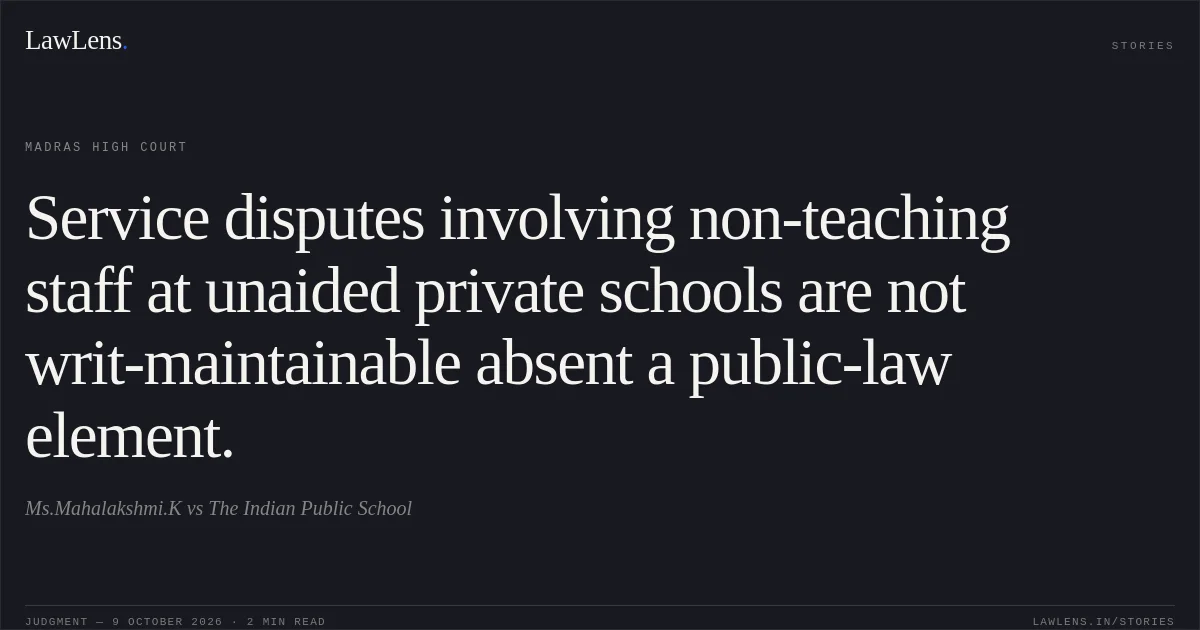
The Court held that the writ petitions were not maintainable because the claims concerned a private contractual service dispute with an unaided private school, not a matter involving a reviewable public-law element.
Both petitions were dismissed without consideration of the merits, with liberty to the petitioners to approach the competent forum for relief.
Source reference: paras. 19–20; p. 13Original Court PDF
Ms.Mahalakshmi.KvsThe Indian Public School
Click to open original judgment
Original judgment, available to read, download and summarize on LawLens.in