Facts
The respondent issued three purchase orders (CC-10/2000, CC-19/2001, and CC-19/2002) to the appellant for wooden cable drums.
Source reference: para. 9Disputes arose regarding the contracts, leading to the appointment of a retired High Court judge as an Arbitrator via a court order dated July 20, 2017.
Source reference: para. 9On January 28, 2020, the Arbitrator passed an award in favor of the appellant.
Source reference: para. 11The respondent challenged the award under Section 34 of the Arbitration and Conciliation Act, 1996. On December 12, 2025, a Single Judge set aside the entirety of the award.
Source reference: para. 1, 2The appellant moved the Division Bench under Section 37, contending that the respondent had unconditionally acknowledged a liability of ₹15,67,936.34 through a letter dated October 7, 2010 (Exhibit C/47), which the Single Judge failed to uphold despite noting the admission.
Source reference: para. 3, 4, 14Issues
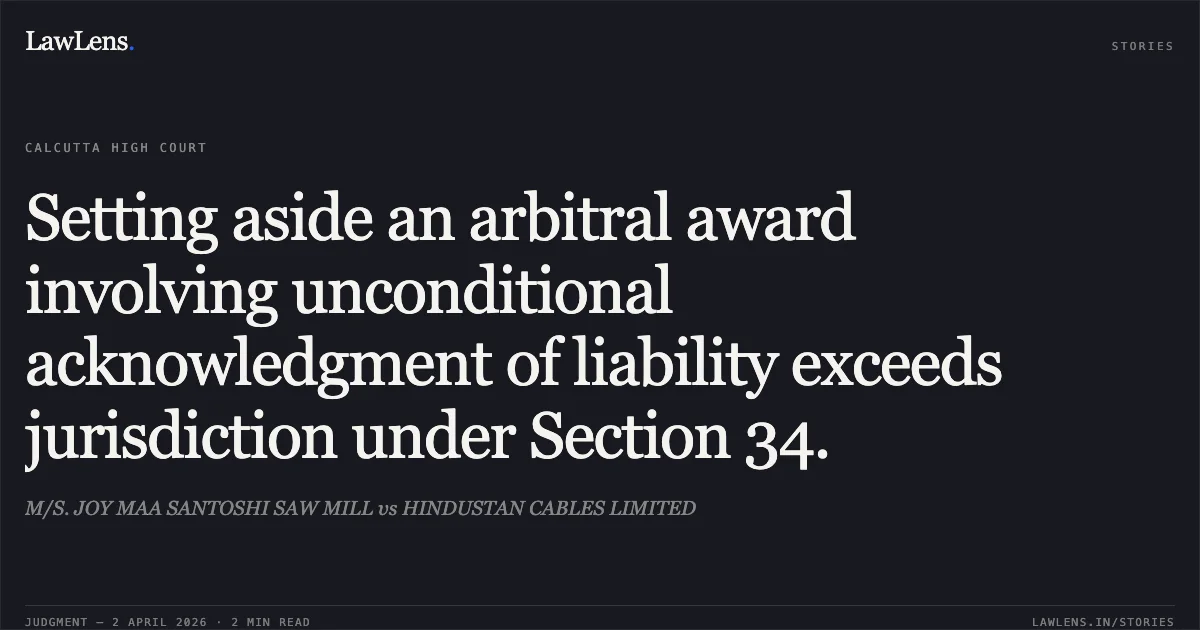
Whether the learned Single Judge exceeded the jurisdiction under Section 34 of the Arbitration and Conciliation Act, 1996, by setting aside an arbitral award in its entirety despite an unconditional acknowledgment of liability by the respondent.
Source reference: para. 15Law Applied
The Court primarily applied Section 34 of the Arbitration and Conciliation Act, 1996, which governs the grounds and scope for setting aside arbitral awards.
Source reference: para. 1, 2Section 37 of the same Act regarding the appellate jurisdiction of the High Court.
Source reference: para. 1, 2The Court also relied on the evidentiary principle that an unconditional acknowledgment of debt (admission of liability) constitutes a binding obligation that limits the court's power to set aside that specific portion of an award.
Source reference: para. 12, 15Reasoning
The Court observed that the respondent’s letter dated October 7, 2010, was an "unconditional acknowledgment of liability" for ₹15,67,936.34 (comprising dues for goods/services and security deposit).
Source reference: para. 12The respondent argued the letter was merely an offer, but the Court rejected this, noting the letter explicitly stated that silence from the appellant would confirm the correctness of the sum.
Source reference: para. 7, 12The Court found that although the Single Judge’s order recognized this admission in paragraph 29, the Judge erred in setting aside the entire award.
Source reference: para. 14The Division Bench reasoned that setting aside admitted liabilities exceeds the narrow jurisdiction provided under Section 34.
Source reference: para. 15Regarding interest, the Court restored the Arbitrator’s initial finding of 9% compounded yearly from March 1, 2004, noting the Arbitrator had subsequently reduced it to 7% without providing reasons.
Source reference: para. 5, 16Holding
The Court allowed the appeal and modified the arbitral award.
It held that the respondent is liable to pay the principal sum of ₹15,67,936.34 along with interest at the rate of 9% per annum, compounded yearly, calculated from March 1, 2004, until actual payment.
Source reference: para. 16Additionally, the Court awarded the appellant ₹3,40,000/- as costs for the 34 arbitration sittings.
Source reference: para. 17, 18All pending applications were disposed of accordingly.
Source reference: para. 19Acts & Sections Cited
2 provisions across 1 statute referred to in this judgment. Each provision opens on LawLens.
Arbitration and Conciliation Act, 19962
Original Court PDF
M/S. JOY MAA SANTOSHI SAW MILLvsHINDUSTAN CABLES LIMITED
Click to open original judgment
Original judgment, available to read, download and summarize on LawLens.in