Facts
The petitioner entered into a 21-year lease agreement in 2004 with Murshidabad Zilla Parishad (Respondent No. 2) for a medical center.
Source reference: p. 2The respondent terminated the lease in January 2022 alleging non-payment of rent, subsequent to which the term also expired by efflux of time in July 2025.
Source reference: p. 3, 17Initial civil proceedings and an application under Section 8 of the Arbitration Act led to the dispute being referred to an Arbitrator.
Source reference: p. 5-6Parallelly, on July 22, 2025, the Sub Divisional Magistrate (SDM/Collector) initiated eviction proceedings under the West Bengal Public Land (Eviction of Unauthorised Occupants) Act, 1962, issuing a show-cause notice.
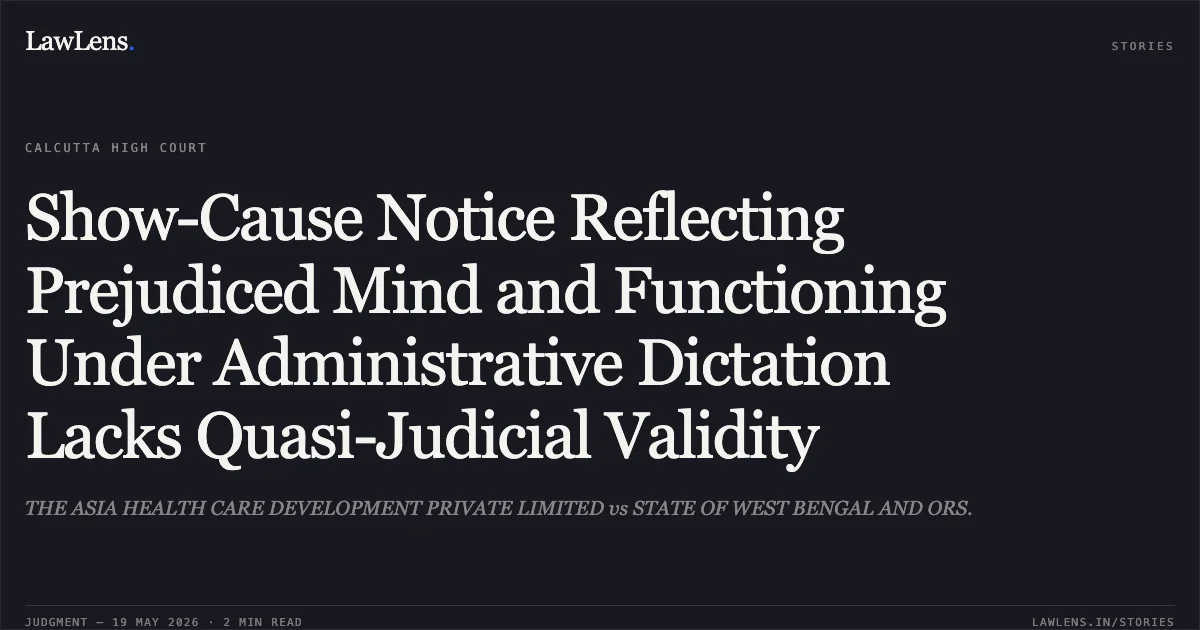
Source reference: p. 6The petitioner challenged this notice, alleging it was issued with a prejudged mind and under dictation from the District Magistrate.
Source reference: p. 7Issues
1. Whether the show-cause notice issued under Section 3(1) of the 1962 Act was vitiated by predetermination and "acting under dictation".
Source reference: p. 20-212. Whether the pending arbitral proceedings and the "status quo" order from a Commercial Court barred the Collector from proceeding under the 1962 Act.
Source reference: p. 27-28Law Applied
Section 3 of the West Bengal Public Land (Eviction of Unauthorised Occupants) Act, 1962, which governs the issuance of show-cause notices for eviction.
Source reference: p. 21The principles from Siemens Limited v. State of Maharashtra and Oryx Fisheries Private Limited v. Union of India, which establish that a show-cause notice is invalid if it reflects a predetermined mind or if the reply would be a mere "empty ceremony".
Source reference: p. 8, 25-26The doctrine that quasi-judicial authorities must not act under the dictation of hierarchical superiors, as held in Orient Paper Mills Limited v. Union of India.
Source reference: p. 25Central Warehousing Corporation v. Sidhartha Titles, clarifying that special statutory eviction mechanisms for public land are not eclipsed by private arbitration.
Source reference: p. 28Reasoning
The Court found the impugned notice legally vulnerable because it used language suggesting the Collector was already "satisfied" as to the unauthorized occupation before hearing the petitioner, deviating from the neutral tone required by Rule 3(1) of the 1963 Rules.
Source reference: p. 22-23Crucially, an internal order dated November 13, 2025, explicitly stated the Collector was proceeding "in compliance with the instruction of the District Magistrate," confirming the authority was not domesticating its own judgment but acting under dictation.
Source reference: p. 24-25The Court reasoned that since the lease had expired by efflux of time, the 1962 Act provided a distinct public law remedy for recovery of public land that runs parallel to private law arbitral disputes regarding contractual breaches.
Source reference: p. 27-29Holding
The Court allowed the writ petition in part, setting aside the impugned show-cause notice dated July 22, 2025, on the grounds of predetermination and acting under dictation.
The Court granted the respondent authorities liberty to initiate fresh proceedings strictly in accordance with the fair procedure laid down in Oryx Fisheries, clarifying that pending arbitration does not preclude statutory action under the 1962 Act.
Source reference: p. 26, 32Acts & Sections Cited
11 provisions across 4 statutes referred to in this judgment. Each provision opens on LawLens.
Arbitration and Conciliation Act, 19964
Specific Relief Act, 19631
Transfer of Property Act, 18821
Original Court PDF
THE ASIA HEALTH CARE DEVELOPMENT PRIVATE LIMITEDvsSTATE OF WEST BENGAL AND ORS.
Click to open original judgment
Original judgment, available to read, download and summarize on LawLens.in