01Facts
The petitioners, accused Nos. 3 and 1 respectively, sought regular bail under Section 483 of the Bharatiya Nagarik Suraksha Sanhita, 2023, in a case alleging offences under Sections 201, 302 and 120(B), read with Section 34 of the IPC
¶ 1 · p. 3The prosecution alleged that the accused conspired to murder an elderly couple and rob valuables from their home
¶ 5 · p. 4Accused No. 4 had previously been granted bail after material prosecution witnesses were examined and, according to the submissions recorded in that order, had not supported the prosecution; accused No. 2 was subsequently granted bail
¶ 3, 6–7 · pp. 3–6The present petitions were successive bail applications
¶ 1 · p. 302Issues
i.1. Whether accused Nos. 1 and 3 were entitled to regular bail in light of the bail granted to accused Nos. 2 and 4 and the circumstances recorded in the earlier bail order
¶ 3, 6–8 · pp. 3–6ii.2. Whether the allegations and the circumstantial nature of the prosecution case justified granting bail to the petitioners subject to conditions
¶ 5, 7–8 · pp. 4–603Law Applied
Section 483 of the BNSS, 2023, empowers the High Court to grant bail.
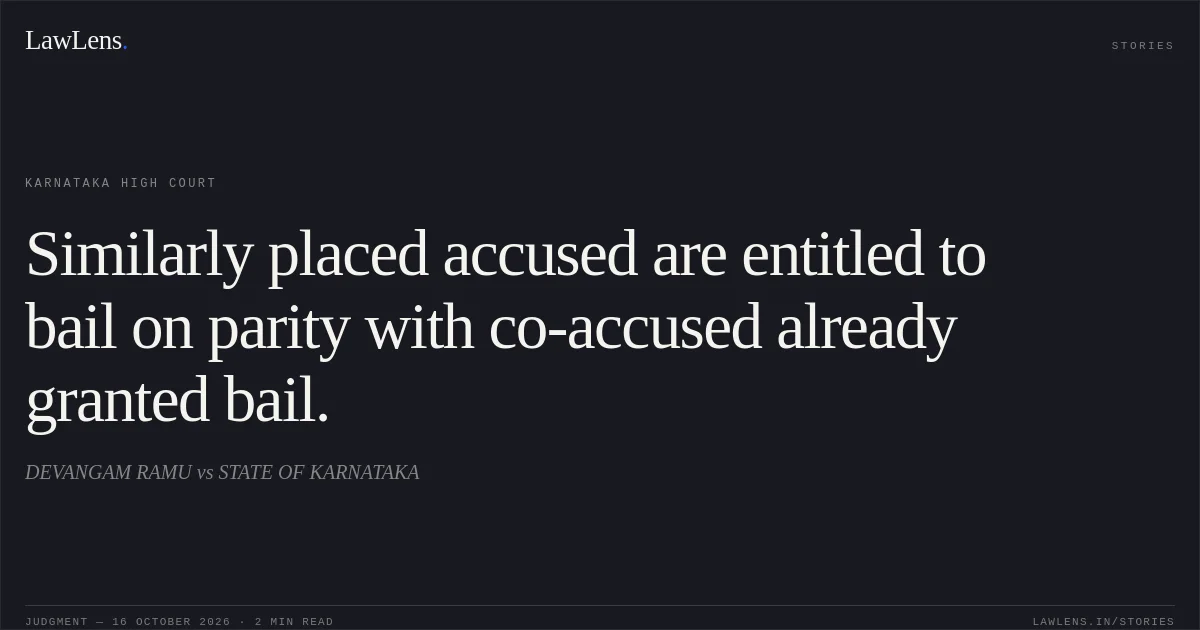
¶ 1, 5–8 · pp. 3–6The Court considered the principle of parity where similarly placed co-accused have been granted bail, alongside the circumstances relevant to the prosecution case and its progress.
¶ 1, 5–8 · pp. 3–6The alleged offences were under Sections 201, 302 and 120(B), read with Section 34 of the IPC
¶ 1, 5–8 · pp. 3–6The Court relied on its earlier bail orders in the same case; no separate precedent or broader legal test was identified in this order
¶ 6–7 · pp. 5–6Provisions in the judgment · 5 · Linked ones open on LawLens
Code of Criminal Procedure, 1973 Section 439
Bharatiya Nagarik Suraksha Sanhita, 2023 Section 483
Indian Penal Code, 1860 Section 201Section 302Section 34
04Reasoning
The Court noted that the prosecution case was based on circumstantial evidence and that the allegations against all four accused were similar
¶ 7–8 · p. 6Accused Nos. 4 and 2 had already been granted bail, and the earlier order concerning accused No. 4 recorded that material witnesses examined had not supported the prosecution
¶ 6–7 · pp. 5–6In those circumstances, the Court considered the petitioners entitled to the same relief, subject to safeguards against non-appearance, witness tampering, further offences and leaving the trial court’s jurisdiction
¶ 8 · pp. 6–705Holding
The Court allowed both petitions and directed that accused Nos. 1 and 3 be released on bail in S.C. No. 1497/2021
¶ 8 · pp. 6–7Each petitioner was required to execute a personal bond of ₹1,00,000 with two sureties for the like sum, one of whom must be a local surety, and to comply with the specified attendance, non-interference, non-reoffending and jurisdictional conditions
p. 7Original Court PDF
DEVANGAM RAMUvsSTATE OF KARNATAKA
Click to open original judgment
Original judgment, available to read, download and summarize on LawLens.in