Facts
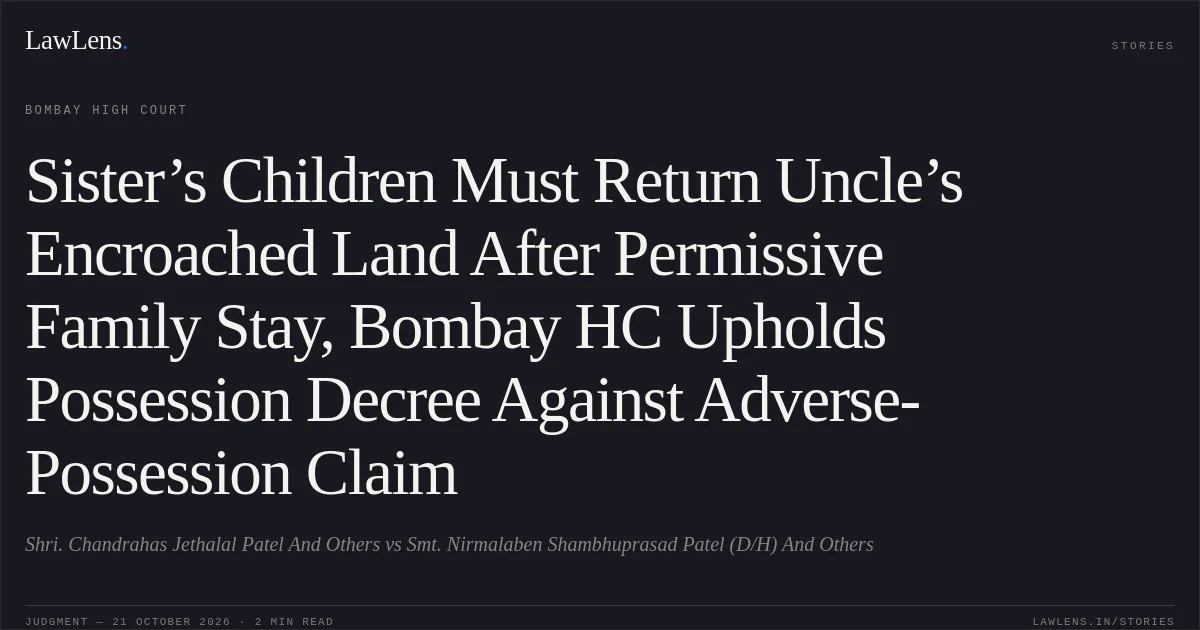
The plaintiffs claimed ownership of land at Village Mohone, Kalyan, and sought possession and removal of structures allegedly encroaching on it.
Source reference: paras. 2–5, pp. 2–4They alleged that Maniben, the sister of the plaintiffs’ predecessor, had been permitted to occupy the property and later constructed on part of it.
Source reference: paras. 2–5, pp. 2–4The defendants asserted title by adverse possession, contending that construction began in 1962 and that the suit was time-barred.
Source reference: paras. 2–5, pp. 2–4The trial court decreed possession and related relief; the first appellate court affirmed.
Source reference: paras. 2–5, pp. 2–4The defendants’ second appeal challenged those concurrent findings.
Source reference: paras. 2–5, pp. 2–4The High Court considered questions concerning adverse possession, the description of the encroached property under Order VII Rule 3 CPC, and limitation.
Source reference: paras. 7–8, p. 4Issues
1. Whether, when a defendant pleads title by adverse possession, the burden of proof shifts to the true owner.
Source reference: para. 7(i), p. 42. Whether the suit for removal of encroachment and possession based on title was maintainable under Order VII Rule 3 CPC.
Source reference: para. 7(ii), p. 43. Whether the plaintiffs’ suit was barred by limitation.
Source reference: para. 8, p. 5Law Applied
Under Article 65 of the Limitation Act, 1963, a suit for possession based on title must be brought within 12 years from when the defendant’s possession becomes adverse; the period does not begin while possession remains permissive.
Source reference: para. 35, p. 21A plea of adverse possession requires proof of possession that is continuous, sufficiently public, and hostile to the owner’s title, with the necessary knowledge attributable to the owner; the burden remains on the party asserting adverse possession.
Source reference: paras. 21–22, pp. 13–15In Maria Margadia Sequeria Fernandes v. Erasmo Jack De Sequeria, the Supreme Court held that gratuitous or permissive occupation does not, merely by its duration, confer title.
Source reference: para. 20, p. 12Order VII Rule 3 CPC, as amended in Bombay, requires an adequate description of immovable property and, in encroachment cases, a sketch showing approximately the encroachment’s location and extent.
Source reference: paras. 23–24, p. 15Under Pratibha Singh v. Shanti Devi Prasad, an identification defect in a decree may, in appropriate circumstances, be cured in execution under Section 47 CPC.
Source reference: para. 32, p. 20Reasoning
The court found that Maniben entered the property permissively and that the defendants therefore could not establish possession hostile to the owners; their plea did not shift the burden to the plaintiffs, and the defendants remained responsible for proving adverse possession.
Source reference: paras. 19–22, pp. 11–15The defendants’ written statement acknowledged that part of their construction lay on the plaintiffs’ land, and the survey map at Exhibit 83 made the encroachment identifiable.
Source reference: paras. 27–33, pp. 17–20Since the defendants had not raised a proper objection to the property’s description before the trial or first appellate court, the court rejected their belated Order VII Rule 3 objection; it also noted that an identification defect could be addressed in execution.
Source reference: paras. 27–33, pp. 17–20Because the occupation remained permissive, it never became adverse and the limitation period under Article 65 did not begin to run.
Source reference: paras. 34–35, pp. 21–22Holding
The High Court answered all three questions against the appellants: the burden of proving adverse possession remained on them; the suit was not defeated by the objection under Order VII Rule 3 CPC; and the suit was within limitation.
Finding no basis to disturb the concurrent decrees, the court dismissed the second appeal with costs.
Source reference: paras. 22, 33, 35–36, pp. 15, 20–22Acts & Sections Cited
6 provisions across 3 statutes referred to in this judgment. Each provision opens on LawLens.
Code of Civil Procedure, 19083
Limitation Act, 19632
Specific Relief Act, 19631
Original Court PDF
Shri. Chandrahas Jethalal Patel And OthersvsSmt. Nirmalaben Shambhuprasad Patel (D/H) And Others
Click to open original judgment
Original judgment, available to read, download and summarize on LawLens.in