01Facts
The petitioners sought quashing under Section 482 Cr.P.C. of three FIRs registered as Crime Nos. 94/2020, 91/2020 and 93/2020 for offences under Sections 420, 465, 468 and 471 read with Section 34 IPC.
¶ 1–5 · pp. 5–7, 9–10The complaints alleged that the petitioners created two false audit reports and used them to provide false information to obtain substantial term loans and overdraft facilities from a bank.
¶ 1–5 · pp. 5–7, 9–10The petitioners argued that the dispute concerned non-payment of loans, that NCRs had initially been issued on the complaints, and that SARFAESI and DRT proceedings were pending.
¶ 6 · p. 7The complainant opposed quashing, relying on documents said to support the allegations of fraud.
¶ 7 · p. 802Issues
i.1. Whether the FIRs should be quashed under Section 482 Cr.P.C. on the grounds that the dispute was civil in nature and loan-recovery proceedings were pending.
¶ 6, 9–10 · pp. 7–10ii.2. Whether the initial issuance of NCRs prevented registration of FIRs where the complaints disclosed cognizable offences.
¶ 6, 9 · p. 7, 903Law Applied
Section 482 Cr.P.C. empowers the High Court to prevent abuse of process and secure the ends of justice; however, the Court relied on Lalita Kumari v. Government of Uttar Pradesh, (2013) 14 SCR 713, for the rule that registration of an FIR is mandatory when information discloses a cognizable offence.
¶ 9 · p. 9It also relied on Dineshbhai Chandubhai Patel v. State of Gujarat, (2018) 3 SCC 104, for the principle that the High Court should not quash an FIR where specific allegations require investigation and the facts remain to be unearthed.
¶ 10 · p. 10The alleged offences were under Sections 420, 465, 468 and 471 IPC, read with Section 34 IPC.
¶ 1–3 · pp. 5–6Provisions in the judgment · 6 · Linked ones open on LawLens
Code of Criminal Procedure, 1973 Section 482
Indian Penal Code, 1860 Section 420Section 465Section 468Section 471Section 34
04Reasoning
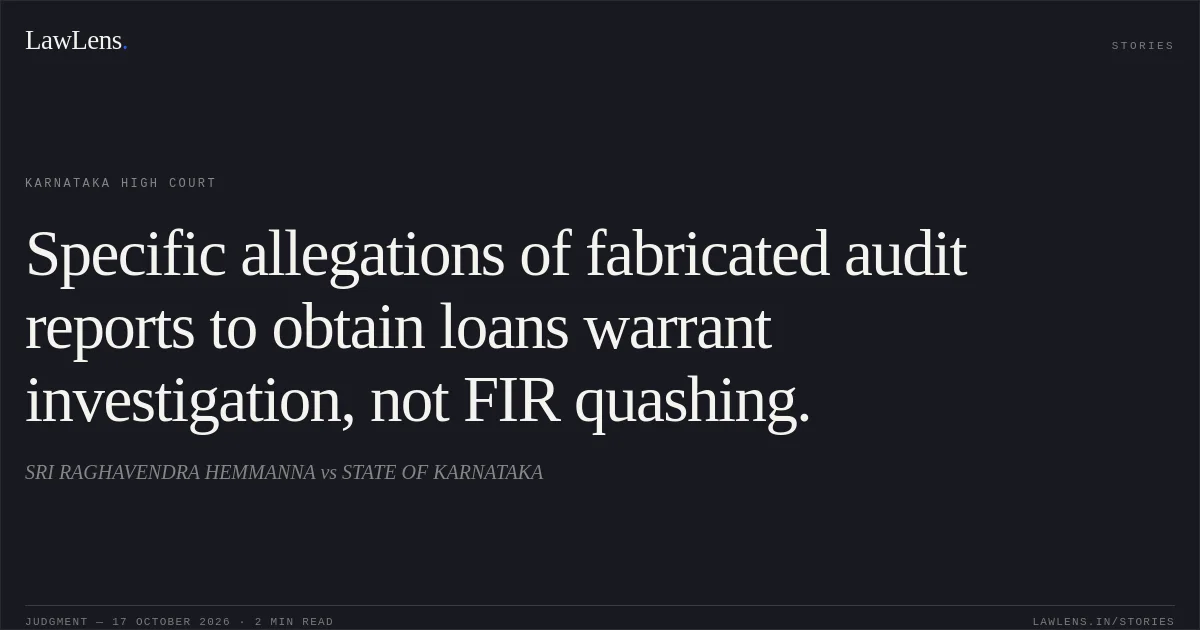
The Court treated the allegations of creating and using false audit reports to obtain loans as specific accusations disclosing cognizable offences, rather than merely a dispute over repayment.
¶ 9–10 · pp. 9–10It held that the earlier NCRs did not bar FIR registration once cognizable offences were disclosed, and that the pending SARFAESI and DRT proceedings did not justify terminating the criminal investigation.
¶ 6, 9–10 · pp. 7, 9–10Whether the reports were fabricated and whether they were used to secure the loans were matters for investigation; the Investigating Officer could ultimately file an appropriate report.
¶ 10 · p. 1005Holding
The Court answered the issues against the petitioners and dismissed all three criminal petitions.
¶ 11 · p. 11It declined to quash the FIRs, leaving the allegations to be investigated.
¶ 11 · p. 11Original Court PDF
SRI RAGHAVENDRA HEMMANNAvsSTATE OF KARNATAKA
Click to open original judgment
Original judgment, available to read, download and summarize on LawLens.in