01Facts
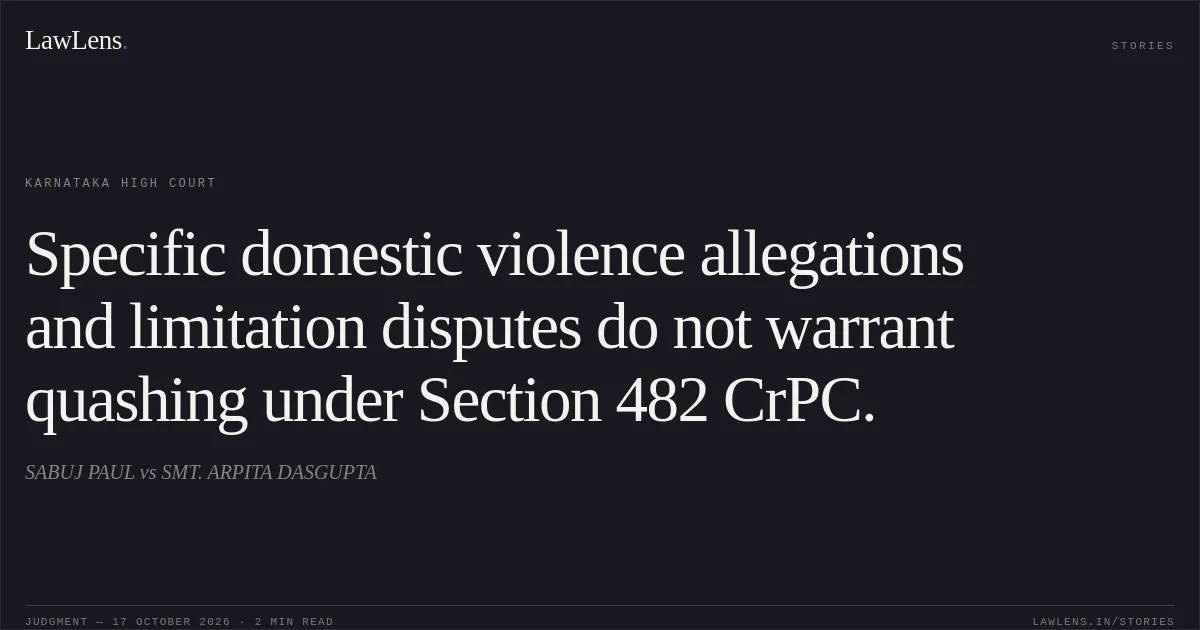
The petitioner-husband sought to quash proceedings in C.Misc. No. 148/2017, initiated by his wife under Section 12 of the Protection of Women from Domestic Violence Act, 2005 (“DV Act”).
¶ 3-5, 12-13, 16-17The wife alleged domestic violence and sought protection, residence, monetary and compensation orders under Sections 18–22.
¶ 3-5, 12-13, 16-17The parties married in 2013; the wife initially lived with the petitioner in Toronto, returned to India in 2016 and later filed the DV Act application.
¶ 3-5, 12-13, 16-17The petitioner argued, among other things, that the application was time-barred, lacked specific allegations and was filed to harass him.
¶ 3-5, 12-13, 16-17The petitioner invoked the High Court’s inherent jurisdiction under Section 482 of the Code of Criminal Procedure, 1973 (“CrPC”).
02Issues
i.Whether the High Court could exercise its jurisdiction under Section 482 CrPC to quash the proceedings initiated under Section 12 of the DV Act.
¶ 15ii.Whether the petitioner had established grounds for quashing the proceedings, including limitation or absence of specific allegations of domestic violence.
¶ 16-1803Law Applied
Section 12 of the DV Act provides the procedure for seeking relief under the Act, while Sections 18–23 provide for protection, residence, monetary, compensation and other orders.
¶ 19-20Section 482 CrPC preserves the High Court’s inherent criminal jurisdiction; the Court relied on Arul Daniel v. Suganya and Oliver Menezes v. Serita Therese Mathias, which adopted the view that an application under Section 12 is not a complaint under the CrPC and that a Section 482 petition to quash such an application does not lie, with Article 227 review available on the limited ground of patent lack of jurisdiction.
¶ 19-20The Court also referred to the Supreme Court’s discussion of Section 482 in Saurabh Kumar Tripathi v. Vidhi Rawal, observing that intervention in DV Act proceedings is warranted in cases of gross illegality or injustice, rather than through casual exercise of that power.
¶ 14, 18Provisions in the judgment · 20 · Linked ones open on LawLens
Code of Criminal Procedure, 1973 11 provisions
Section 2Section 64Section 190Section 200Section 201Section 202Section 203Section 204Section 468Section 473Section 482Protection of Women from Domestic Violence Act, 2005 Section 2Section 12Section 18Section 19Section 20Section 21Section 22Section 23
Hindu Marriage Act, 1955 Section 9
04Reasoning
The Court held that the petitioner’s limitation argument could not be resolved in the Section 482 petition because limitation presented a mixed question of fact and law.
¶ 16It also rejected the claim that the application contained no specific allegations, noting the wife’s pleaded allegations and distinguishing cases involving only omnibus accusations.
¶ 17Whether domestic violence had occurred was a matter for trial.
¶ 18The Court further considered the authorities addressing the procedural character of Section 12 proceedings and the limits on Section 482 intervention.
¶ 18-21Although it recognised that intervention could be appropriate where illegality or injustice was shown, it found no such basis on the record.
¶ 18-2105Holding
The Court answered the principal issue in the negative and held that the petitioner had not made out grounds for exercising Section 482 CrPC jurisdiction to quash the DV Act proceedings.
¶ 21-22It dismissed the criminal petition.
¶ 21-22Original Court PDF
SABUJ PAULvsSMT. ARPITA DASGUPTA
Click to open original judgment
Original judgment, available to read, download and summarize on LawLens.in