Facts
The plaintiff (respondent) filed a suit for specific performance based on a registered agreement to sell dated 30.12.2019 regarding a two-storeyed house
Source reference: para. 1-2The total consideration was ₹30 lakhs, with ₹20 lakhs paid as earnest money via cheque
Source reference: para. 2-3The defendant (appellant) denied executing the agreement, alleging it was a fraudulent document obtained by exploiting a business relationship involving silver trading
Source reference: para. 7-10The defendant further claimed the earnest money was actually payment for business transactions/labour charges and that the property was undervalued
Source reference: para. 11, 23, 79The Trial Court decreed the suit in favor of the plaintiff on 11.03.2025
Source reference: para. 1Issues
1. Whether the defendant executed a valid registered agreement to sell and received the earnest money consideration
Source reference: para. 40, 632. Whether the plaintiff continuously remained ready and willing to perform his part of the contract as per Section 16(c) of the Specific Relief Act
Source reference: para. 40, 1153. Whether the relief of specific performance remains discretionary following the 2018 Amendment to the Specific Relief Act
Source reference: para. 40, 129Law Applied
The court applied Section 16(c) of the Specific Relief Act, 1963, which mandates the plaintiff to prove continuous readiness (financial capacity) and willingness (conduct)
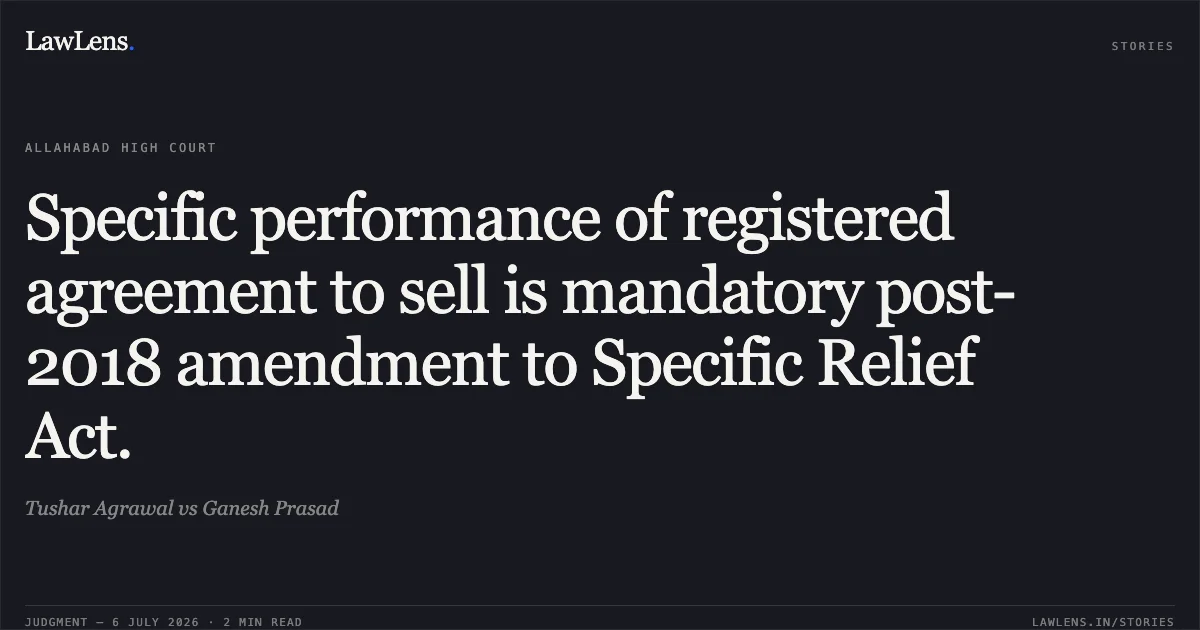
Source reference: para. 59, 122It relied on the amended Section 10 of the Specific Relief Act (w.e.f. 01.10.2018), noting that specific performance is now a mandatory rather than discretionary relief
Source reference: para. 54, 132The court utilized the "best evidence rule" under Section 91 of the Evidence Act regarding written contracts
Source reference: para. 50Presumption of validity for registered documents established in Prem Singh v. Birbal and Hemalatha v. Tukaram
Source reference: para. 55, 91, 93Reasoning
The Court found the agreement was duly registered with the defendant’s digital photograph and thumb impression, creating a high presumption of genuineness that the defendant failed to rebut with cogent evidence
Source reference: para. 90-94Regarding consideration, the Court noted the ₹20 lakh payment originated from the plaintiff’s personal savings account, not a firm account, contradicting the defendant's claim that it was a business transaction
Source reference: para. 98, 113On readiness and willingness, the Court determined the plaintiff maintained a bank balance exceeding the required ₹10 lakh and sent timely legal notices
Source reference: para. 124, 119Relying on Syed Dastagir v. T.R. Gopalakrishna Setty, the Court held that "readiness and willingness" must be judged in spirit and substance rather than through mechanical adherence to specific forms
Source reference: para. 116-117The Court observed that since the agreement was dated post-2018, the mandatory enforcement rule under the amended Section 10 applied
Source reference: para. 131-133Holding
The High Court dismissed the appeal and affirmed the Trial Court's decree, holding that the defendant failed to prove fraud or that the consideration was for business dealings
The Court ordered the defendant to execute the sale deed within two months upon receipt of the balance ₹10 lakhs; failing which, the plaintiff may seek execution through the Court
Source reference: para. 141The Court concluded that the relief was mandatory under the post-2018 legal framework and the plaintiff had satisfied all statutory requirements
Source reference: para. 133, 139Acts & Sections Cited
9 provisions across 3 statutes referred to in this judgment. Each provision opens on LawLens.
Code of Civil Procedure, 19083
Specific Relief Act, 19635
Code of Criminal Procedure, 19731
Original Court PDF
Tushar AgrawalvsGanesh Prasad
Click to open original judgment
Original judgment, available to read, download and summarize on LawLens.in