01Facts
The plaintiffs sued for specific performance of an agreement to sell dated 19.06.1989, under which the defendant agreed to sell 4 kanal of land in Village Bari Kohri at Rs.24,000 per acre, with Rs.8,000 paid as earnest money.
¶ 2, 9The land was purchased by the defendant from the Custodian Department, and mutation was sanctioned in his favour in 1993.
¶ 2, 9The plaintiffs alleged that the defendant did not inform them of the mutation, that they learned of it in March 1994, and that they served a notice dated 06.04.1994 calling for execution of the sale deed on 11.04.1994.
¶ 2, 9The defendant denied executing any agreement, pleaded that he was addicted to liquor, and alleged that his thumb impressions were obtained on blank papers and misused.
¶ 4, 10The trial court dismissed the suit. The first appellate court affirmed that dismissal, and the plaintiffs filed this second appeal.
¶ 6, 702Issues
i.1. Whether the plaintiffs proved the due execution of the agreement to sell dated 19.06.1989.
¶ 10–12, 14ii.2. Whether the plaintiffs were ready and willing to perform their part of the contract.
¶ 15iii.3. Whether the plaintiffs had locus standi to file the suit.
¶ 15iv.4. Whether the suit is maintainable in its present form.
¶ 16v.5. Whether the suit is barred by limitation.
¶ 17vi.6. Whether the concurrent findings of fact of the courts below can be interfered with in second appeal.
¶ 1803Law Applied
Specific performance is a discretionary remedy to be exercised judiciously within the law, and it cannot be granted merely because signatures or thumb impressions are present; due execution of the agreement must be proved.
¶ 12On second appeal, the Court relied on the Supreme Court's decision in Shivali Enterprises v. Godawari (quoting Randhir Kaur v. Prithvi Pal Singh, (2019) 17 SCC 71), holding that concurrent findings of fact, including findings based on documentary evidence, cannot be disturbed on the ground that they are erroneous, and that interference lies only for an error of law or a substantial defect in procedure under the old Section 100 CPC and Section 41 of the Punjab Courts Act.
¶ 18A suit founded on an agreement allegedly not honoured is maintainable irrespective of whether the plaintiff ultimately proves it.
¶ 16Limitation is assessed from the plaintiffs' date of knowledge of the mutation.
¶ 17Provisions in the judgment · 1 · Linked ones open on LawLens
Code of Civil Procedure, 1908 Section 100
04Reasoning
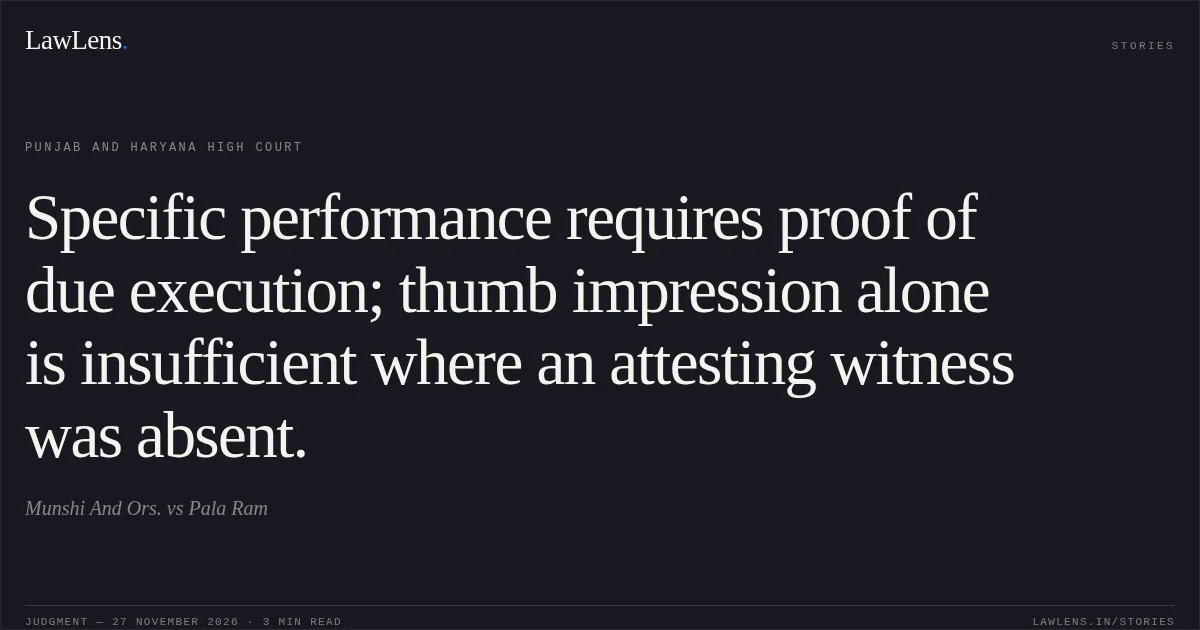
The deed writer (PW-1) and attesting witness PW-3 deposed that both attesting witnesses were present and that the agreement was read over before the defendant affixed his thumb impression. However, PW-3 admitted under cross-examination that the second attesting witness, Mansha Ram, was not present at execution and that his thumb impression was obtained the next day. This falsified the execution account and made the defendant's intoxication plea probable.
¶ 11The thumb impressions did not specify the hand used, and the second attesting witness's name was inconsistently recorded as "Gulam," "Gula," and "Bula" Mohammad.
¶ 12The First Appellate Court's finding that the register entry (Serial No. 333) was written in ballpoint pen on an original page while the rest of the register copy was a photostat, suggesting later insertion, was accepted as a further circumstance.
¶ 13Because execution failed, readiness and willingness (Issue 2) and locus standi (Issue 3) followed as negative findings.
¶ 15The Court reversed the lower courts on maintainability (Issue 4), reasoning that failure to prove a claim does not make the suit non-maintainable.
¶ 16The Court affirmed that the suit was within three years of the plaintiffs' knowledge of the mutation in March 1994 (Issue 5).
¶ 17The Court found no perversity or error of law in the concurrent findings and declined to interfere.
¶ 1805Holding
The plaintiffs failed to prove due execution of the agreement dated 19.06.1989, so Issues 1, 2 and 3 are decided against them.
¶ 14–16The finding on Issue 4 is reversed, and the suit is held maintainable, but this does not alter the outcome. Issue 5 is decided in the plaintiffs' favour, and the suit is held not time-barred.
¶ 16–17The concurrent findings of the courts below are affirmed as free from perversity or error of law, and the Regular Second Appeal is dismissed with costs.
¶ 18, 19Original Court PDF
Munshi And Ors.vsPala Ram
Click to open original judgment
Original judgment, available to read, download and summarize on LawLens.in