01Facts
The plaintiff sued for specific performance of an agreement to sell dated 04.07.1988, under which the defendant agreed to sell 2½ Marlas out of Khasra No. 122, Khata No. 119/60, for Rs. 1,000.
¶ 2The plaintiff alleged full payment on execution, delivery of possession, and a promise to mutate the land within three months and then execute a sale deed.
¶ 2A legal notice dated 22.01.1991 was served and the defendant did not comply.
¶ 2The defendant denied the agreement, the payment and the delivery of possession.
¶ 3The defendant pleaded that the land belonged to Maha Singh (his father) and Bhag Singh, that Hukam Singh owned a 5-Marla portion, that the defendant's share was not more than 15/14 Marlas, and that the property was worth at least Rs. 7,500.
¶ 3The trial court (Senior Sub Judge, Ludhiana, 05.11.1993) decreed the suit.
¶ 1, 5The First Appellate Court (Additional District Judge, Ludhiana, 29.01.1996) reversed that decree and dismissed the suit.
¶ 1, 5Both courts held the agreement duly executed, relying on the handwriting expert (PW-3) and the attesting witness, Raj Gopal Sharma.
¶ 6Both courts found that Maha Singh owned 7½ Marlas of Khasra No. 122 and that the plaintiff bought that land from co-sharer Bhag Singh through the defendant as attorney in 1988.
¶ 7Maha Singh left three sons and four daughters.
¶ 8The trial court held that the defendant's share was 2½ Marlas because the daughters had married about 20 years earlier and made no claim.
¶ 8–9The First Appellate Court held the defendant's share to be 1/7th, about one Marla.
¶ 9The daughters were not impleaded and mutation was pending.
¶ 1002Issues
i.1. Whether the agreement to sell dated 04.07.1988 was duly executed by the defendant.
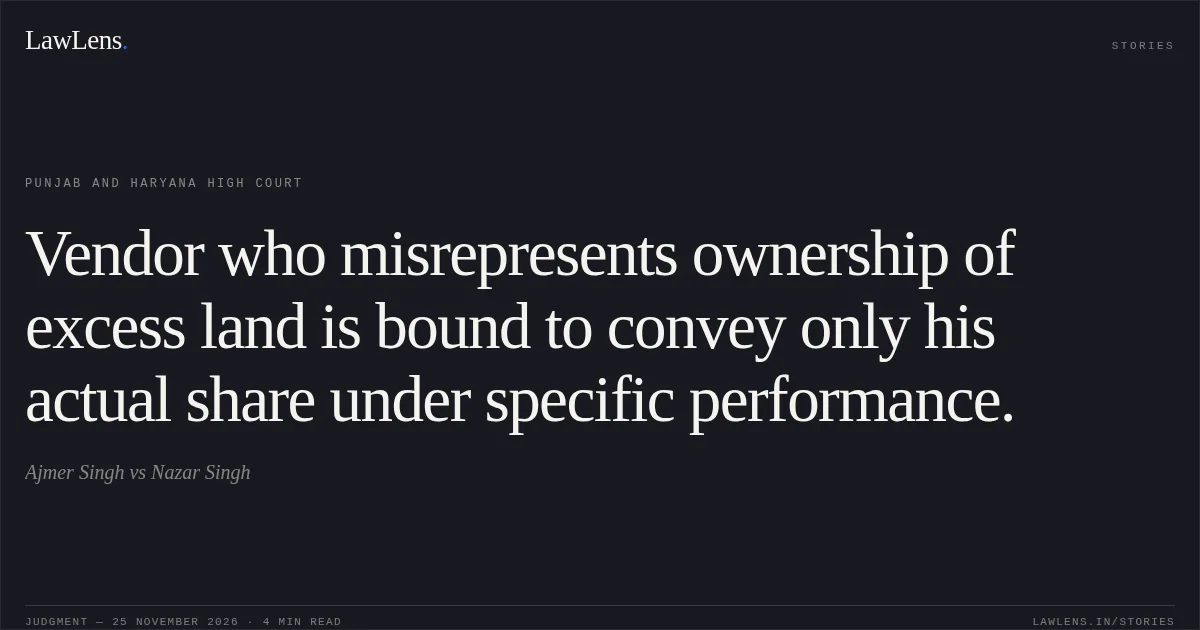
¶ 6, 7, 11ii.2. Whether the defendant, having inherited only a fractional share of the land, can be compelled to convey the land in excess of his share, despite having represented ownership of 2½ Marlas and received the full consideration.
¶ 8, 10, 11iii.3. Whether the relief of specific performance should be denied in full or modified to the extent of the defendant's share.
¶ 10, 11, 1203Law Applied
The judgment cites no statute and no precedent by name. Concurrent findings of fact on due execution of an agreement, based on the evidence of a handwriting expert and an attesting witness, are not disturbed on reappreciation in second appeal.
¶ 6, 7Succession to a father's estate is governed by the rule that all Class-I legal heirs are entitled to their shares, and the absence of a claim or a long lapse of time since marriage does not defeat that entitlement.
¶ 9, 10A party who has falsely represented ownership cannot take advantage of his own misrepresentation, and once due execution is proved, the seller is bound by the agreement to the extent of the property he actually owns.
¶ 11Partial relief may be granted where the defect in the agreement lies within the seller's own representation.
¶ 11, 1204Reasoning
The Court accepted the concurrent findings that the agreement was executed, relying on the expert's thumb-impression comparison and the attesting witness's testimony. The defendant's self-serving testimony, unsupported by corroboration, did not displace those findings.
¶ 6, 7On the second issue, the First Appellate Court had correctly held that the daughters were Class-I heirs entitled to shares, so the trial court's 2½-Marla finding could not stand.
¶ 10The defendant therefore owned only about one Marla, and the Court held he could not convey 2½ Marlas.
¶ 10The Court refused to deny relief altogether, because the defect arose from the defendant's own misrepresentation of ownership. The succession and title were within his exclusive knowledge, and the plaintiff had paid the full consideration on that representation.
¶ 11The Court therefore modified the relief: specific performance was granted to the extent of the defendant's share of the land covered by the agreement.
¶ 11, 1205Holding
The Court held that the agreement dated 04.07.1988 was duly executed and binding on the defendant.
¶ 11The Court held that the defendant could not convey land beyond his inherited share, and that the appropriate relief was modification rather than outright dismissal.
¶ 10, 11The First Appellate Court's judgment and decree were set aside, and the trial court's decree was modified.
¶ 12The defendant was directed to execute a sale deed for the land owned by him, or which fell to his share (described as "approximately upto 2½ Marlas"), within one month. If he fails, the plaintiff may obtain execution and registration through process of execution to the extent of the defendant's share.
¶ 12The appeal was allowed in these terms.
¶ 13Original Court PDF
Ajmer SinghvsNazar Singh
Click to open original judgment
Original judgment, available to read, download and summarize on LawLens.in