Facts
The Respondent was engaged as a Mali on a temporary/ad-hoc basis in the Forest Department on 07.12.1994 and joined on 29.12.1994
Source reference: p. 4, para 9He consistently sought regularization of his services over a 30-year tenure
Source reference: p. 5, para 11The Central Administrative Tribunal (CAT), Jammu, vide order dated 31.12.2024, directed the Petitioners to regularize the Respondent’s services effective from 01.01.2002 (upon completion of seven years of service) emphasizing his continuous work against a clear vacancy
Source reference: p. 2, para 2; p. 3, para 5The UT Administration challenged this order, contending that the Respondent had not completed the requisite seven years by 2002 due to a court-intervened re-joining in 1997, and that the relevant regularization rule (SRO 64 of 1994) stood repealed by S.O. 514 of 2023
Source reference: p. 2, paras 3-4Issues
1. Whether the continuous service of 30 years entitles an ad-hoc employee to regularization despite the employer's claim of "temporary" status
Source reference: p. 6, para 12; p. 9, para 172. Whether the repeal of SRO 64 of 1994 can retrospectively extinguish a right to regularization that crystallized prior to said repeal
Source reference: p. 9, para 18Law Applied
The Court applied the principles governing regularization of irregular appointments as distinguished from illegal ones under State of Karnataka v. Uma Devi (2006)
Source reference: p. 3, para 4It relied heavily on recent Supreme Court precedents including Shripal v. Nagar Nigam, Ghaziabad (2025), which held that Uma Devi cannot be used as a "shield" to justify exploitative long-term daily-wage engagements
Source reference: p. 6, para 12Jaggo v. Union of India (2025), which deprecated labeling perennial work as "contractual" to deny benefits
Source reference: p. 7, para 14The Court applied Dharam Singh v. State of U.P. (2025) and Bhola Nath v. State of Jharkhand (2026) to emphasize the State’s duty as a "model employer"
Source reference: p. 8, paras 15-16Regarding statutory rights, the Court applied the principle that a right accrued under a statute cannot be taken away retrospectively by its repeal
Source reference: p. 9, para 18Reasoning
The Court observed that the Respondent had been performing duties (fencing, sowing, planting) since 1991-92 and held a sanctioned post since 1994
Source reference: p. 4-5, paras 9-10It rejected the Petitioner's "ad-hoc" argument, noting that 30 years of uninterrupted service confirms the "permanency" and "perennial nature" of the work
Source reference: p. 9, para 17, 19The Bench criticized the State for resorting to a "policy of hire and fire," characterizing the long-term temporary status as an "exploitative engagement"
Source reference: p. 6, para 12Regarding the repeal of SRO 64, the Court held that since the Respondent’s right to regularization had "crystallized" well before 2023, it could not be defeated retrospectively, as doing so would violate Articles 14 and 16 of the Constitution
Source reference: p. 9, para 18The Court found the Petitioners' stance to be based on "hyper-technical grounds" despite their own departmental recommendations for the Respondent's regularization
Source reference: p. 5-6, paras 10-11Holding
The Court dismissed the writ petition, upholding the Tribunal's order
It held that the Respondent is entitled to regularization effective from 01.01.2002 with all consequential benefits, including promotions
Source reference: p. 2, para 2The Court affirmed that the State, as a model employer, cannot rely on contractual labels to justify prolonged ad-hocism when the work is permanent in nature
Source reference: p. 8-9, paras 16-17Final relief was granted by dismissing the challenge to the CAT's pragmatic view
Source reference: p. 10, para 20Original Court PDF
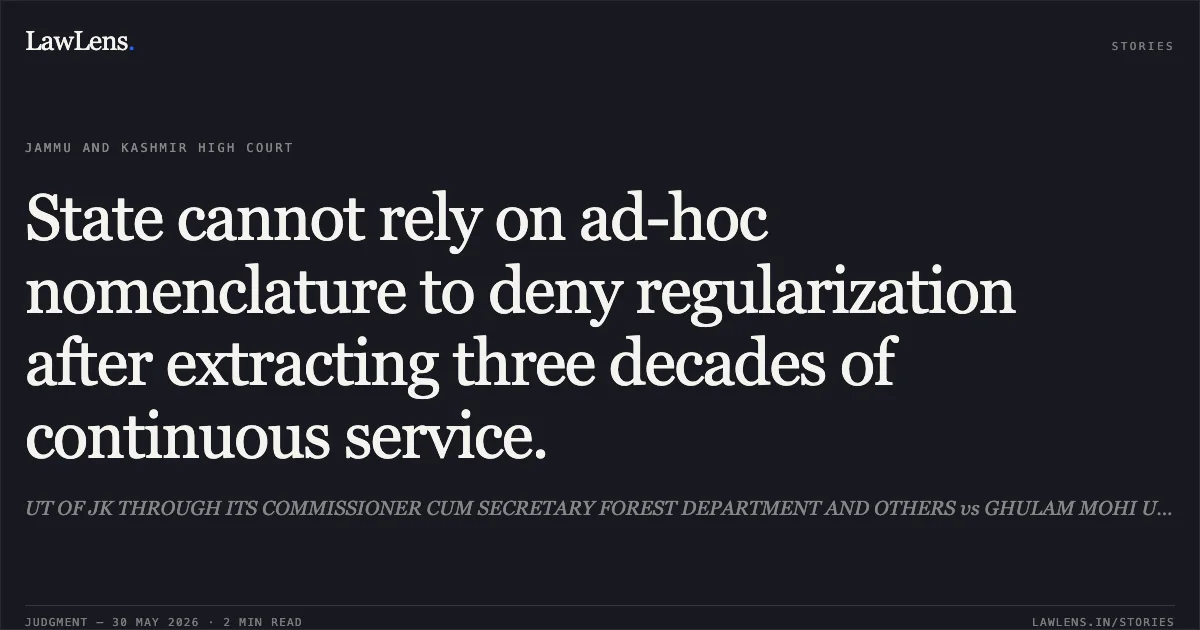
UT OF JK THROUGH ITS COMMISSIONER CUM SECRETARY FOREST DEPARTMENT AND OTHERSvsGHULAM MOHI UD DIN MALIK
Click to open original judgment
Original judgment, available to read, download and summarize on LawLens.in