Facts
The petitioner was appointed as a Watchman at Aadivasi Kanya Aashram, Daldali, District Kabirdham, via an order dated 27.08.1998.
Source reference: p. 2He joined service on 04.09.1998 and has been working continuously for approximately 27 years.
Source reference: p. 3, para 5Despite long-term service, his oral requests for regularization under the Works-charged and Contingency Paid Employees Recruitment and Condition of Service Rules, 1975, were not addressed by the respondents.
Source reference: p. 2, para 2The petitioner subsequently filed this writ petition seeking a direction for the regularization of his services as a permanent employee with all consequential benefits.
Source reference: p. 2, para 1Issues
Whether the petitioner is entitled to regularization of service after completing 27 years of continuous temporary employment in light of the evolving jurisprudence against "ad-hocism".
Source reference: p. 3, para 5-6Law Applied
Narendra Kumar Tiwari v. State of Jharkhand, which addressed the regularization of employees completing 10 years of service.
Source reference: p. 3, para 6Jaggo v. Union of India, emphasizing that the State must lead by example and that extended temporary engagement contravenes international labour standards.
Source reference: p. 3, para 6Bhola Nath v. State of Jharkhand, which prohibited the State from denying regularization after a decade of service under the guise of "contractual engagement".
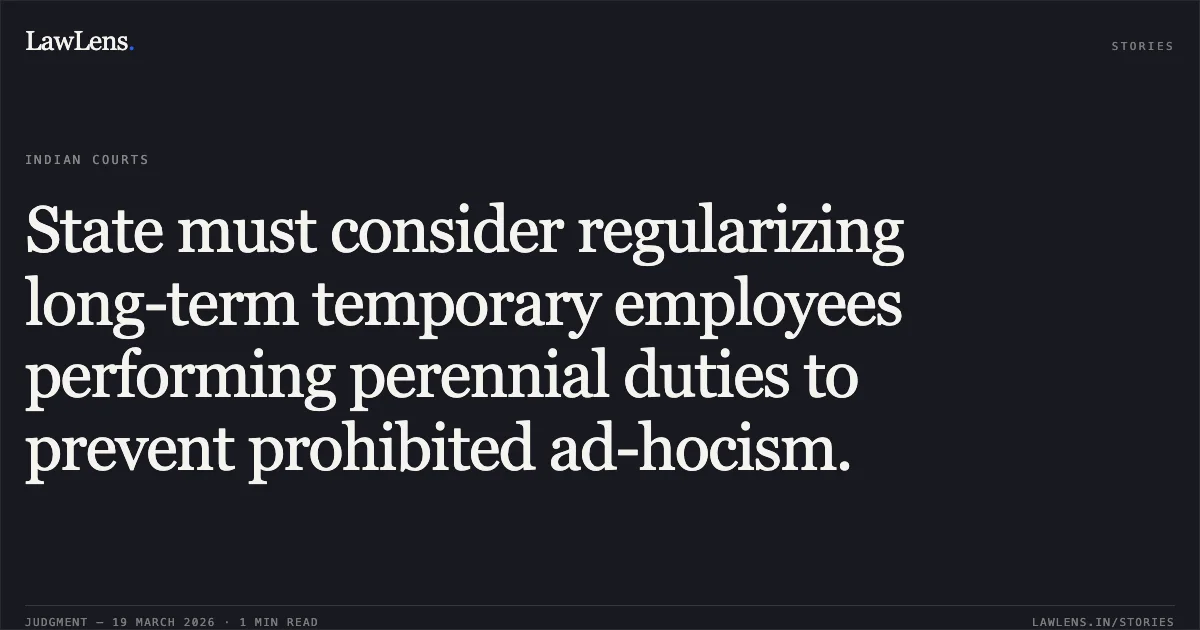
Source reference: p. 3, para 7Dharam Singh v. State of UP, which defined the State as a "constitutional employer" under Articles 14, 16, and 21, deprecating the practice of "ad-hocism" and precarious engagement for perennial work.
Source reference: p. 4-6, para 8Reasoning
The court examined the petitioner's 27-year service record and noted that he had been performing integral functions for nearly three decades without permanent status.
Source reference: p. 3, para 5Applying the "constitutional employer" doctrine from Dharam Singh, the court observed that the State cannot balance budgets at the expense of those performing recurring public functions.
Source reference: p. 4, para 8The court reasoned that long-term extraction of regular labour under temporary labels corrodes public administration and violates the promise of equal protection under the Constitution.
Source reference: p. 4, para 8It determined that rather than allowing administrative drift or technicalities to prolong the petitioner's insecurity, the authorities must be compelled to evaluate the claim against fixed timelines and judicial precedents that mandate transitioning perennial workers to a sanctioned footing.
Source reference: p. 5-6, para 8-9Holding
The High Court disposed of the writ petition with a direction permitting the petitioner to submit a fresh comprehensive representation to the Commissioner (Respondent 2), the Assistant Commissioner (Respondent 4), and the Superintendent (Respondent 5).
The court ordered the concerned authorities to take a decision on the petitioner’s regularization in accordance with the law and the cited Supreme Court judgments within four months from the receipt of the representation.
Source reference: p. 6, para 9Original Court PDF
JAY SINGHvsSTATE OF CHHATTISGARH
Click to open original judgment
Original judgment, available to read, download and summarize on LawLens.in