Facts
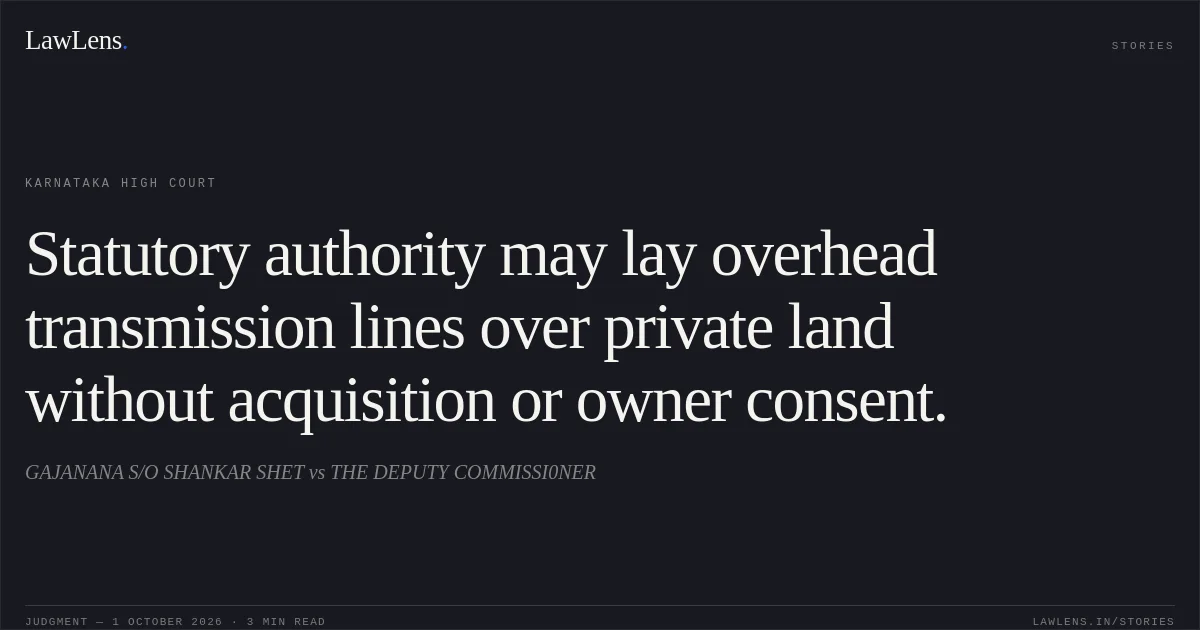
The petitioner, owner of agricultural land bearing Sy. No. 141, Hissa No. 2, challenged a notice dated 14 June 2024 proposing to draw a 110 kV overhead transmission line across his property.
Source reference: para. 1–11No tower was proposed on his land; the towers were on adjoining lands.
Source reference: para. 1–11He alleged that the line would impair residential development potential and that the land should be acquired or his consent obtained.
Source reference: para. 1–11He had earlier withdrawn a civil suit with liberty to pursue an appropriate remedy.
Source reference: para. 1–11The respondents relied on their statutory authority, the public utility purpose of the project, and the proposed alignment; they disputed that the land would become unusable.
Source reference: para. 1–11Issues
Whether the petitioner could have the notice quashed and restrain the transmission line solely because his consent had not been obtained and his land had not been acquired.
Source reference: para. 12Whether the asserted effect on the property’s future residential development potential justified preventing the line from being drawn.
Source reference: para. 22, 27Law Applied
Section 164 of the Electricity Act, 2003, read with the Indian Telegraph Act, 1885, authorizes the placement and maintenance of transmission lines over private property without requiring acquisition of the land as a condition precedent.
Source reference: para. 13–15, 21Under Section 10 of the Telegraph Act, the authority obtains a right of user, not ownership, and must cause as little damage as possible and pay compensation for damage sustained.
Source reference: para. 13–15, 21In Power Grid Corporation of India Ltd. v. Century Textiles and Industries Ltd., (2017) 5 SCC 143, the Supreme Court affirmed this distinction between the right of user and acquisition.
Source reference: para. 14The High Court also relied on Power Grid Corporation of India Ltd. v. M/s Abhishek Developers, W.A. Nos. 1203 of 2022 and connected matter, and W.P. No. 104689 of 2025, for the principles that owner consent is not mandatory in these circumstances and that compensation, rather than obstruction of the line, is the appropriate remedy.
Source reference: para. 16–17, 25A dissatisfied owner may pursue the remedy under Section 16 of the Telegraph Act.
Source reference: para. 16Reasoning
The Court found that the respondents proposed only to draw wires between towers on adjoining lands, not to acquire or take possession of the petitioner’s land.
Source reference: para. 18–21Because the proposed exercise was supported by statutory authority, neither lack of consent nor absence of acquisition made it unlawful; Article 300-A did not require acquisition where the authority exercised a lawful right of user.
Source reference: para. 18–21The petitioner produced no sanctioned layout, conversion order, building plan, or other material establishing an approved residential use or development proposal that the line would frustrate.
Source reference: para. 22–23, 27The Court therefore considered the asserted future development impact insufficient to displace the technical alignment selected for a public utility project.
Source reference: para. 22–23, 27Any actual damage was to be addressed through the statutory compensation mechanism.
Source reference: para. 24–26Holding
The Court dismissed the writ petition, finding no illegality in the notice warranting relief under Articles 226 and 227 of the Constitution.
The dismissal does not prevent the petitioner from seeking compensation for actual damage under the Indian Telegraph Act, 1885; if dissatisfied with the compensation determined, he may pursue the remedy under Section 16.
Source reference: para. 29(i)–(iv)No separate direction was issued concerning his representation to the Deputy Commissioner.
Source reference: para. 29(i)–(iv)Acts & Sections Cited
3 provisions across 2 statutes referred to in this judgment. Each provision opens on LawLens.
Electricity Act, 20031
Indian Telegraph Act, 18852
Original Court PDF
GAJANANA S/O SHANKAR SHETvsTHE DEPUTY COMMISSI0NER
Click to open original judgment
Original judgment, available to read, download and summarize on LawLens.in