Facts
The petitioner was appointed as a Lecturer (Research in Plant Pathology) at Bidhan Chandra Krishi Viswavidyalaya (BCKV) in 1994 and was primarily stationed under the All India Co-ordinated Research Project (AICRP)
Source reference: p. 2Although he was declared a permanent staff of the University in 2011, the State contended his appointment was project-linked and lacked prior State sanction under Section 33A of the BCKV Act, 1974
Source reference: p. 3, 10In 2023, the petitioner sought a transfer to a substantive post in the University’s Department of Plant Pathology to avail himself of the enhanced retirement age of 65 (applicable to regular University teachers) instead of 62 (applicable to AICRP scientists)
Source reference: p. 4-5The State Government refused to approve the transfer and the enhanced superannuation age, leading the petitioner to challenge the orders dated November 10, 2023, and January 17, 2024
Source reference: p. 1, 6Issues
1. Whether an employee appointed under a research project (AICRP) can be equated to a regular "teacher" of the University for the purpose of extending the retirement age to 65 years.
Source reference: p. 4, 152. Whether the University has the autonomous power to transfer a project-linked employee to a substantive sanctioned post without the prior concurrence or approval of the State Government under Section 33A of the BCKV Act, 1974.
Source reference: p. 6, 16Law Applied
Section 33A of the Bidhan Chandra Krishi Viswavidyalaya Act, 1974, which mandates prior approval of the State Government for appointments to posts borne on the University establishment
Source reference: p. 15Definition of "teacher" under Section 2(16) of the Act, which includes persons conducting research, but held this must be read harmoniously with the appointment procedures
Source reference: p. 5, 18Principle from Taylor v. Taylor (1875), asserting that when a statute prescribes a specific mode of action, it must be followed strictly
Source reference: p. 16Doctrine that there can be no estoppel against statute, meaning administrative practice cannot override clear statutory requirements
Source reference: p. 17Reasoning
The court reasoned that while the petitioner performed duties (research and teaching) similar to regular teachers, the source and character of his appointment were determinative
Source reference: p. 15The AICRP is a tripartite arrangement with ICAR providing 75% funding, making it a distinct administrative and funding stream from the University’s regular establishment
Source reference: p. 13, 17The court rejected the petitioner's argument that State approval is unnecessary for transfers to already "sanctioned" posts; it clarified that Section 33A requires State approval for the appointment of a specific person to a post to maintain fiscal control
Source reference: p. 16Despite the University’s support for the petitioner and historical instances of similar transfers, the court held that "functional integration does not imply legal absorption"
Source reference: p. 17Since the petitioner’s initial induction lacked the mandatory State sanction required for regular University cadre, he remained an AICRP scientist governed by different superannuation rules
Source reference: p. 18Holding
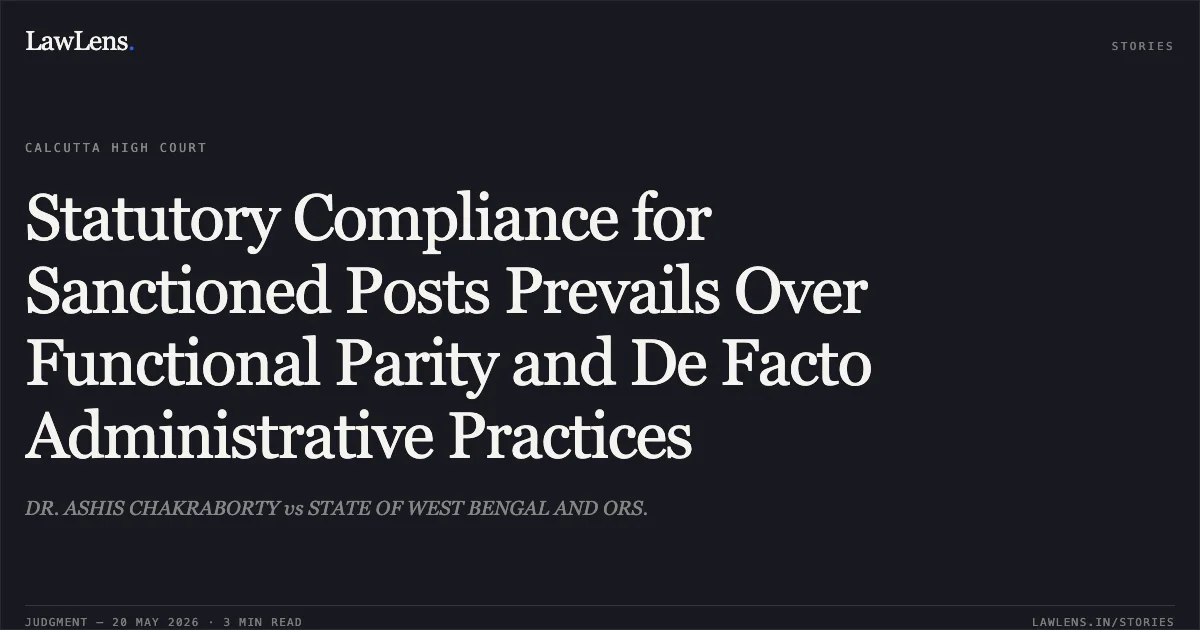
The court held that the petitioner is not a regular "teacher" of the University establishment in the absence of an appointment complying with Section 33A of the BCKV Act
Movement from a project-linked post to a substantive University post constitutes a fresh induction/absorption requiring State approval, not a collateral transfer. Consequently, the petitioner is not entitled to the enhanced retirement age of 65 years. The writ petition was dismissed, and all impugned orders were upheld
Source reference: p. 18, 19Acts & Sections Cited
3 provisions across 1 statute referred to in this judgment. Each provision opens on LawLens.
Bidhan Chandra Krishi Viswa Vidyalaya Act, 19743
Original Court PDF
DR. ASHIS CHAKRABORTYvsSTATE OF WEST BENGAL AND ORS.
Click to open original judgment
Original judgment, available to read, download and summarize on LawLens.in