Facts
The petitioners, as legal heirs of the original lessee B. Ganganna, challenged an endorsement dated 06.03.2019 that rejected their request to extend the validity of quarry lease QL-41
Source reference: p. 3The lease was originally granted in 1996 for five years over 3-20 acres in Sy. No. 26, Maddakkanahalli village—an area classified as a government lake
Source reference: p. 6, 13Following the original lessee’s death in 2000, his widow, Smt. Lokamma, applied for renewal on 04.01.2003, which was significantly past the 90-day statutory deadline prior to the lease's expiry on 27.09.2001
Source reference: p. 7, 20Although intermediate committees recommended renewal and an expert report noted the lake had been dry since 1967, the Deputy Commissioner finally issued an objection in 2015, stating quarrying cannot be permitted on a lake bed
Source reference: p. 8, 14, 10Smt. Lokamma died in 2016, and the petitioners subsequently sought a 50-year deemed extension under the 2023 amendment to the Karnataka Minor Mineral Concession Rules
Source reference: p. 10-11Issues
1. Whether quarrying activities can be legally permitted or renewed in an area designated as a government lake bed
Source reference: para. 282. Whether the petitioners are entitled to the benefit of a "deemed extension" of the lease under Rule 8A of the Karnataka Minor Mineral Concession Rules, 1994, despite the original renewal application being time-barred
Source reference: para. 28Law Applied
Rule 9(2) of the Karnataka Minor Mineral Concession Rules, 1994, which mandates that renewal applications for specified minerals must be filed at least 90 days before the lease expires
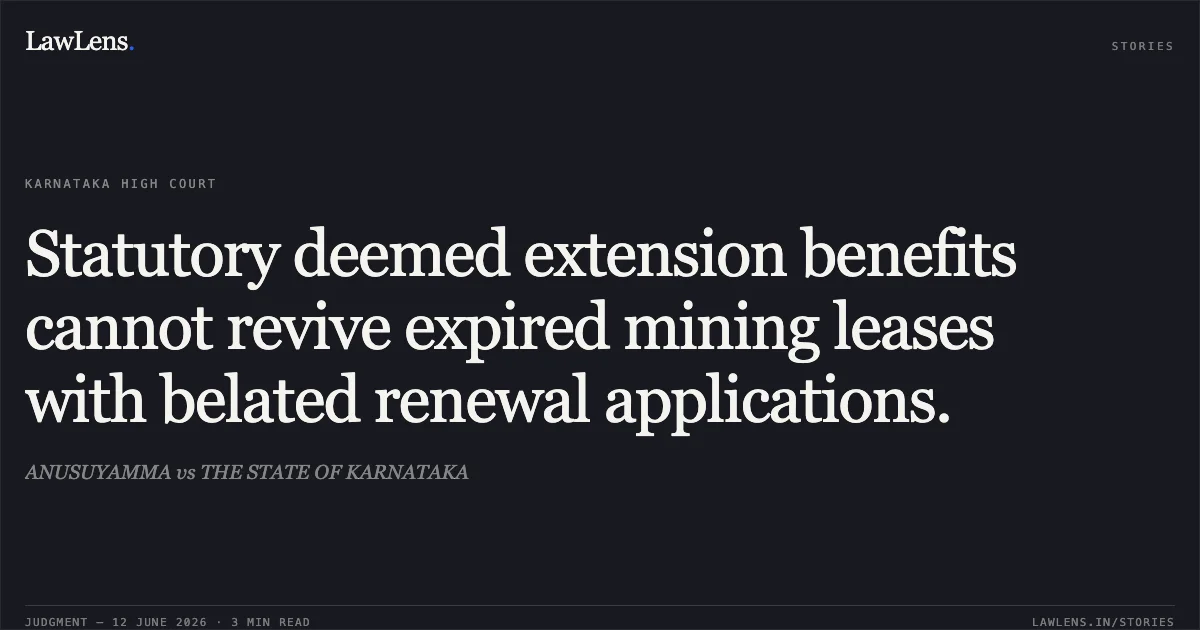
Source reference: p. 20The "deemed extension" under Rule 8A (as amended in 2016 and 2023) applies only to subsisting leases where terms were complied with and renewal applications were filed within the specified legal timeframe as established in G.K. Basavaraju v. State of Karnataka
Source reference: p. 22Environmental principles regarding the protection of water bodies established by the Supreme Court in Hinch Lal Tiwari v. Kamala Devi and followed by the Madras High Court in L. Krishna v. State of Tamil Nadu, which prohibit the diversion of lake beds for commercial activities
Source reference: p. 10Reasoning
The court reasoned that since QL-41 expired on 27.09.2001 and the renewal application was only filed on 04.01.2003, the lease had legally "died," and there is no statutory power to resuscitate an expired lease or condone such delay
Source reference: p. 21The court clarified that the subsequent amendments to Rule 8A providing for 30 or 50-year deemed extensions were intended for active leases and did not revive "dead" leases where the renewal was not sought in time
Source reference: p. 21-22The court held that even if the lake was currently dry or received water only seasonally, it remains a "government lake" in revenue records
Source reference: p. 18The court emphasized that the Deputy Commissioner’s duty to protect water bodies overrides any prior "no-objection" certificates, and a renewal is effectively a fresh grant where the state must consider current environmental protections
Source reference: p. 19Holding
The court held that the petitioners have no vested right to a lease over a government lake bed and the "deemed extension" under Rule 8A is unavailable because the original renewal application was filed after the lease had already expired
The court dismissed the writ petition, concluding QL-41 stood extinguished as of 2001, and no rights survived to be transferred to the petitioners upon Smt. Lokamma's death in 2016
Source reference: p. 24, 23Original Court PDF
ANUSUYAMMAvsTHE STATE OF KARNATAKA
Click to open original judgment
Original judgment, available to read, download and summarize on LawLens.in