Facts
The Appellants (State of Chhattisgarh) challenged the Single Judge's order dated 09.12.2025, which allowed the Respondent’s writ petition.
Source reference: para 4The Respondent, a power producer, had been granted a 12-year electricity duty exemption via a notification dated 12.08.2016, effective until August 2028.
Source reference: para 5Following the Chhattisgarh Electricity Duty (Amendment) Act, 2022, the State sought to recover arrears of duty based on newly amended rates, ignoring the existing exemption.
Source reference: para 5The Single Judge quashed the State’s demand, holding that the exemption remained valid until formally cancelled.
Source reference: para 5The State preferred this writ appeal with a 23-day delay, which was condoned by the Court.
Source reference: para 1-2Issues
Whether the State can demand electricity duty at amended rates under the 2022 Amendment Act while a prior specific exemption notification granted under Section 3B of the Act of 1949 remains in force and uncancelled.
Source reference: para 5Whether the power to amend the schedule of duty rates is distinct from the power to grant or cancel exemptions/relaxations from such duty.
Source reference: para 5Law Applied
The Court primarily applied Section 3B of the Chhattisgarh Electricity Duty Act, 1949 (formerly the CP and Berar Electricity Duty Act), which governs the State's power to grant exemptions from duty.
Source reference: para 5It specifically relied on Section 3B(b), which mandates that any cancellation or withdrawal of a previously notified exemption must be executed through a "like notification".
Source reference: para 5The Court further applied the principle of stare decisis by following its own recent coordinate bench precedent in Writ Appeal No. 213/2026 (decided on 12.03.2026), which dealt with identical facts and legal questions.
Source reference: para 5-6Reasoning
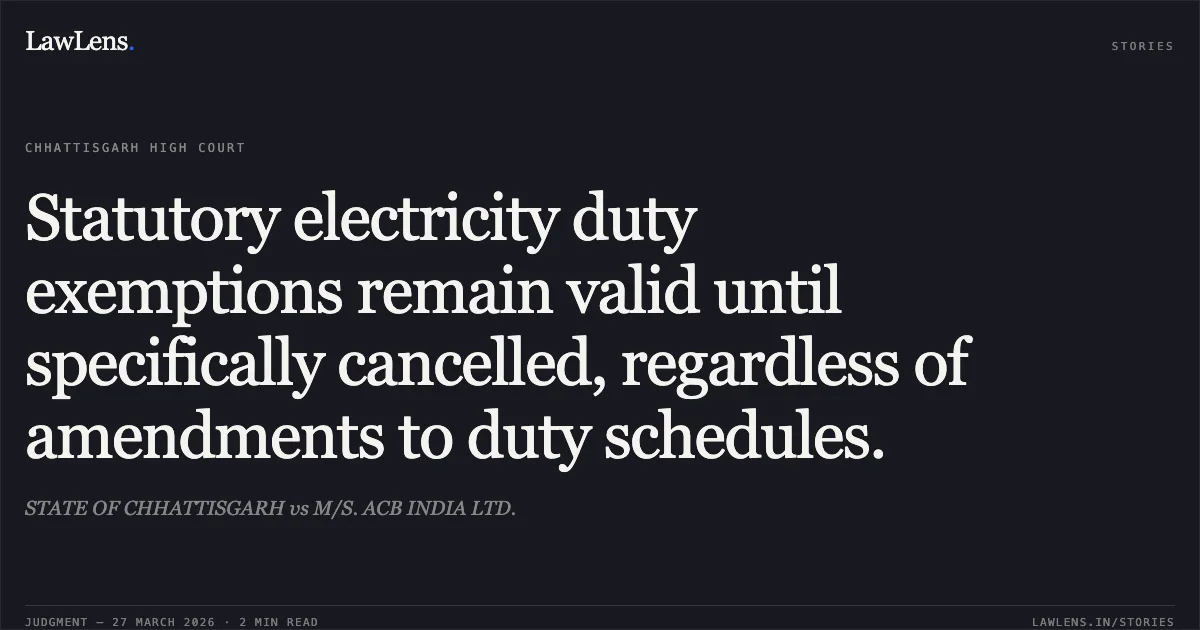
The Court reasoned that the power to amend the rate schedule and the power to grant or revoke exemptions are two separate statutory functions.
Source reference: para 5It observed that once an exemption is granted via notification for a specific period (in this case, 12 years), that exemption does not automatically lapse due to a general amendment in the duty rates.
Source reference: para 5Under Section 3B(b) of the Act, if the State intends to withdraw an exemption in the public interest, it must issue a specific notification clearly stating the cancellation of the earlier notification.
Source reference: para 5In the present case, the State failed to produce any evidence or document showing that the Respondent's specific exemption notification (Annexure P-3) had been formally withdrawn or cancelled.
Source reference: para 5Consequently, the Court held that the Respondent remained entitled to the exemption until 2028, and the demand for duty based on the 2022 Amendment was legally unsustainable.
Source reference: para 5-7Holding
The High Court dismissed the writ appeal, affirming the Single Judge's decision.
The Court held that the demand raised by the State for electricity duty was illegal as the exemption notification was still in force.
Source reference: para 5However, the Court granted the State liberty to recalculate any actual outstanding dues, if applicable, and to raise a fresh demand strictly in accordance with the law and the court’s observations regarding the validity of the existing exemption.
Source reference: para 5Original Court PDF
STATE OF CHHATTISGARHvsM/S. ACB INDIA LTD.
Click to open original judgment
Original judgment, available to read, download and summarize on LawLens.in