Facts
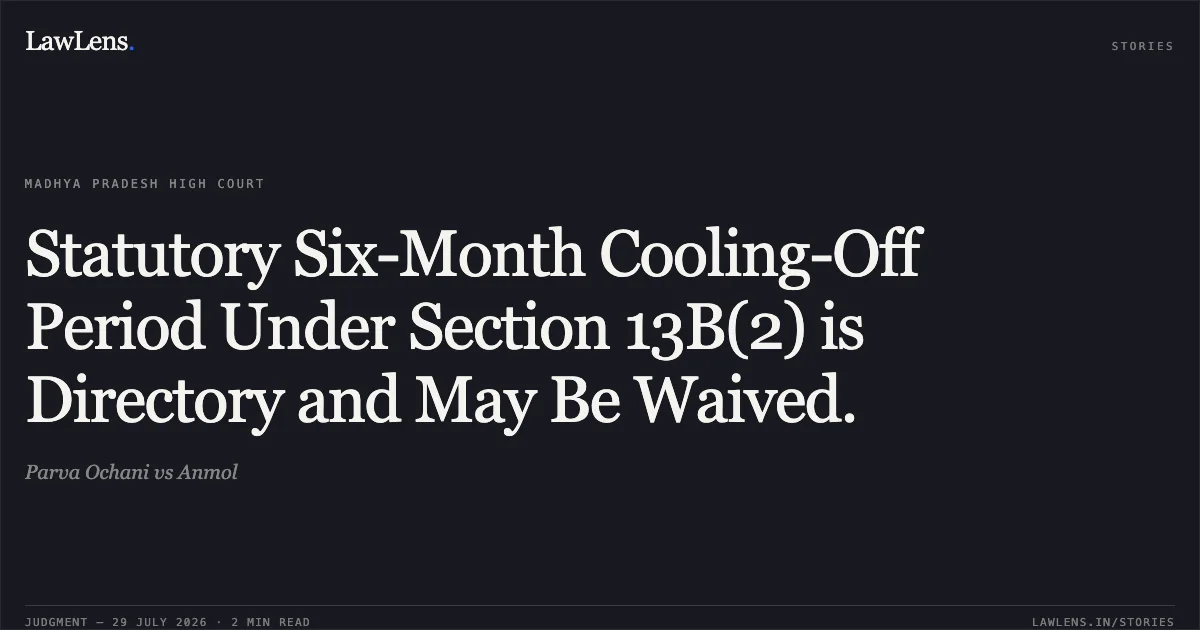
The petitioner challenged an order dated July 8, 2026, passed by the 3rd Additional Principal Judge, Family Court, Indore, in HMC No. 788/2026.
Source reference: para. 2The lower court had rejected an application seeking to waive the statutory "cooling-off" period required for a divorce by mutual consent.
Source reference: para. 6The parties sought the waiver to expedite the dissolution of their marriage under the Hindu Marriage Act.
Source reference: para. 3Issues
1. Whether the statutory waiting period prescribed under Section 13B(2) of the Hindu Marriage Act is mandatory or directory.
Source reference: para. 4, 52. Whether the Family Court erred in refusing to waive the cooling-off period by failing to apply contemporary judicial precedents.
Source reference: para. 6Law Applied
Section 13B of the Hindu Marriage Act, 1955, which outlines the procedure for divorce by mutual consent.
Source reference: para. 3The Supreme Court ruling in Amardeep Singh v. Harveen Kaur, which established that the six-month waiting period is directory, not mandatory, and can be waived if the marriage is irretrievably broken and settlement terms are met.
Source reference: para. 4Amit Kumar v. Suman Beniwal, clarifying that the conditions for waiver are illustrative and that courts should exercise discretion to prevent the prolongation of agony when no chance of reconciliation exists.
Source reference: para. 5Reasoning
The High Court determined that the Family Court’s refusal to waive the cooling-off period was based on outdated legal interpretations.
Source reference: para. 6By analyzing the principles in Amardeep Singh, the Court noted that the primary object of the law is to protect against hurried decisions, not to force the continuation of a purposeless marriage where parties have genuinely settled alimony and custody issues.
Source reference: para. 4The Court found that if the four specific criteria—statutory period compliance, failed mediation, genuine settlement, and the potential for prolonged agony—are considered, the court has the discretion to waive the period.
Source reference: para. 4, 5The Court concluded that the lower court failed to consider these subsequent decisions that transformed the waiting period from a mandatory requirement into a directory guideline.
Source reference: para. 6Holding
The High Court allowed the petition and quashed the impugned order of the Family Court.
The matter was remanded to the Family Court with directions to reconsider the waiver application in light of the cited precedents as expeditiously as possible, preferably within 15 days; and the Court also granted permission for the parties to appear via video conferencing.
Source reference: para. 6, 8Acts & Sections Cited
1 provisions across 1 statute referred to in this judgment. Linked provisions open on LawLens.
Hindu Marriage Act, 19551
Original Court PDF
Parva OchanivsAnmol
Click to open original judgment
Original judgment, available to read, download and summarize on LawLens.in