01Facts
The petitioner was appointed as a Nursing Sister (Senior Nursing Officer) via an order dated February 22, 2022.
¶ 2Clause 8 of the appointment order stipulated a three-year probation period during which the petitioner would receive a staggered "fixed salary": 70% in the first year, 80% in the second year, and 90% in the third year, with full salary payable only upon successful completion.
¶ 2The petitioner challenged this clause, seeking a writ of certiorari to quash the pay structure and a mandamus for full salary and consequential benefits from the date of appointment.
¶ 102Issues
i.1. Whether the condition of paying 70%, 80%, and 90% of the minimum pay scale during the probation period is legally sustainable under the applicable recruitment rules and constitutional principles.
¶ 3ii.2. Whether the state can discriminate between employees appointed via the Public Service Commission and those appointed through other state agencies regarding salary during probation.
¶ 603Law Applied
The Court relied on Rule 8(1) of the Madhya Pradesh Civil Services (General Conditions of Services) Rules, 1961, and the General Administration Department circular dated December 12, 2019.
¶ 6The Court applied the constitutional principle of "Equal Pay for Equal Work".
¶ 6The Court primarily followed the precedent set by the Division Bench in Vinita Tiwari & Ors. v. Indore Municipal Corporation (W.A. No. 2977/2025) and The State of Madhya Pradesh & Ors. v. Dilliraj Bhilala (W.A. No. 1498/2024), which deprecated the practice of paying reduced stipends during probation for non-MPPSC appointees.
¶ 3, 6Provisions in the judgment · 2
order dated 22 02 2022 (P/2) Section 8
circular Section 2
04Reasoning
The Court rejected the State's argument that the petitioner was estopped from challenging the conditions because she accepted the appointment.
¶ 4Relying on the Vinita Tiwari judgment, the Court reasoned that there is no "reasonableness" in creating two distinct classes of probationers—those recruited via PSC (who receive full minimum pay) and those via other agencies (who receive staggered pay).
¶ 6The Court held that if an employee is appointed through a proper channel after due process, they are entitled to the minimum pay scale at par with other employees under the "Equal Pay for Equal Work" doctrine.
¶ 6Consequently, the deduction of salary (stipend) during probation was found to have no logical or legal basis.
¶ 605Holding
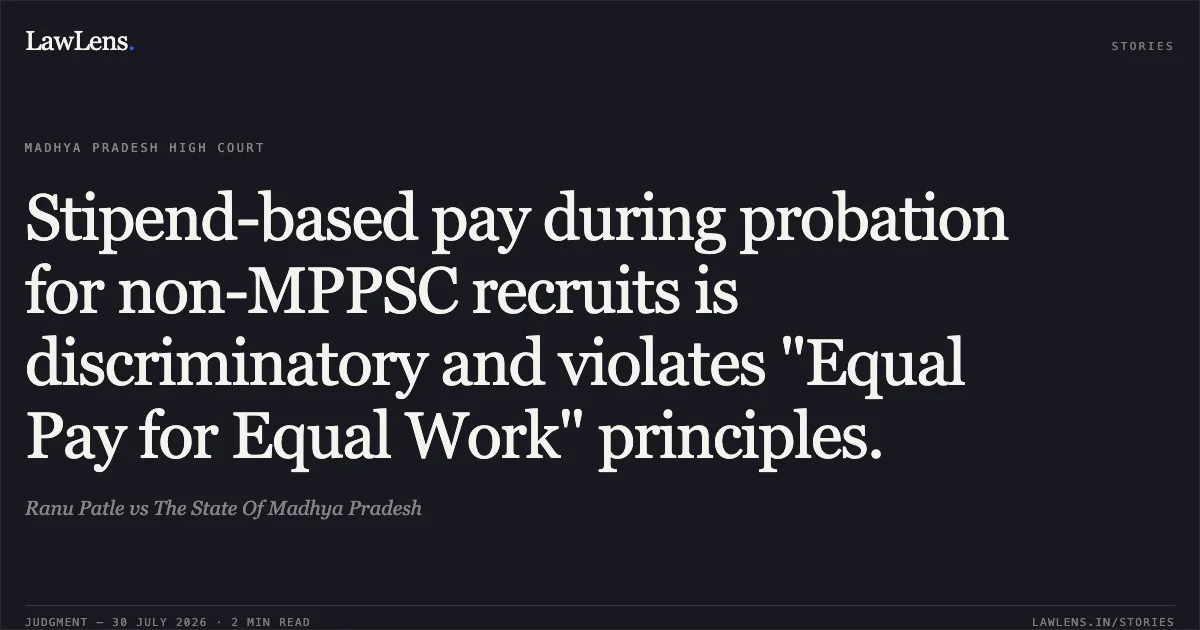
The Court answered the issues in favor of the petitioner, holding that the staggered pay condition was unsustainable.
¶ 7The Court quashed Condition No. 8 of the appointment order dated February 22, 2022 and directed the respondents to pay the petitioner the full admissible salary as per the Rules for the entire duration of the probation from the initial date of appointment.
¶ 7The arrears must be cleared within three months from the receipt of the order. The petition was allowed and disposed of.
¶ 7, 8Original Court PDF
Ranu PatlevsThe State Of Madhya Pradesh
Click to open original judgment
Original judgment, available to read, download and summarize on LawLens.in