Facts
The Respondent No. 1 (Wardha Bank) maintained a current account with the Appellant (YES Bank).
Source reference: p. 3On 24.05.2023, 24 allegedly fraudulent RTGS/NEFT transactions totaling ₹1,21,16,004/- occurred.
Source reference: p. 3-4Wardha Bank filed a complaint before the Adjudicating Officer (AO), Maharashtra, under Sections 43 and 43A of the IT Act.
Source reference: p. 4Following a High Court directive for expeditious disposal, the AO issued a notice for hearing.
Source reference: p. 4Although the Appellant provided four specific, corrected email addresses for communication on 29.10.2024, the AO sent the final hearing notice dated 06.02.2025 to incorrect addresses.
Source reference: p. 5, 6, 9-10Consequently, the Appellant failed to appear at the final hearing.
Source reference: p. 6By an order dated 11.02.2025, the AO directed the Appellant to refund the disputed sum with 18% interest and pay ₹29,83,996/- in compensation.
Source reference: p. 2The Appellant challenged this order on grounds of natural justice violations.
Source reference: p. 2Issues
1. Whether the procedure adopted by the Learned Adjudicating Officer in passing the Impugned Order satisfied the mandatory requirement of a reasonable and effective opportunity of hearing under Section 46(2) of the Information Technology Act, 2000, read with relevant Procedural Rules?
Source reference: p. 8 / para. 9, 412. Whether the order is liable to be set aside on the ground of violation of the Principles of Natural Justice, particularly the doctrine of audi alteram partem?
Source reference: p. 8 / para. 9, 88Law Applied
Section 46(2) of the Information Technology Act, 2000, which mandates a "reasonable opportunity for making representation".
Source reference: p. 18-19Rules 4 and 7 of the IT (Manner of Holding Enquiry) Rules, 2003, which require "sufficient evidence of actual delivery" of electronic notices.
Source reference: p. 22-25The constitutional principle of audi alteram partem as an essential ingredient of Article 14 and 21, citing Maneka Gandhi v. Union of India (procedure must be "right, just and fair").
Source reference: p. 40-41Sahara India v. CIT (civil consequences necessitate natural justice).
Source reference: p. 45-46State Bank of India v. Rajesh Agarwal, establishing that the right to a fair hearing includes the right to know and meet the evidence.
Source reference: p. 47-48Reasoning
The Tribunal found that the AO's office was formally notified of the Appellant’s correct service coordinates on 29.10.2024, yet failed to use them for the final hearing notice.
Source reference: p. 27-29Per Rule 7, electronic service requires proof of delivery, which was absent from the record.
Source reference: p. 25, 29The AO erroneously invoked the ex parte power under Rule 4(h), as valid notice is a condition precedent for such action.
Source reference: p. 30The AO failed to dispose of the Appellant's substantive applications to summon the Investigating Officer and forensic auditors.
Source reference: p. 31-32The duty to act judicially is implicit in Section 46, and a High Court directive for "expeditious disposal" does not authorize the truncation of due process or the bypass of mandatory service rules.
Source reference: p. 33-35, 59The exchange of written pleadings alone did not satisfy the requirement for an effective hearing when oral arguments and evidence were requested.
Source reference: p. 32-33, 50-51Holding
The Tribunal answered both issues in the affirmative.
The Tribunal held that the Impugned Order dated 11.02.2025 was passed in gross violation of the principles of natural justice and statutory procedural requirements.
Source reference: p. 51-52The Tribunal quashed and set aside the order and remitted the matter to the Adjudicating Officer for de novo adjudication on merits, directed to be concluded within four months.
Source reference: p. 74-75The Tribunal issued comprehensive "General Directions" to all Adjudicating Officers nationwide to standardize procedures regarding complaint registration, multi-modal service of notice, hybrid hearings, and the publication of cause lists.
Source reference: p. 66-73Acts & Sections Cited
13 provisions across 5 statutes referred to in this judgment. Each provision opens on LawLens.
Information Technology Act, 20007
Indian Penal Code, 18602
Code of Criminal Procedure, 19732
Code of Civil Procedure, 19081
Telecom Regulatory Authority of India Act, 19971
Original Court PDF
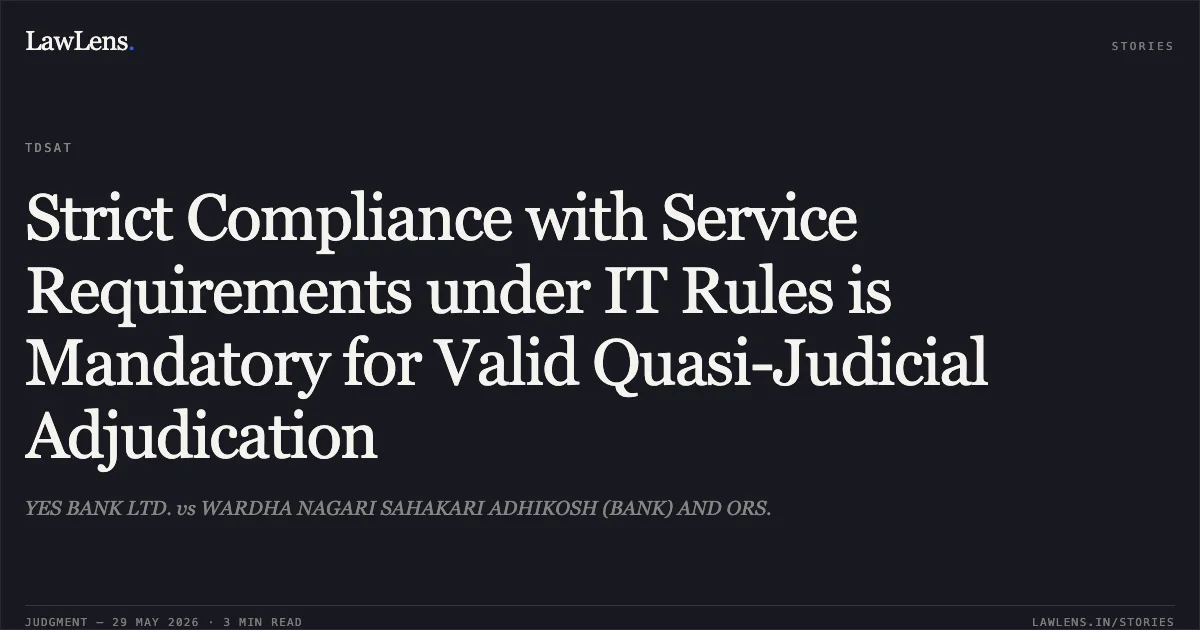
YES BANK LTD.vsWARDHA NAGARI SAHAKARI ADHIKOSH (BANK) AND ORS.
Click to open original judgment
Original judgment, available to read, download and summarize on LawLens.in