Facts
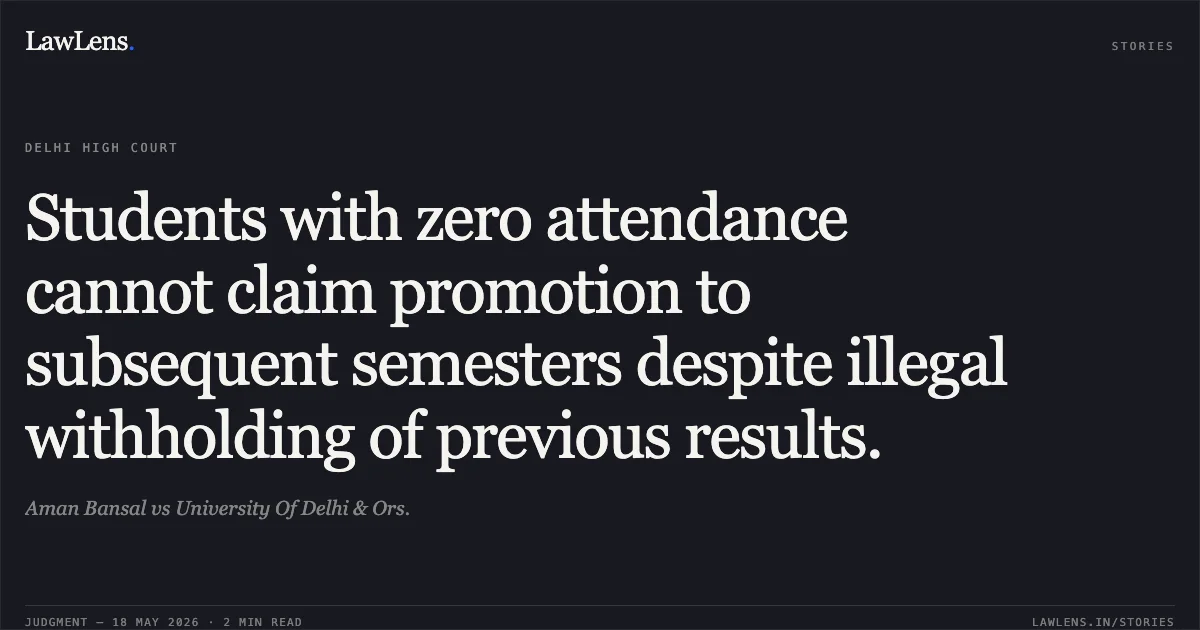
The Appellant, an LL.B. student at the University of Delhi, was detained in Semester-II due to a 27.58% attendance record.
Source reference: p. 3, para 8Though provisionally allowed to sit for Semester-II exams, his results were withheld, leading to a denial of admission into Semester-III.
Source reference: p. 3, para 8Consequently, the Appellant did not attend any Semester-III classes or appear for its exams.
Source reference: p. 3, para 9He subsequently took re-admission in Semester-II in January 2026 to avoid a gap.
Source reference: p. 3, para 9The Single Judge directed the declaration of results but refused promotion to Semester-IV, noting that the Appellant had "nil attendance" for Semester-III.
Source reference: p. 2, para 6; p. 5, para 19Issues
1. Whether a student who has neither attended any classes nor appeared for examinations in a particular semester can claim the right to progress to the subsequent semester.
Source reference: p. 5, para 162. Whether the benefit of the precedent in Courts on its Own Motion Re: Suicide Committed by Sushant Rohilla regarding attendance shortages can be extended to cases of "nil attendance".
Source reference: p. 6, para 21Law Applied
The Court applied the attendance requirements governed by the Bar Council of India (BCI) norms and the University Prospectus, which requires cumulative passing of papers for promotion.
Source reference: p. 4, para 12It relied on the principle established in Harsh Meena & Ors. v. University of Delhi & Ors. [LPA 740/2025], which holds that permitting students who have not attended even a single class to sit for exams would discourage sincere students and reward indiscipline.
Source reference: p. 4, para 14It distinguished the "shortage of attendance" principles in Courts on its Own Motion Re: Suicide Committed by Sushant Rohilla [W.P.(CRL) 793/2017] from cases of total absence.
Source reference: p. 5, para 6Reasoning
The Court reasoned that academic continuity cannot be restored by skipping an entire semester of schooling.
Source reference: p. 7, para 23It noted that while the Appellant’s Semester-II result was withheld, he remained inactive during the Semester-III period and only approached the Court once Semester-IV was already underway.
Source reference: p. 7, para 23The Court emphasized a fundamental distinction between a "shortage of attendance" (where a student participates but falls below the threshold) and "nil attendance" (where the student is entirely absent from the academic process).
Source reference: p. 6, para 21The Court held that allowing a student to bypass a semester without attending a single class—regardless of whether the initial denial of admission was attributable to them—would undermine academic integrity and public perception of legal education.
Source reference: p. 4, para 14; p. 6, para 20Holding
The Court held that the Appellant is not entitled to admission in Semester-IV or supplementary exams for Semester-III because he did not attend any classes for the latter.
The Court dismissed the appeal and upheld the Single Judge's order. No order as to costs was made.
Source reference: p. 7, para 25The Court concluded that the ratio of Sushant Rohilla is confined to attendance shortages and cannot be used to bridge a total academic vacuum.
Source reference: p. 6, para 21Acts & Sections Cited
1 provisions across 1 statute referred to in this judgment. Each provision opens on LawLens.
Limitation Act, 19631
Original Court PDF
Aman BansalvsUniversity Of Delhi & Ors.
Click to open original judgment
Original judgment, available to read, download and summarize on LawLens.in