Facts
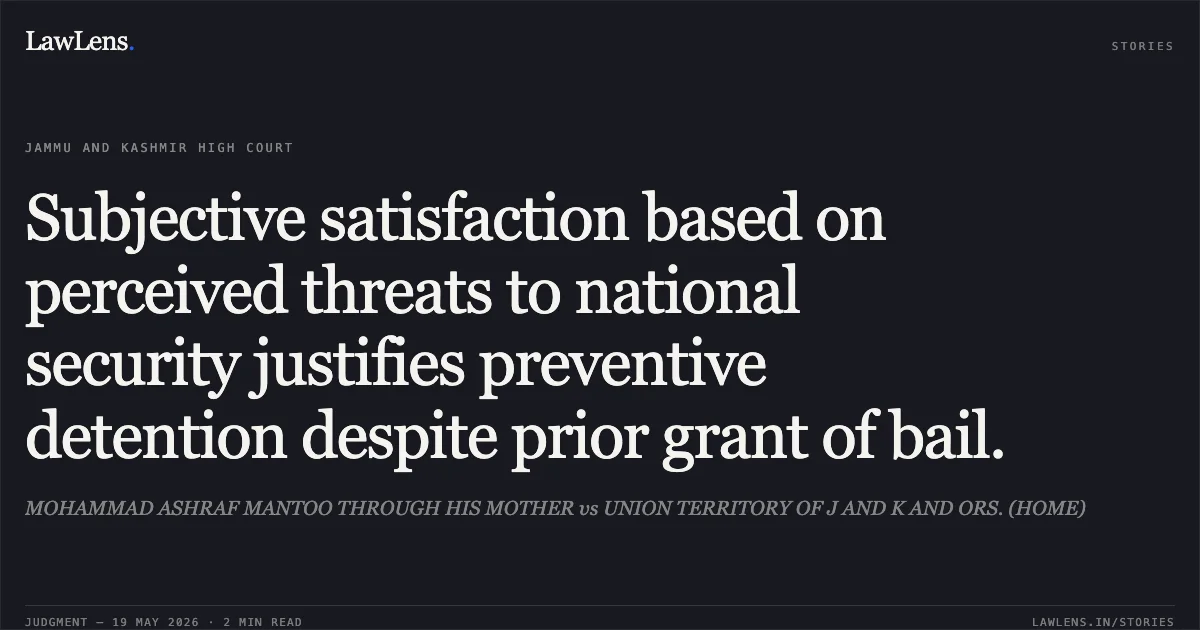
The petitioner, Mohd Ashraf Mantoo, challenged the detention order (No. 12/DMA/PSA/DET/2025) dated 26.04.2025, issued by the District Magistrate, Anantnag, under the Jammu Kashmir Public Safety Act (PSA)
Source reference: p. 2The petitioner was detained to prevent activities prejudicial to the security of the State/UT of J
Source reference: p. 2Despite being granted bail in two prior criminal cases (FIR No. 192/2021 under NDPS Act and FIR No. 94/2022 under UAP Act), the executive alleged he remained affiliated with the banned outfit Lashkar-e-Taiba (LeT), created underground hideouts for terrorists, and facilitated a drug-terror nexus
Source reference: p. 4, 7The petitioner contended the order was passed mechanically without supplying full material or considering his representation
Source reference: p. 2, 4Issues
1. Whether the non-furnishing of the entire material forming the basis of the grounds of detention prevented the petitioner from making an effective representation
Source reference: p. 4 / para. 72. Whether the grounds of detention were a mere "replica" of the police dossier, indicating non-application of mind by the Detaining Authority
Source reference: p. 4 / para. 73. Whether the representation filed on behalf of the detenue was properly considered by the Government
Source reference: p. 4 / para. 7Law Applied
The Court applied the statutory provisions of the Jammu Kashmir Public Safety Act, 1978, regarding preventive detention for the security of the State
Source reference: p. 1, 8It relied on Article 22(5) of the Constitution of India, which mandates that the detaining authority must communicate the grounds of detention and afford the earliest opportunity to make a representation
Source reference: p. 8-9The court further applied the principles of procedural fairness and personal liberty established in Maneka Gandhi v. Union of India, asserting that procedures must be just and fair
Source reference: p. 8Additionally, it cited Ashok Kumar v. Delhi Administration Ors., distinguishing preventive detention (based on suspicion/reasonable probability) from punitive conviction (based on legal evidence)
Source reference: p. 9Reasoning
The Court found that the first contention regarding non-supply of material was belied by the record, which showed the petitioner had received 36 leaves of documents, including the dossier, FIRs, and witness statements
Source reference: p. 5 / para. 9Regarding the second issue, the Court held that a mere reproduction of factual aspects from the police dossier in the grounds of detention does not per se prove non-application of mind, provided the authority draws its own subjective satisfaction
Source reference: p. 5 / para. 10The Court observed that the Detaining Authority had specifically analyzed the "dangerous nexus" between the petitioner’s narcotic trafficking and terrorist networks before concluding that detention was imperative
Source reference: p. 5-6 / para. 10On the third issue, the Court noted from the official records that the petitioner’s representation had indeed been considered and rejected by the Government, with the decision communicated to him on 10.06.2025
Source reference: p. 6 / para. 11Holding
The Court answered all issues in the negative, finding that the procedural safeguards were strictly followed and the Detaining Authority's subjective satisfaction was justified by the petitioner's "incorrigible criminal bent of mind" and "anti-national activities"
The Court held that the security of the State outweighs individual liberty when there is a reasonable probability of activities prejudicial to public safety. The petition was dismissed as being devoid of merit, and the detention order was upheld
Source reference: p. 9, 10Acts & Sections Cited
5 provisions across 2 statutes referred to in this judgment. Each provision opens on LawLens.
Narcotic Drugs and Psychotropic Substances Act, 19852
Unlawful Activities (Prevention) Act, 19673
Original Court PDF
MOHAMMAD ASHRAF MANTOO THROUGH HIS MOTHERvsUNION TERRITORY OF J AND K AND ORS. (HOME)
Click to open original judgment
Original judgment, available to read, download and summarize on LawLens.in