Facts
The petitioner was preventively detained by an order dated 27.12.2025 passed by the Police Commissioner, Surat City, classifying him as a “dangerous person” under Section 2(c) of the Gujarat Prevention of Anti-social Activities Act, 1985 (PASA).
Source reference: para 1The detention was based on two criminal cases registered against the petitioner between 11.12.2025 and 14.12.2025 at Pandesara police station for offenses under Sections 115(2), 118(1), 351(3), 352, 54, 125A, and 296B of the Bhartiya Nyaya Sanhita (BNS) and Section 135 of the G.P. Act.
Source reference: para 7The petitioner had already been granted bail in these cases by the concerned court.
Source reference: para 7.1The petitioner challenged the order through his cousin, arguing it was passed mechanically and without material evidence that his activities disturbed public order.
Source reference: para 4Issues
1. Whether the detention order passed under the Act of 1985 is sustainable in law given the material on record.
Source reference: para 62. Whether the activities of the detenue reached the threshold of being "prejudicial to the maintenance of public order" as opposed to mere "law and order" issues.
Source reference: para 9Law Applied
The court applied Section 2(c) of the Gujarat PASA Act, 1985, which defines a "dangerous person" as one who habitually commits or attempts to commit specified offenses under the IPC/BNS or Arms Act.
Source reference: para 8It relied on the constitutional principle under Article 22(3)(b) that preventive detention is an extraordinary power to be used sparingly.
Source reference: para 9The court heavily cited Dhaya M. v. State of Kerala (AIR 2025 SC 2868), which emphasizes that detention is an exception to Article 21 and should not be used when ordinary criminal law (such as cancellation of bail) provides sufficient remedy.
Source reference: para 9It also referenced Vijay Narain Singh v. State of Bihar regarding the strict construction of preventive detention laws.
Source reference: para 9Reasoning
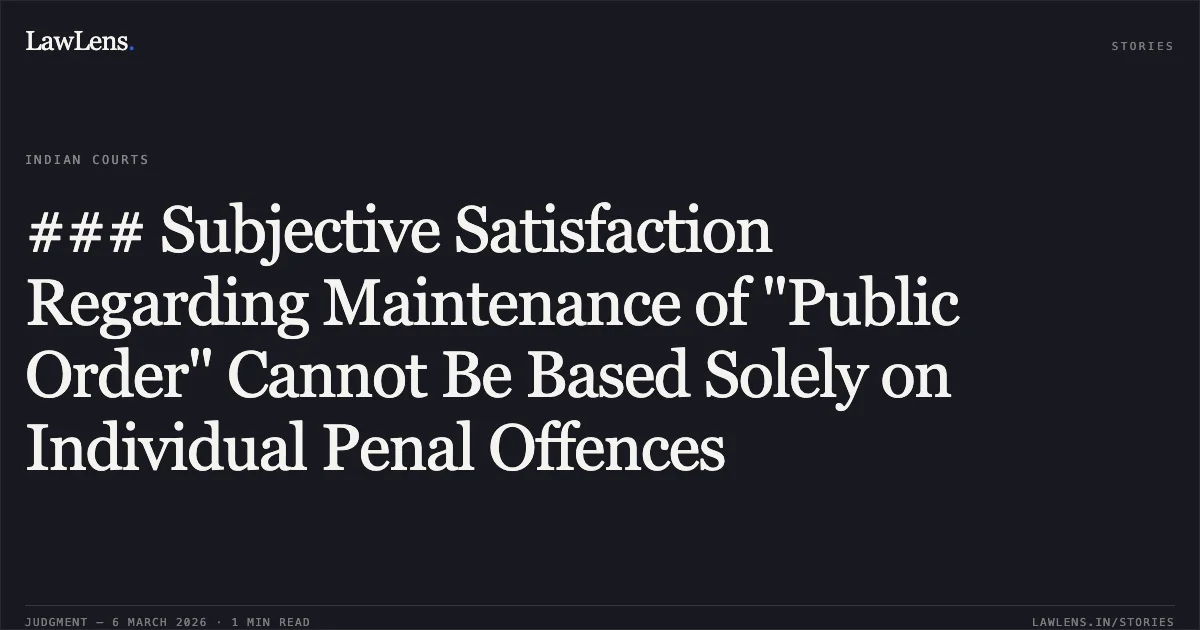
The court found that the detaining authority failed to establish a nexus between the petitioner's criminal cases and a breach of "public order".
Source reference: para 9Reasoning that the subjective satisfaction was flawed, the court noted that the two registered cases were insufficient to conclude that the petitioner’s actions affected society at large rather than being isolated law-and-order incidents.
Source reference: para 9, 10Furthermore, the court observed that since the petitioner was already granted bail, the state should have moved for cancellation of bail under ordinary criminal law instead of resorting to the "extraordinary" and "hard law" of preventive detention to "clip the wings" of the accused.
Source reference: para 9Holding
The court held that the subjective satisfaction arrived at by the detaining authority was not legal, valid, or in accordance with law.
The Court allowed the petition, quashed the detention order dated 27.12.2025, and directed that the detenue be set at liberty forthwith unless required in any other case.
Source reference: para 11Rule was made absolute.
Source reference: para 11Acts & Sections Cited
11 provisions across 3 statutes referred to in this judgment. Each provision opens on LawLens.
Gujarat Prevention of Anti-social Activities Act, 19851
Bharatiya Nyaya Sanhita, 20237
Indian Penal Code, 18603
Original Court PDF
Rajnish @ Lambu S/o. Rajubhai Rajbhar v. State of Gujarat & Ors.; R/Special Criminal Application No. 2180 of 2026
Click to open original judgment
Original judgment, available to read, download and summarize on LawLens.in