Facts
The Revenue appealed against Tribunal orders that quashed assessment and revisional proceedings for the Assessment Years 2017-18 and 2011-12.
Source reference: no citationIn ITA No. 55/2024, the Dispute Resolution Panel (DRP) directions were communicated without a Document Identification Number (DIN), followed by a second communication containing the DIN.
Source reference: paras 4-4.2In ITA No. 216/2023, a revisional order under Section 263 was similarly issued without a DIN, but an intimation letter with the DIN was generated and served on the same day.
Source reference: paras 5-5.2The Tribunal held these orders invalid for violating CBDT Circular No. 19/2019, which mandates that every communication must bear a computer-generated DIN to be valid.
Source reference: paras 4.2 & 5.2The Revenue argued that technical glitches during uploading caused the initial DIN-less communication, but subsequent intimation letters ensured substantial compliance.
Source reference: paras 27-30Issues
1. Whether the Tribunal was right in law in quashing assessment/revisional orders when the DIN was duly generated and communicated through a separate intimation letter shortly after the initial order.
Source reference: para 3 & 3.12. Whether the communication of an order without a DIN, followed by an intimation letter containing the DIN, constitutes sufficient compliance with CBDT Circular No. 19/2019.
Source reference: para 193. Whether a typographical error in manually quoting the DIN on the order (e.g., quoting the intimation letter's DIN instead of the order's DIN) invalidates the proceedings.
Source reference: para 41Law Applied
The court primarily interpreted CBDT Circular No. 19/2019, which mandates the quoting of a Document Identification Number (DIN) in the body of every communication to ensure a proper audit trail and transparency.
Source reference: para 20-21Instruction No. 5 (2019) issued by the Directorate of Income Tax (Systems), which prescribes the procedure for generating DINs for manually prepared documents uploaded to the ITBA portal.
Source reference: para 37The court applied the principle of "substantial compliance," holding that procedural requirements must be interpreted to advance the underlying objective of the law—in this case, maintaining an audit trail—rather than defeating it due to technical glitches.
Source reference: paras 31-33Reasoning
The Court found that the ITBA (Income Tax Business Application) system automatically communicates a document once uploaded for DIN generation, often leading to an initial communication without the DIN.
Source reference: paras 27 & 29Since the Revenue immediately issued separate intimation letters—which themselves bore a DIN and specifically referenced the DIN of the subject order—the "audit trail" intended by the Circular was maintained.
Source reference: paras 32-33The Court rejected the Assessees’ claim that prior approval from the Chief Commissioner was required for such "manual" issuance; it held that since the orders were issued electronically via the ITBA portal, they did not fall under the "exceptional manual issuance" category requiring prior written approval.
Source reference: paras 34-35Regarding the incorrect DINs manually typed on the physical orders, the Court ruled these were mere typographical errors. Since the accompanying intimation letters contained the correct, verifiable DINs, the authenticity of the orders was preserved.
Source reference: paras 43-46Holding
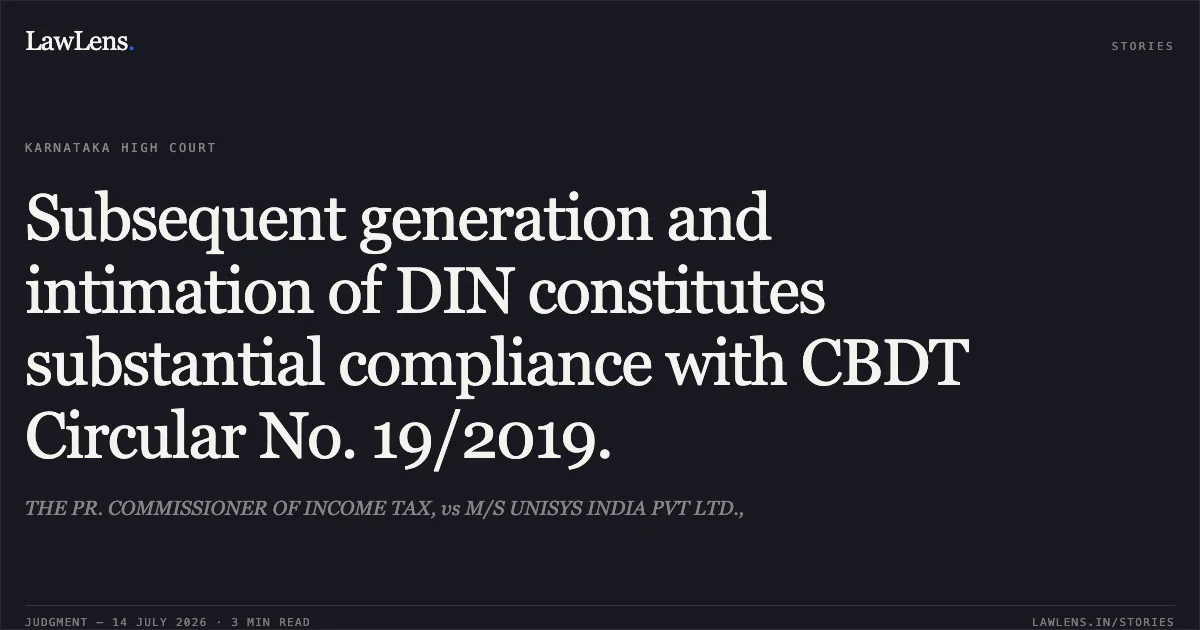
An order is only invalid under Circular No. 19/2019 if no DIN is generated or communicated at all; subsequent communication of a DIN through an intimation letter satisfies the mandatory requirement of the Circular.
The Court answered the substantial questions of law in favor of the Revenue and set aside the Tribunal's orders, remitting the matters to the ITAT for adjudication on the merits of the respective cases.
Source reference: para 47 & Order (iv)Acts & Sections Cited
7 provisions across 1 statute referred to in this judgment. Linked provisions open on LawLens.
Income Tax Act, 19617
Original Court PDF
THE PR. COMMISSIONER OF INCOME TAX,vsM/S UNISYS INDIA PVT LTD.,
Click to open original judgment
Original judgment, available to read, download and summarize on LawLens.in