Facts
The complainant, wife of the deceased, alleged that the appellants (a police Officer-in-Charge and a Constable) murdered her husband during State Assembly elections at the instance of an Assistant Commissioner of Police (ACP)
Source reference: para. 2(i)The Magistrate took cognizance in 2001 and summoned the accused
Source reference: para. 2(ii)The ACP successfully moved the Supreme Court in 2006, which quashed the proceedings against him for want of sanction under Section 197(1) of the Cr.P.C., as he was a public servant removable only by the Government
Source reference: para. 2(iii)-(v)Following this, the Magistrate extended the same benefit to the appellants and halted proceedings
Source reference: para. 2(vi)The High Court reversed this order, holding that the previous Supreme Court decision applied only to the ACP
Source reference: para. 2(viii)The appellants challenged this before the Supreme Court, citing a 2010 West Bengal Government notification that extended Section 197 protection to all subordinate police ranks
Source reference: para. 4Issues
1. Whether the appellants, as co-accused holding subordinate ranks, are entitled to the benefit of the Supreme Court’s decision in Sankaran Moitra v. Sadhana Das regarding the requirement of prior sanction?
Source reference: para. 6 / para. 72. Whether the benefit of the State Government notification dated 19.11.2010, issued under Section 197(3) of the Cr.P.C., would be available to the appellants in a case where cognizance was taken prior to the notification?
Source reference: para. 6 / para. 11Law Applied
The court primarily applied Section 197 of the Cr.P.C., which bars courts from taking cognizance of offences alleged against certain public servants acting in official duty without government sanction
Source reference: para. 7It relied on Nagraj v. State of Mysore and Fakhruzamma v. State of Jharkhand to establish that Section 197(1) protection is limited to public servants removable only by or with the sanction of the Government
Source reference: para. 9The court further applied the principle from Baijnath v. State of M.P., which posits that the legal bar on cognizance must be assessed at the time the court exercises its power to take cognizance; a valid cognizance order cannot be nullified by a subsequent notification unless expressly provided
Source reference: para. 14Reasoning
The court reasoned that the appellants, being subordinate rank officers at the time of cognizance, were removable by authorities other than the State Government (e.g., the Inspector General of Police), thus excluding them from the protection of Section 197(1) enjoyed by their co-accused ACP
Source reference: para. 10Regarding the 2010 notification, the court emphasized that the bar under Section 197 operates specifically at the stage of "taking cognizance"
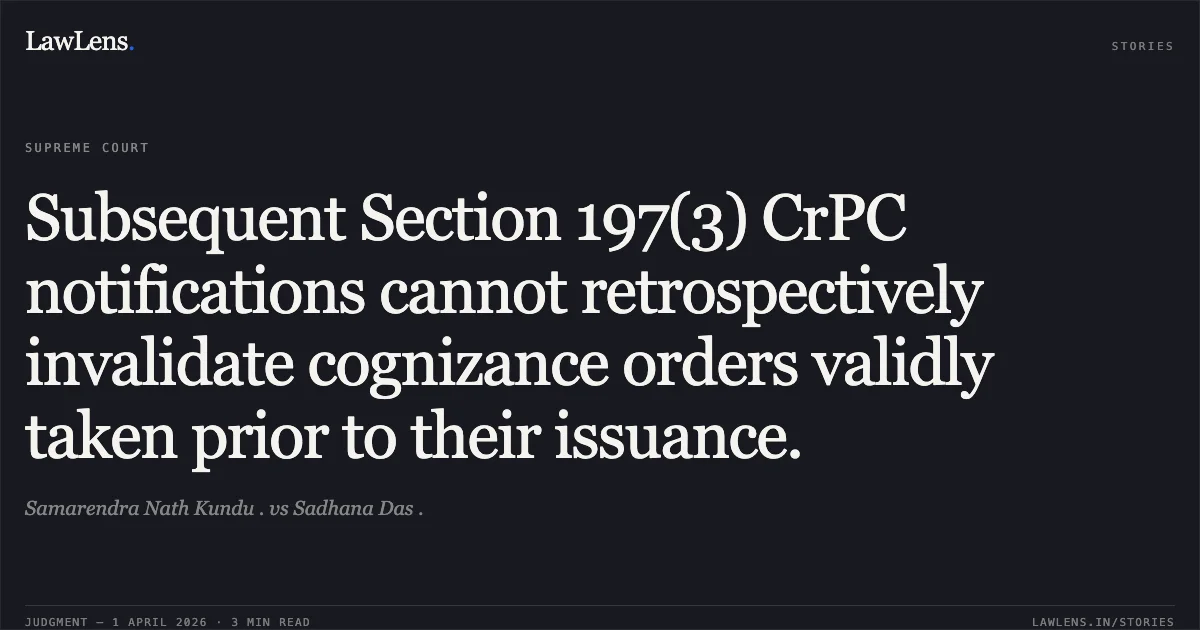
Source reference: para. 14Since the Magistrate had already validly taken cognizance in 2001—a period when no such protection existed for subordinate ranks—the subsequent 2010 notification could not retroactively invalidate the proceedings
Source reference: para. 14-15The court clarified that a post-cognizance change in the law regarding sanction does not affect a trial where the initial cognizance was legally sound
Source reference: para. 14Holding
The Supreme Court dismissed the appeal, holding that the appellants were not entitled to the protection of Section 197 of the Cr.P.C.
The Court answered the first issue by clarifying that the Sankaran Moitra precedent was rank-specific and did not apply to subordinate officers removable by non-governmental authorities
Source reference: para. 10On the second issue, it held that the 2010 notification is prospective and does not affect cases where cognizance was validly taken before its issuance
Source reference: para. 15The Court discharged any interim orders and directed the trial to proceed while refraining from commenting on the merits of the murder allegations
Source reference: para. 15-16Acts & Sections Cited
7 provisions across 2 statutes referred to in this judgment. Each provision opens on LawLens.
Code of Criminal Procedure, 19733
Indian Penal Code, 18604
Original Court PDF
Samarendra Nath Kundu .vsSadhana Das .
Click to open original judgment
Original judgment, available to read, download and summarize on LawLens.in