Facts
The appellants are landowners whose property in Mavanoor Village was acquired for the Hubballi-Ankola Broad Gauge Line via a notification dated 18.04.2002
Source reference: para 4The Land Acquisition Officer (LAO) awarded compensation at ₹40,000/- per acre on 31.03.2003
Source reference: para 4While the appellants did not seek a reference under Section 18 of the Land Acquisition Act, 1894 ("the Act"), other landowners did, resulting in the Reference Court enhancing the amount to ₹2,00,000/- per acre on 17.11.2006
Source reference: para 4On 01.02.2007, the appellants filed their first application under Section 28-A seeking re-determination based on this Reference Court award
Source reference: para 5During the pendency of this application, appeals were filed in the High Court; however, the LAO allowed the appellants' first application on 02.04.2013, despite the pendency of landowner appeals
Source reference: para 5Subsequently, on 22.07.2013, the High Court further enhanced the compensation to ₹3,50,000/- per acre
Source reference: para 5The appellants then filed a second Section 28-A application on 25.11.2013 to claim parity with the High Court’s award
Source reference: para 6The LAO rejected this second application, and while a Single Judge of the High Court quashed the rejection, a Division Bench reversed the decision, holding that Section 28-A applies only to awards by a Court of original jurisdiction and not appellate decrees
Source reference: para 7-9Issues
1. Whether the term "Court" under Section 28-A of the Act is restricted to the Principal Civil Court of original jurisdiction or includes Appellate Courts like the High Court and Supreme Court
Source reference: para 142. Whether a second application for re-determination of compensation under Section 28-A is maintainable based on an enhancement by an Appellate Court, even if the claimant previously received an enhancement based on a Reference Court award
Source reference: para 253. Whether the decision in Ramsingbhai Jerambhai v. State of Gujarat (2018), which restricted Section 28-A to Reference Court awards, constitutes a binding precedent
Source reference: para 23-24Law Applied
The Court primarily applied Section 28-A of the Land Acquisition Act, 1894, which provides for the re-determination of compensation for non-referencing landowners to ensure parity with similarly placed owners
Source reference: para 12-14It interpreted the definition of "Court" under Section 3(d) in conjunction with Section 54 (Appeals), concluding that appellate decrees are continuations of the original proceedings
Source reference: para 13, 15The Court relied on the "Doctrine of Merger," which posits that a lower court's decree merges into the operative decree of the superior court
Source reference: para 16Regarding precedents, the Court followed Union of India v. Pradeep Kumari (1995), which advocated for a beneficial construction of Section 28-A to remove inequalities
Source reference: para 17-18and applied the per incuriam rule to Ramsingbhai Jerambhai v. State of Gujarat (2018) for its failure to consider Pradeep Kumari and the Act's objective
Source reference: para 23-24Reasoning
The Supreme Court reasoned that the Act is dual-natured, being expropriatory regarding acquisition and beneficial regarding compensation
Source reference: para 12The Court rejected the narrow interpretation of "Court" in Section 28-A, noting that if parity is the objective, it must extend to the final judicial determination, whether by a Reference Court or an Appellate Court
Source reference: para 14Applying the Doctrine of Merger, the Court held that once the High Court enhances an award, the Reference Court's award ceases to exist independently and is subsumed by the appellate decree
Source reference: para 15-16The Court clarified that the "only one application" rule established in Pradeep Kumari was intended to prevent multiple applications based on different awards from the same Reference Court level, not to bar an application seeking the benefit of a subsequent appellate enhancement
Source reference: para 18, 26The Court further noted that the LAO erred by deciding the first application while appeals were pending, contrary to the stay-of-hands principle established in Babua Ram v. State of U.P. (1995)
Source reference: para 17, 27Finally, the Court held that statutory prescriptions for parity override principles of estoppel or waiver in this context
Source reference: para 26Holding
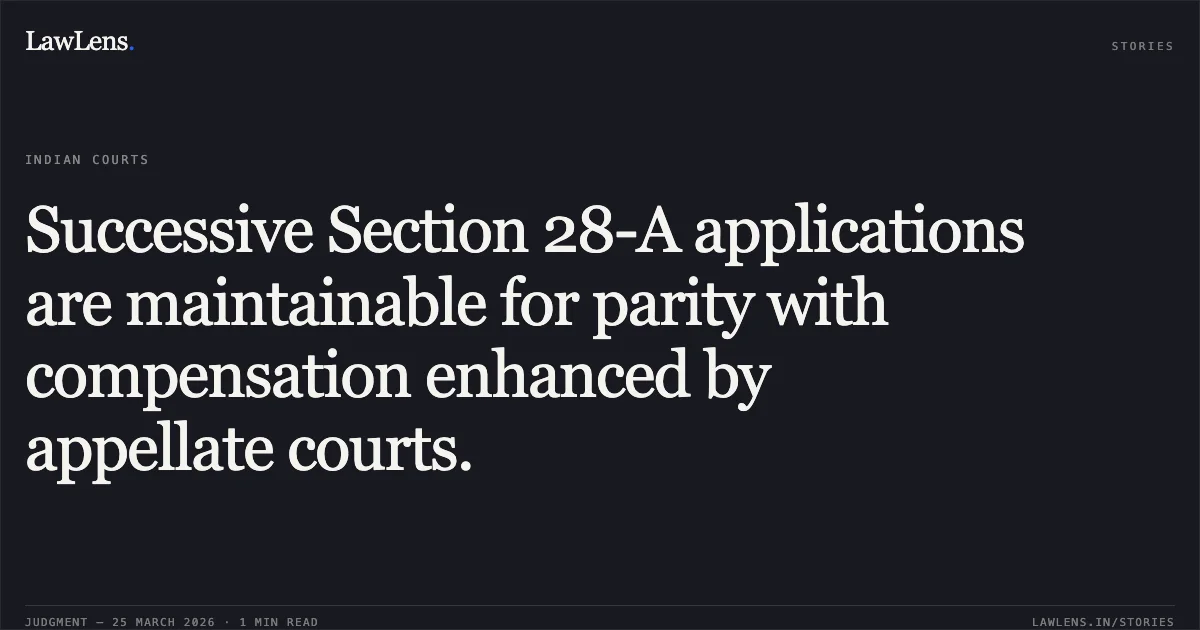
The Supreme Court allowed the appeals, holding that a second Section 28-A application is maintainable to claim parity with an Appellate Court’s enhancement, regardless of the prior receipt of compensation based on a Reference Court award
The Court set aside the High Court Division Bench's judgment and the LAO's rejection order dated 30.11.2013
Source reference: para 28It directed the respondents to re-determine the compensation in favor of the appellants based on the High Court’s enhanced rate of ₹3,50,000/- per acre within eight weeks
Source reference: para 28The decision in Ramsingbhai Jerambhai was formally declared not to be a binding precedent
Source reference: para 23Acts & Sections Cited
1 provisions across 1 statute referred to in this judgment. Each provision opens on LawLens.
Code of Civil Procedure, 19081
Original Court PDF
AndanayyavsDeputy Chief Engineer
Click to open original judgment
Original judgment, available to read, download and summarize on LawLens.in