Facts
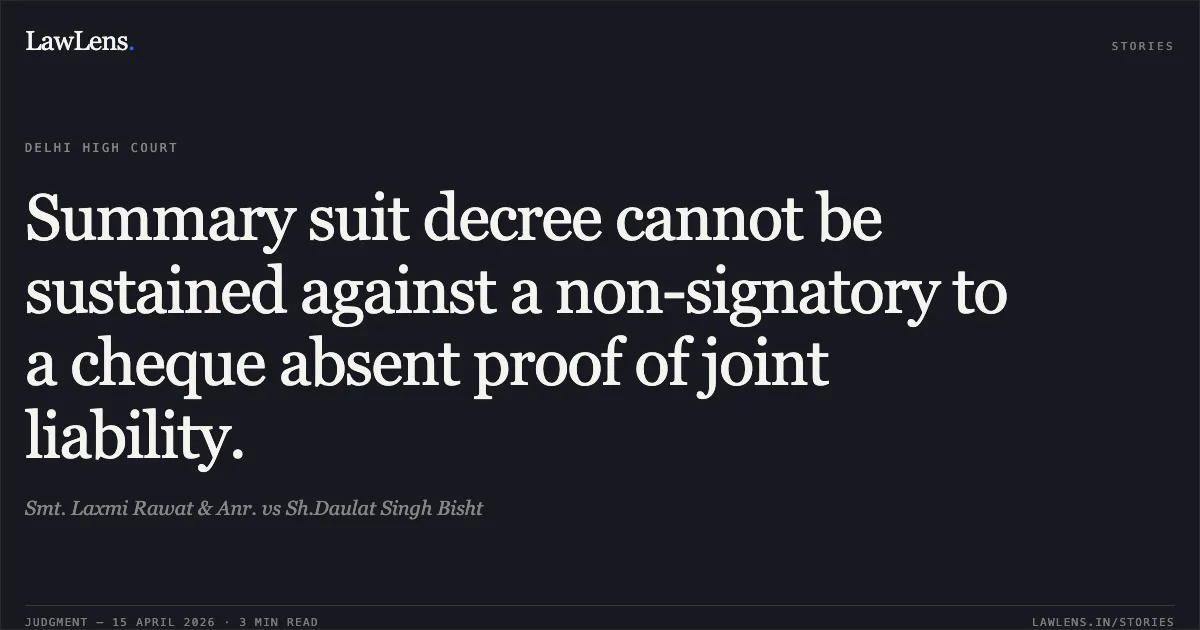
The Respondent (Plaintiff) filed a summary suit under Order XXXVII of the CPC for the recovery of ₹6,00,000/- against the Appellants (Defendants), who are husband and wife
Source reference: para 2The Plaintiff alleged that he provided a loan of ₹6,00,000/- to the Appellants on July 10, 2016
Source reference: para 4Appellant No. 1 (Smt. Laxmi Rawat) issued a post-dated cheque in 2016, which was later replaced by another cheque dated August 14, 2018, on the instructions of Appellant No. 2 (Sh. Dinesh Singh Rawat)
Source reference: para 5, 8The 2018 cheque was returned unpaid with the remark "Account closed"
Source reference: para 8The Appellants sought leave to defend under Order XXXVII Rule 3(5) CPC
Source reference: para 12Appellant No. 1 contended that the cheques were stolen in July 2016 after she was sedated by a stranger, an incident reported to the police
Source reference: para 15, 17Appellant No. 2 denied any involvement in the transaction
Source reference: para 19The Trial Court (ADJ) dismissed the application for leave to defend, holding the "stolen cheque" defense to be moonshine, and decreed the suit against both Appellants
Source reference: para 20The Appellants challenged this judgment under Section 96 of the CPC
Source reference: para 1Issues
1. Whether the defense raised by Appellant No. 1 regarding the theft of signed cheques constituted a "substantial defense" necessitating the grant of leave to defend?
Source reference: para 26-272. Whether Appellant No. 2 could be held liable for recovery in a summary suit based on a cheque signed exclusively by Appellant No. 1?
Source reference: para 29-30Law Applied
The court primarily applied the summary procedure under Order XXXVII of the Code of Civil Procedure (CPC), specifically Rule 3(5) regarding the conditions for granting leave to defend
Source reference: para 12It also exercised appellate jurisdiction under Section 96 of the CPC
Source reference: para 1The court relied on the principle that in summary suits based on negotiable instruments, a defendant must disclose a triable issue or a fair/substantial defense to obtain leave; a defense that is an "afterthought" or lacks "cogent evidence" does not suffice to prevent a decree
Source reference: para 26, 30Reasoning
Regarding Appellant No. 1, the Court found the defense of "stolen cheques" to be inherently unbelievable.
Source reference: para 26The alleged theft occurred in 2016, yet the cheque in question was dated August 14, 2018; the Court reasoned that it was "blatantly evident" that the defense was an afterthought intended to evade liability for a signed instrument
Source reference: para 26The Court concurred with the Trial Court that a person keeping signed blank cheques does so at their own peril and that claiming theft is a common but often baseless trend in recovery suits
Source reference: para 20, 27However, regarding Appellant No. 2, the Court found that the suit was based on a document (the cheque) executed solely by Appellant No. 1
Source reference: para 29The Plaintiff’s claim that the loan was taken "jointly" was a "bald assertion" unsupported by evidence or cause of action against the husband
Source reference: para 30Since the summary suit was rooted in the cheque issued by the wife, the husband could not be held liable in the absence of his signature or a proven joint liability
Source reference: para 30Holding
The High Court partly allowed the appeal.
It upheld the decree against Appellant No. 1 (Smt. Laxmi Rawat), affirming that her leave to defend was rightly dismissed as her defense lacked merit
Source reference: para 31-32Conversely, the Court allowed the leave to defend for Appellant No. 2 (Sh. Dinesh Singh Rawat) and simultaneously dismissed the recovery suit against him, holding that no cause of action was disclosed against him as he was not a signatory to the cheque
Source reference: para 30, 32The decree of the Trial Court was modified to apply only to Appellant No. 1
Source reference: para 32Acts & Sections Cited
3 provisions across 2 statutes referred to in this judgment. Each provision opens on LawLens.
Code of Civil Procedure, 19082
Negotiable Instruments Act, 18811
Original Court PDF
Smt. Laxmi Rawat & Anr.vsSh.Daulat Singh Bisht
Click to open original judgment
Original judgment, available to read, download and summarize on LawLens.in