Facts
The Municipal Corporation, Chandigarh, conducted a recruitment exam for one post of Law Officer, where selection was based solely on a written test
Source reference: para. 3A dispute arose regarding Question No. 73, which asked which Constitutional Schedule is immune from judicial review on the grounds of violating fundamental rights
Source reference: para. 4The recruiting body identified "Option B (Ninth Schedule)" as correct, whereas the third respondent, Amit Kumar Sharma, selected "Option D (None of the above)"
Source reference: para. 5The third respondent’s score was reduced due to negative marking, leading him to challenge the results.
Source reference: para. 5-6The learned Single Judge dismissed the writ petition, holding that Article 31B still provides immunity as upheld in Shankari Prasad and Kesavananda Bharati
Source reference: para. 5-6However, the Division Bench of the High Court reversed this, ruling that per I.R. Coelho, no Schedule is absolutely immune from judicial review if it violates the basic structure of the Constitution
Source reference: para. 7The appellant, who had already joined the post, appealed the Division Bench's decision
Source reference: para. 2, 8Issues
1. Whether Option ‘B’ (Ninth Schedule) or Option ‘D’ (None of the above) is the correct answer to the question regarding the judicial immunity of Constitutional Schedules
Source reference: para. 102. Whether a candidate can be expected to provide a definitive answer to a complex question of constitutional interpretation in a multiple-choice recruitment exam
Source reference: para. 103. What relief should be granted to balance the equities between the selected candidate and the high-ranking respondent
Source reference: para. 11Law Applied
The Court considered Article 31B of the Constitution, which provides for the validation of certain Acts included in the Ninth Schedule
Source reference: para. 5It referenced a line of precedents including Shankari Prasad Singh Deo v. Union of India and Sajjan Singh v. State of Rajasthan, which initially upheld the immunity of the Ninth Schedule
Source reference: para. 5It further noted the shift in C. Golak Nath v. State of Punjab and the eventual establishment of the Basic Structure doctrine in Kesavananda Bharati v. State of Kerala
Source reference: para. 5Crucially, the Court relied on I.R. Coelho (Dead) by LRs v. State of T.N., which clarified that while Article 31B provides certain immunities, Ninth Schedule laws are subject to judicial review if they violate fundamental rights that form part of the "basic features" of the Constitution
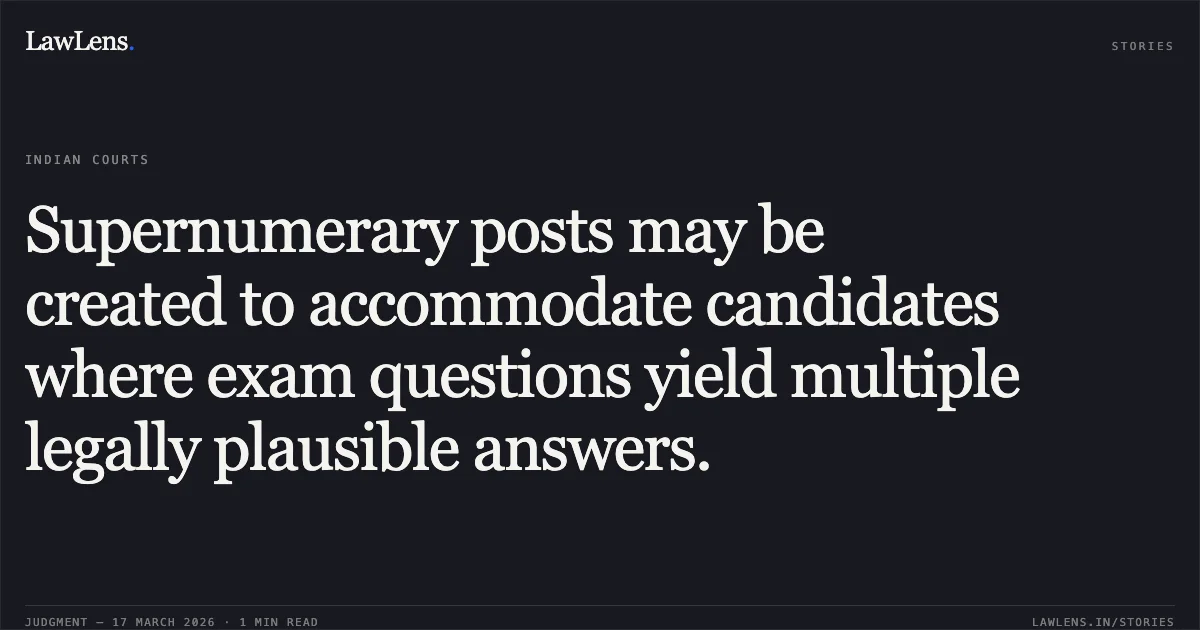
Source reference: para. 6-7Finally, it applied the principle from Vikas Pratap Singh v. State of Chhattisgarh regarding the creation of supernumerary posts to balance equities
Source reference: para. 8Reasoning
The Supreme Court observed that the "correctness" of the answer depended on the level of legal interpretation applied
Source reference: para. 10From a literal reading of Article 31B, Option ‘B’ appeared appropriate; however, a deeper jurisprudential analysis based on I.R. Coelho supported Option ‘D’, as no schedule enjoys absolute immunity
Source reference: para. 10The Court emphasized that when High Court judges themselves differ in their interpretation of the correct answer, it is unreasonable to expect law graduates in a competitive exam to reach a singular conclusion on such complex, decades-old constitutional jurisprudence
Source reference: para. 10Consequently, the Court found merit in both positions and determined that penalizing a candidate for a nuanced interpretation of law was inequitable
Source reference: para. 10Holding
The Supreme Court held that both candidates deserved accommodation due to the ambiguity of the question and the complexity of the law
The Court directed the Municipal Corporation, Chandigarh, to create a supernumerary post to appoint the third respondent while allowing the appellant to remain in his current post
Source reference: para. 11The appellant, having joined first, is to be treated as senior to the third respondent
Source reference: para. 11The appeal was disposed of with these directions to balance the constitutional rights of the deserving candidate with the job security of the already appointed officer
Source reference: para. 12Original Court PDF
Charan Preet SinghvsMunicipal Corporation Chandigarh
Click to open original judgment
Original judgment, available to read, download and summarize on LawLens.in