Facts
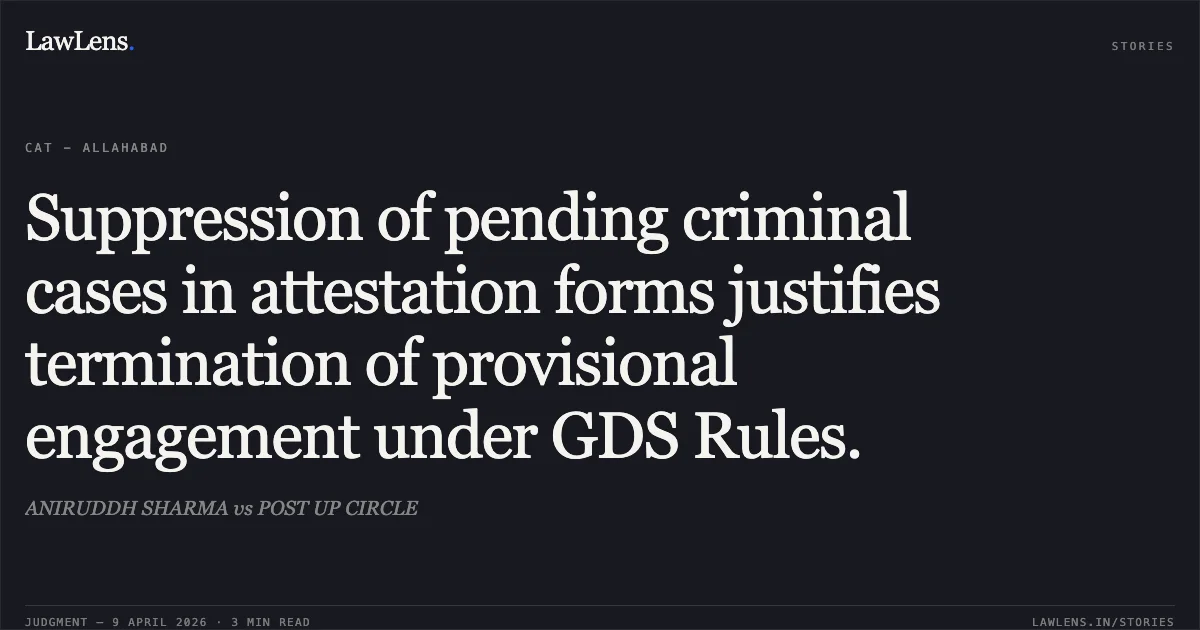
The applicant was appointed as a Gramin Dak Sevak (GDS), Assistant Branch Post Master (ABPM) on compassionate grounds on July 13, 2022, following the death of his father.
Source reference: para. 3Prior to his engagement, the applicant submitted an attestation form declaring that no criminal cases were pending against him in any court of law.
Source reference: para. 4However, a subsequent character and antecedent verification conducted by the District Magistrate, Saharanpur, revealed that a criminal case (Case No. 67/2020) involving Sections 323, 427, 504, and 506 of the Indian Penal Code was pending against the applicant at the time of his attestation.
Source reference: para. 4.1Consequently, the respondent authority terminated the applicant’s services on February 5, 2024, citing the suppression of material facts and misrepresentation.
Source reference: para. 4.2The termination was invoked under Rule 8 of the Gramin Dak Sevak (Conduct and Engagement) Rules, 2020, as the applicant had not completed three years of service.
Source reference: para. 4.3Issues
1. Whether the suppression of a pending criminal case in the attestation form constitutes sufficient grounds for termination of a GDS employee.
Source reference: para. 92. Whether the termination of the applicant’s services under Rule 8 of the GDS (Conduct and Engagement) Rules, 2020, without a prior hearing or notice, was legally sustainable.
Source reference: para. 10, 11Law Applied
The court primarily applied Rule 8 of the Gramin Dak Sevak (Conduct and Engagement) Rules, 2020, which empowers the authority to terminate the engagement of a Sevak with less than three years of continuous service by providing one month's notice or basic allowance in lieu thereof.
Source reference: para. 10The Tribunal also relied on the Supreme Court precedent in Union of India & Ors. v. Shishu Pal @ Shiv Pal (2024), which held that suppression of material facts regarding pending criminal cases at the recruitment stage severely impacts an employee's credibility and justifies termination.
Source reference: para. 9The court cited Rajasthan Rajya Vidhut Prasaran Nigam Limited v. Anil Kanwaria, affirming the employer’s right to refuse continuation of an employee who makes false declarations regarding criminal history, regardless of the nature of the dispute.
Source reference: para. 9Reasoning
The Tribunal found that the applicant had admittedly failed to disclose the existence of a pending FIR in his attestation form, which amounted to a deliberate suppression of material information relating to his character and suitability for public service.
Source reference: para. 9Applying the principles from Shishu Pal, the court reasoned that the employer cannot be forced to continue an employee who lacks trustworthiness from the inception of their service.
Source reference: para. 9Regarding the procedural aspect, the Tribunal observed that the applicant had served for less than three years, making him subject to the summary termination procedure under Rule 8 of the 2020 Rules.
Source reference: para. 11The court noted that the respondents had complied with the proviso to Rule 8 by granting the applicant one month’s TRCA (Time Related Continuity Allowance) plus Dearness Allowance in lieu of the notice period.
Source reference: para. 11The plea that the termination violated principles of natural justice was rejected, as the rules specifically allow for immediate termination upon payment in lieu of notice for employees with less than three years of tenure.
Source reference: para. 11Holding
The Tribunal answered both issues in the affirmative, holding that the suppression of criminal history justified termination and that the procedure followed under Rule 8 was legally sound.
The Tribunal concluded that there was no illegality or infirmity in the impugned order dated February 5, 2024, and dismissed the Original Application.
Source reference: para. 11, 12-14Acts & Sections Cited
5 provisions across 2 statutes referred to in this judgment. Each provision opens on LawLens.
Administrative Tribunals Act, 19851
Indian Penal Code, 18604
Original Court PDF
ANIRUDDH SHARMAvsPOST UP CIRCLE
Click to open original judgment
Original judgment, available to read, download and summarize on LawLens.in