Facts
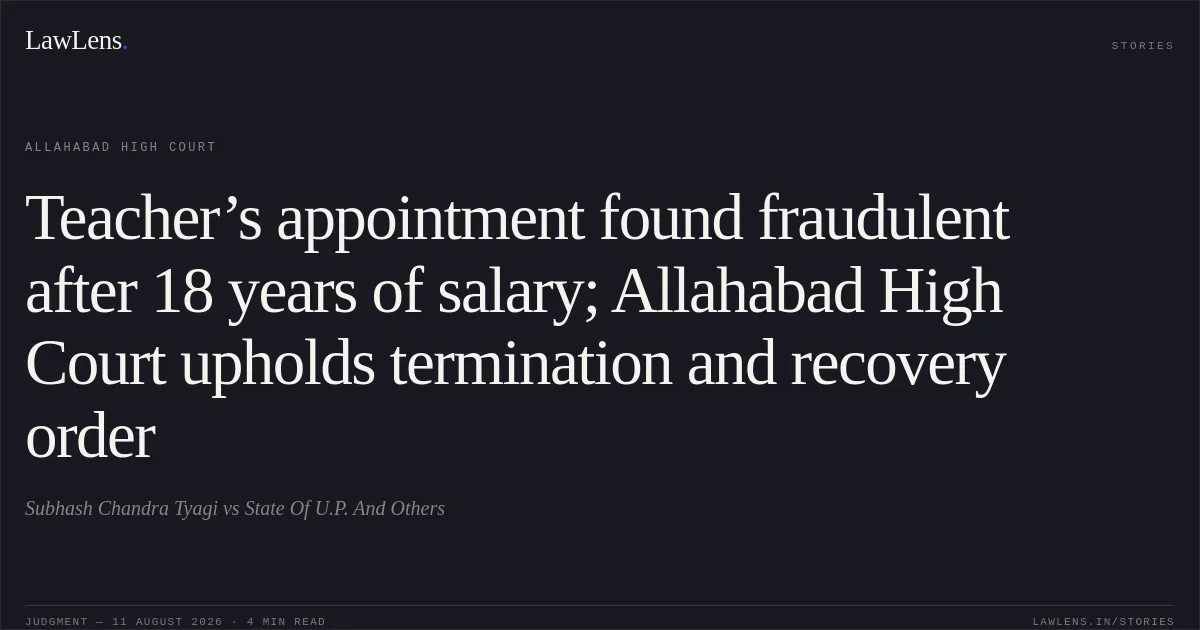
The appellant claimed appointment as an Assistant Teacher in LT Grade against a short-term vacancy allegedly caused by Ved Prakash Harit proceeding on leave without pay for two years from 9 September 1992.
Source reference: paras. 5, 19–21Following an advertisement dated 24 November 1992 and a selection process, the appellant was appointed on 18 December 1992 on the basis of alleged deemed approval by the District Inspector of Schools (“DIOS”).
Source reference: paras. 5, 19–21The appellant filed Writ-A No. 42763 of 1993 when salary was not paid. During the pendency of that writ petition, the Court permitted him to continue until approval or disapproval of his appointment.
Source reference: paras. 6–7The DIOS subsequently approved the appointment on 23 May 1995, subject to the condition that it would end upon Harit’s return.
Source reference: paras. 6–7In 2010–2011, the State produced records indicating that Harit’s name did not appear in the relevant salary bills, that there was no documentary proof of his employment or leave, and that the then DIOS who had approved the appellant’s appointment had been penalised for facilitating 96 fraudulent appointments and salary payments.
Source reference: paras. 8–9The writ petition was dismissed as infructuous and the interim order was vacated on 11 January 2011.
Source reference: para. 23Following dismissal of the writ petition, the DIOS and the Authorized Controller terminated the appellant’s services by orders dated 19 and 20 January 2011.
Source reference: paras. 2, 12–14Issues
Whether the appellant’s appointment against the alleged short-term vacancy was lawful and could survive after dismissal of the earlier writ petition and vacation of the interim order?
Source reference: paras. 19–24, 31Whether the appellant was entitled to protection or regularisation under Section 33-F of the U.P. Secondary Education Services Selection Board Act, 1982?
Source reference: paras. 32–34Whether the termination orders were invalid because they were non-speaking or because no separate adjudicatory order had been passed before termination?
Source reference: para. 15(ii); paras. 31, 37Whether the appellant could retain salary and other benefits received during the period of his continuance under the interim order, and whether recovery or costs were justified?
Source reference: paras. 25–31, 37–38Law Applied
The Court applied the principle that an interim order does not create an independent or indefeasible right and remains subject to the final outcome of the proceedings; when the underlying writ petition is dismissed, the interim order merges into the final order and any undeserved advantage obtained under it may be neutralised through restitution, as held in Amarjeet Singh v. Devi Ratan, (2010) 1 SCC 417, and Ram Krishna Verma v. State of U.P., (1992) 2 SCC 620.
Source reference: paras. 26–28It further applied the rule that fraud vitiates all judicial and administrative acts and that a person cannot acquire equity or estoppel by continuing in service on the basis of a fraudulently obtained appointment, relying on Jainendra Singh v. State of U.P., (2012) 8 SCC 748, and the authorities cited in paragraph 30.
Source reference: paras. 29–30Section 33-F of the U.P. Secondary Education Services Selection Board Act, 1982, permits substantive appointment only where the statutory conditions—including a genuine qualifying short-term vacancy, lawful appointment, continuous service, eligibility, and suitability—are satisfied; it does not validate a fraudulent or non-existent vacancy.
Source reference: paras. 32–34The Court also relied on the principle that higher courts should avoid remand where the record is sufficient and remand would merely generate further litigation.
Source reference: para. 35Reasoning
The Court found no reliable evidence that Harit was an employee of the institution, had received salary from the State exchequer, or had proceeded on the alleged leave.
Source reference: paras. 22–24His name was absent from the relevant salary bills, and the institution had no records evidencing his appointment or leave.
Source reference: paras. 22–24Consequently, the alleged short-term vacancy itself was found to be fictitious or unestablished, and the appellant’s appointment was held unlawful from its inception.
Source reference: paras. 22–24The DIOS’s approval could not cure the defect because it had been granted without verifying the underlying records, particularly in circumstances where the approving officer had later been punished for facilitating fraudulent appointments.
Source reference: paras. 9, 24The appellant’s refusal to answer the supplementary counter-affidavit or produce evidence further weakened his claim, and his statement that the earlier writ petition had become infructuous did not preserve the benefits obtained under the interim order.
Source reference: para. 23Since dismissal of the writ petition discharged the interim protection, the appellant acquired no continuing right to remain in service.
Source reference: para. 23Section 33-F could not be invoked mechanically because its operation presupposed a lawful appointment against a genuine short-term vacancy; the statutory provision could not be used to confer a benefit arising from fraud or illegality.
Source reference: paras. 33–34The Court therefore held that termination was the necessary consequence of the invalid appointment and that the salary benefits obtained from the State exchequer could not be retained.
Source reference: paras. 31, 37Holding
The appeal was dismissed.
The Court upheld the termination of the appellant’s services, holding that the appointment was unlawful from its inception because the alleged short-term vacancy and Harit’s underlying employment were not established.
Source reference: paras. 31, 34, 38The appellant was not entitled to protection or regularisation under Section 33-F of the 1982 Act.
Source reference: para. 34The Court declined to interfere with the direction concerning recovery/costs of ₹2,16,000, holding that the appellant could not claim equitable relief against recovery of benefits obtained through an unlawful appointment and interim protection.
Source reference: para. 37The interim order dated 2 May 2011 staying recovery was vacated, and the Court directed that the consequences follow.
Source reference: para. 38Acts & Sections Cited
3 provisions across 2 statutes referred to in this judgment. Linked provisions open on LawLens.
U.P. Secondary Education Services Selection Board Act, 19822
Uttar Pradesh Secondary Education Services Commission Act, 19711
Original Court PDF
Subhash Chandra TyagivsState Of U.P. And Others
Click to open original judgment
Original judgment, available to read, download and summarize on LawLens.in