Facts
The Himachal Pradesh Staff Selection Commission issued an advertisement dated 28 December 2019 for the post of Conductor in the Himachal Pradesh Road Transport Corporation (“HRTC”). The petitioner participated in the selection process, was selected, and was appointed as a Conductor on contract basis by order dated 18 November 2021. The parties executed an agreement dated 7 December 2021 governing the terms of his appointment
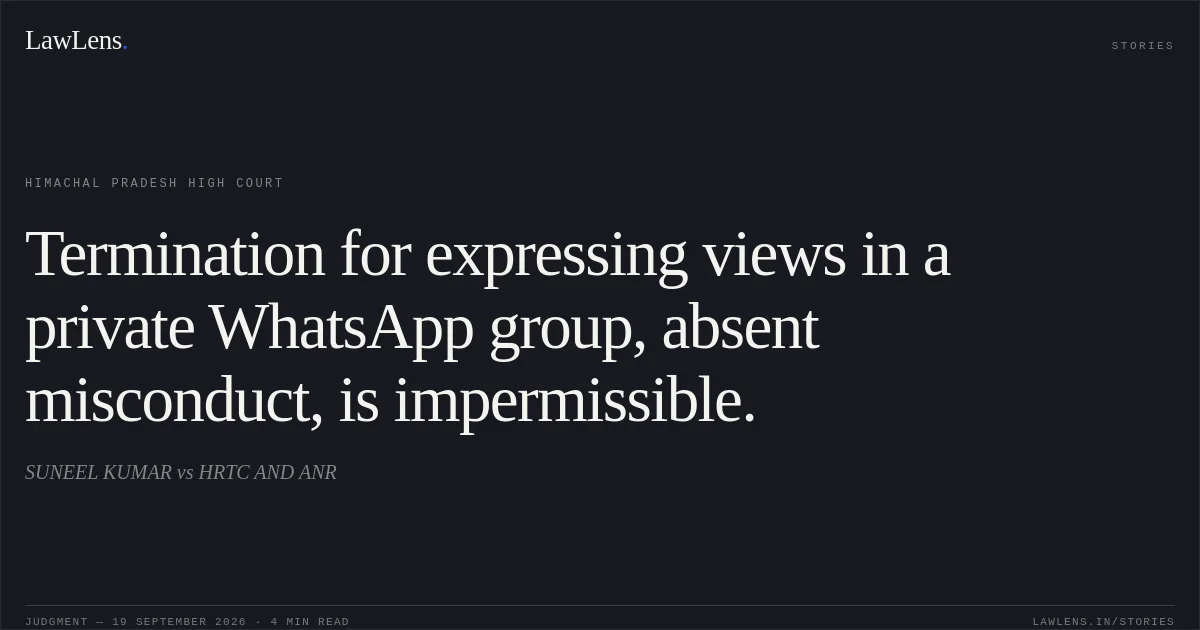
Source reference: pp.1–2On 21 August 2023, HRTC issued guidelines regulating employees’ conduct on social media and instant-messaging platforms. The petitioner, along with other conductors, was a member of a WhatsApp group titled “Himachal Parichalak Ekta”. After the petitioner posted two messages in the group on 4 September 2023, HRTC issued him a show-cause notice dated 26 September 2023, alleging violation of Guideline No. ii of the office order and Clauses 3 and 8 of the appointment agreement. The notice additionally stated that the petitioner was not a fit person to be retained in service
Source reference: pp.2–3The petitioner replied that the messages were not objectionable, had merely expressed his views, and had been posted in a private, end-to-end encrypted WhatsApp group rather than on a public social-media platform. His reply was rejected, and his services were terminated by office order dated 10 October 2023
Source reference: pp.2–3During the writ proceedings, an interim order dated 20 October 2023 permitted him to continue in service, although he claimed that his regularisation and consequential benefits had been withheld due to the termination order
Source reference: p.3Issues
1. Whether the petitioner’s termination was justified under Clause 3 of the contract agreement on the ground that his conduct or performance was unsatisfactory?
Source reference: p.42. Whether the petitioner’s WhatsApp messages constituted “anti-management activities” falling within Clause 8 of the contract agreement?
Source reference: p.53. Whether posting the messages in a private WhatsApp group violated Guideline No. ii of HRTC’s social-media office order dated 21 August 2023?
Source reference: pp.5–84. Whether the termination order was vitiated by a predetermined conclusion and violation of principles of natural justice, because the show-cause notice had already concluded that the petitioner was unfit to be retained in service?
Source reference: pp.8–9Law Applied
The Court applied Clause 3 of the appointment agreement, under which contractual services could be terminated if the appointee’s performance or conduct was not found satisfactory, or if a regular incumbent was appointed against the relevant vacancy
Source reference: p.4It also considered Clause 8, which permitted termination for specified anti-management activities, including participation in a strike, refusal to perform assigned work, or exertion of political or outside pressure on the authorities
Source reference: p.5Guideline No. ii of HRTC’s office order prohibited employees from discussing or criticising Government or HRTC policies or actions “on social media”
Source reference: pp.5–6Relying on A. Lakshminarayanan v. Assistant General Manager, 2023 SCC OnLine Mad 5311, the Court recognised that WhatsApp is principally a private, end-to-end encrypted communication platform; discussion among members of a private WhatsApp group on matters of common interest, including expression of grievances, does not by itself amount to actionable misconduct
Source reference: pp.7–8The Court further applied the principle that a disciplinary authority must approach the matter with an open mind and cannot treat the post-hearing process as an empty formality after reaching a predetermined conclusion
Source reference: p.9Reasoning
Clause 3 was held inapplicable because HRTC neither alleged that the petitioner’s overall performance or conduct as a contract appointee was unsatisfactory nor claimed that a regular incumbent had been appointed against his post. The Court also found that none of the specific acts contemplated by Clause 8—such as strike participation, refusal to perform work, or exertion of outside pressure—was present
Source reference: pp.4–5Guideline No. ii likewise did not justify termination. The petitioner had posted the messages in a private WhatsApp group consisting of HRTC conductors, and not on a public social-media page or platform accessible to the general public. The messages appeared to form part of an ongoing internal conversation, and the respondent failed to properly examine either their substance or whether they amounted to criticism of any HRTC policy
Source reference: pp.7–9The Court held that views which were unpalatable to HRTC could not, without more, justify termination.
Source reference: p.9Further, the show-cause notice had already recorded the conclusion that the petitioner was unfit to remain in service before his reply was considered. The subsequent hearing was therefore merely formal and reflected a mechanical decision-making process
Source reference: p.9Holding
The Court answered the issues in favour of the petitioner. It held that the petitioner’s messages in the private WhatsApp group did not violate Clauses 3 or 8 of the appointment agreement or Guideline No. ii of the HRTC office order, and that the termination process was vitiated by a predetermined conclusion and mechanical consideration of his reply
The writ petition was allowed; the termination order dated 10 October 2023 was quashed and set aside. The petitioner was directed to be treated as continuing in service of HRTC, with all consequential benefits to follow in accordance with law
Source reference: p.9Original Court PDF
SUNEEL KUMARvsHRTC AND ANR
Click to open original judgment
Original judgment, available to read, download and summarize on LawLens.in