Facts
The Appellant (Informant) challenged the trial court's judgment dated 29.08.2024, which acquitted Respondents 2-4 of charges under Sections 302/34, 341/34, 323/34, and 504/34 of the IPC.
Source reference: para. 2On 30.05.2020, a dispute arose when the Appellant questioned the placement of firewood (jalawan) on her land. The accused persons allegedly assaulted her. When her devar (Anmol Kumar) intervened, Respondent 2 (Shrawan Kumar) struck him on the head with an iron rod.
Source reference: para. 3Anmol Kumar died on 02.06.2020 while being transported to Patna for treatment.
Source reference: para. 42, 44Despite injury reports and eyewitness testimony from the Informant (PW-7), the trial court acquitted the respondents because other injured witnesses (PW-6 and PW-8) turned hostile and the Informant's testimony was deemed inconsistent.
Source reference: para. 9-13Issues
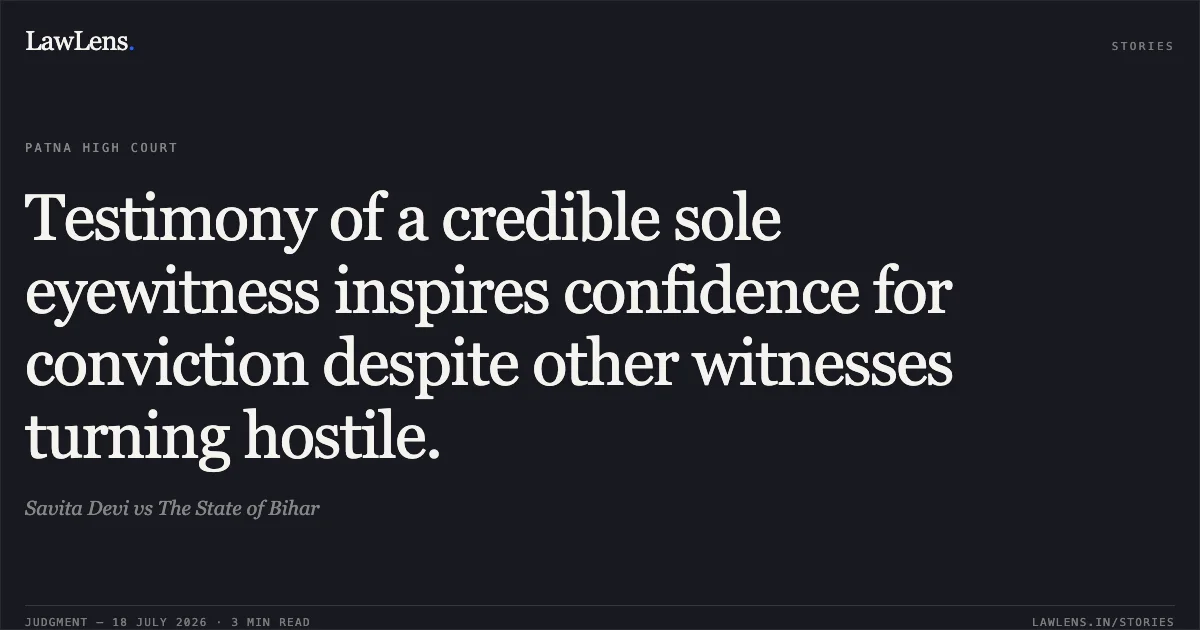
1. Whether the trial court erred in rejecting the testimony of the sole eyewitness (PW-7) solely because other witnesses turned hostile?
Source reference: para. 11, 142. Whether the act of the accused constitutes murder under Section 302 or culpable homicide not amounting to murder under Section 304 IPC?
Source reference: para. 59-603. Whether the delay in lodging the FIR and lapses by the Investigating Officer (I.O.) are fatal to the prosecution's case?
Source reference: para. 17, 57Law Applied
The court applied Section 134 of the Indian Evidence Act (now Section 139 BSA), affirming that no particular number of witnesses is required to prove a fact.
Source reference: para. 16, 49It relied on Khujji @ Surendra Tiwari v. State of M.P., holding that the testimony of a hostile witness remains admissible to the extent it supports the prosecution.
Source reference: para. 35The court differentiated between Murder (Section 300) and Culpable Homicide by applying Exception 4 to Section 300 IPC, which covers deaths caused without premeditation in a sudden fight in the heat of passion.
Source reference: para. 60The principle from Tara Singh v. State of Punjab regarding the effect of delayed FIRs in rural contexts.
Source reference: para. 57Reasoning
The High Court found the trial court’s acquittal perverse. It noted that PW-7’s testimony was consistent regarding the time, place, and manner of occurrence.
Source reference: para. 58, 43Although PW-6 and PW-8 turned hostile, their medical reports (Exhibits P-2 and P-3) proved they were injured by hard, blunt objects at the stated time, contradicting their claims of "accidental" injuries.
Source reference: para. 32, 53The medical evidence (PW-11) confirmed the deceased died of a head injury caused by a hard object (iron rod), corroborating PW-7.
Source reference: para. 44-46The court observed the assault occurred "in the spur of the moment" following a sudden quarrel over firewood, with no repetition of blows or evidence of premeditated intent to kill. Consequently, the offense was downgraded from Section 302 to Section 304 Part II IPC as the act was done with the knowledge that it was likely to cause death, but without the specific intent to murder.
Source reference: para. 59-60, 62Holding
The High Court allowed the appeal in part, setting aside the acquittal. Respondent 2 (Shrawan Kumar) was convicted under Section 304 Part II IPC and sentenced to seven years of rigorous imprisonment and a fine of ₹50,000.
Respondents 3 and 4 (Bucho Das and Badri Das) were convicted under Section 323/34 IPC for causing simple hurt; they were sentenced to the period already undergone during trial and released. All respondents were acquitted of charges under Sections 341 and 504 IPC.
Source reference: para. 65, 7 (Sentence), 68, 70Acts & Sections Cited
20 provisions across 5 statutes referred to in this judgment. Each provision opens on LawLens.
Indian Penal Code, 1860
Bharatiya Sakshya Adhiniyam, 20231
Code of Criminal Procedure, 19732
Bharatiya Nyaya Sanhita, 20232
Bharatiya Nagarik Suraksha Sanhita, 20231
Original Court PDF
Savita DevivsThe State of Bihar
Click to open original judgment
Original judgment, available to read, download and summarize on LawLens.in