Facts
The informant alleged that a dispute over a deduction from money sent to her by her brother led to an altercation at appellant no. 1’s residence.
Source reference: p. 2–3, para. 3She alleged that appellant no. 1 assaulted her and abused her by referring to her caste, while appellants nos. 2 and 3 assaulted her husband; villagers intervened after hearing the noise.
Source reference: p. 2–3, para. 3The police submitted a final report for lack of evidence, but the Special Judge took cognizance of BNS offences and offences under Sections 3(1)(r) and 3(1)(s) of the SC/ST Act.
Source reference: p. 3–4, para. 4The Special Judge rejected the appellants’ anticipatory-bail application, citing the bar under Section 18 of the Act.
Source reference: p. 1–2, para. 4The appellants appealed under Section 14A(2) of the Act.
Source reference: p. 1–2, para. 2Issues
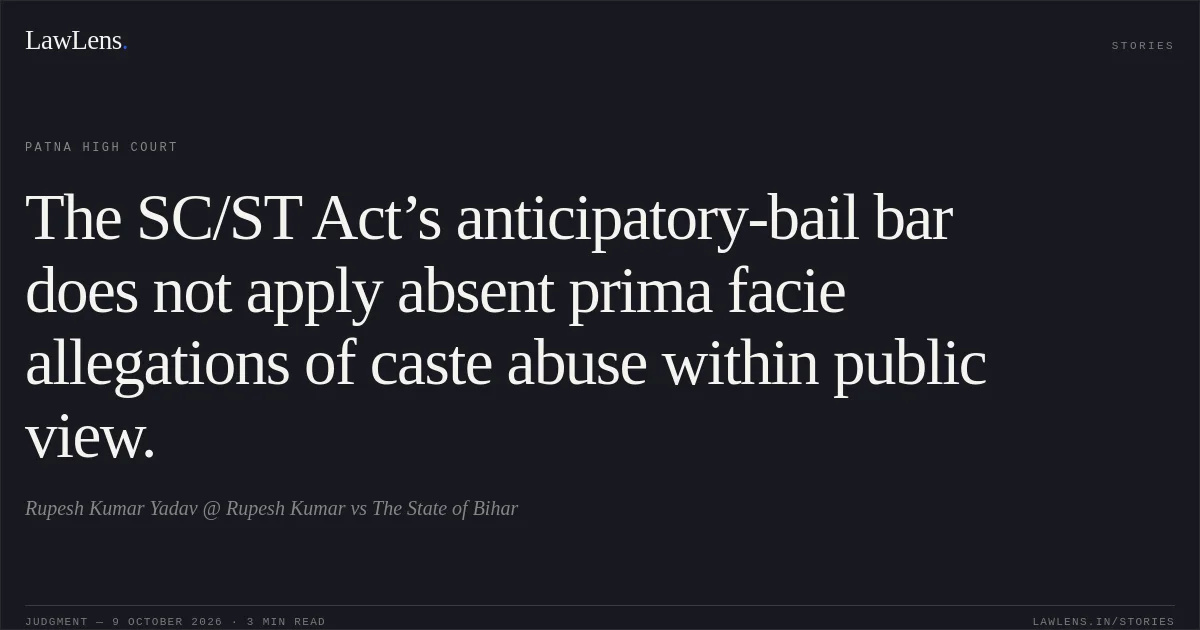
Whether the allegations disclosed a prima facie case under Sections 3(1)(r) or 3(1)(s) of the SC/ST Act, such that the bar on anticipatory bail under Section 18 applied
Source reference: p. 9–11, paras. 12–16Whether the appellants were entitled to pre-arrest bail in the circumstances of the case
Source reference: p. 11–12, paras. 15–17Law Applied
Sections 3(1)(r) and 3(1)(s) of the SC/ST Act require, respectively, intentional insult or intimidation with intent to humiliate a Scheduled Caste or Scheduled Tribe member, or abuse of such a person by caste name, in a place within public view.
Source reference: p. 6, para. 7; p. 9, para. 10Relying on Swaran Singh v. State and Hitesh Verma v. State of Uttarakhand, the Court distinguished a “place within public view” from a public place; the relevant question is whether the place and circumstances permit members of the public to witness or hear the conduct.
Source reference: p. 6–8, para. 9It also cited Karuppudayar v. State, stating that an occurrence within a private space where members of the public are not present is not, on that basis alone, within public view.
Source reference: p. 8–9, para. 10The Court cited Prathvi Raj Chauhan v. Union of India for the principle that the Section 18 bar does not apply where no prima facie offence under the Act is made out.
Source reference: p. 6, para. 8It further cited Keshaw Mahto v. State of Bihar for the propositions that mere knowledge of the complainant’s caste is insufficient and that, under Section 3(1)(s), the caste name must be used as an abuse.
Source reference: p. 9, para. 11Reasoning
The FIR placed the alleged occurrence at appellant no. 1’s residence and did not state that the alleged caste-based words were spoken where members of the public were present or could hear them.
Source reference: p. 10, para. 13The villagers were said to have intervened after hearing the noise, with no allegation that they witnessed or heard the alleged abuse.
Source reference: p. 10, para. 13The caste-based abuse was attributed only to appellant no. 1; no such insult or abuse was alleged against appellants nos. 2 and 3.
Source reference: p. 10–11, para. 14The Court also considered that the incident arose from a monetary dispute and noted the final report, the absence of an injury report, the completion of investigation, and the appellants’ lack of criminal antecedents.
Source reference: p. 11, paras. 14–15It therefore found the statutory ingredients insufficiently established at the prima facie stage to attract the Section 18 bar.
Source reference: p. 11–12, para. 16Holding
The Court held that the appellants had prima facie shown that the bar under Section 18 of the SC/ST Act did not apply.
It set aside the order rejecting anticipatory bail and allowed the appeal.
Source reference: p. 12, paras. 16–18The appellants were directed to be released on pre-arrest bail, in the event of arrest or surrender within four weeks, on bonds of ₹10,000 each with two like sureties, subject to the conditions under Section 482(2) of the BNSS.
Source reference: p. 12, paras. 16–18Acts & Sections Cited
10 provisions across 4 statutes referred to in this judgment. Each provision opens on LawLens.
Scheduled Castes and the Scheduled Tribes (Prevention of Atrocities) Act, 19892
Bharatiya Nyaya Sanhita, 20236
Code of Criminal Procedure, 19731
Bharatiya Nagarik Suraksha Sanhita, 20231
Original Court PDF
Rupesh Kumar Yadav @ Rupesh KumarvsThe State of Bihar
Click to open original judgment
Original judgment, available to read, download and summarize on LawLens.in