01Facts
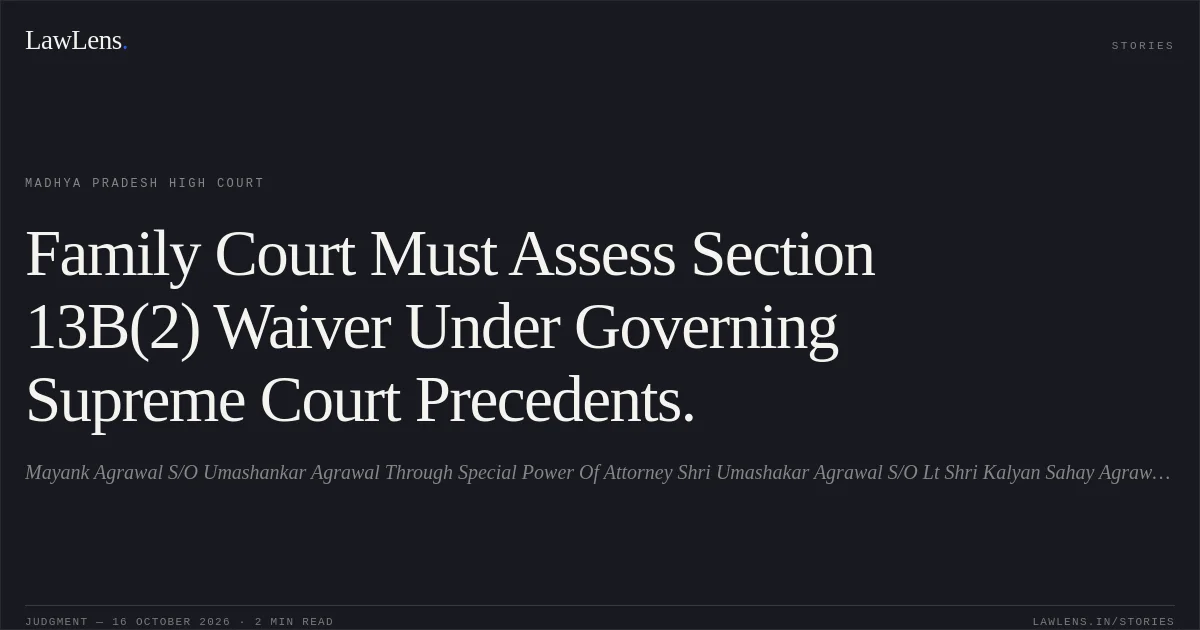
The petitioner and respondent jointly filed a petition for divorce by mutual consent under Section 13B of the Hindu Marriage Act, 1955.
The Family Court fixed the matter after six months for compliance with the statutory cooling-off period under Section 13B(2), and rejected the petitioner’s application seeking waiver of that period and an early decision after recording the parties’ evidence.
¶ 2The petitioner approached the High Court under Article 227 of the Constitution, relying on earlier decisions permitting waiver of the cooling-off period.
¶ 2–3The High Court noted that the parties had been living separately since 2016.
¶ 6However, the relief portion reproduced in the judgment refers to unfreezing a bank account, indicating an apparent textual inconsistency in the judgment record.
p. 102Issues
i.Whether the Family Court erred in rejecting the petitioner’s application for waiver of the six-month cooling-off period under Section 13B(2) of the Hindu Marriage Act, 1955, without considering the subsequent law laid down by the Supreme Court.
¶ 2, 4–6ii.Whether the matter should be remanded to the Family Court for reconsideration of the waiver application in light of the governing precedents.
¶ 6–703Law Applied
The Court applied Section 13B of the Hindu Marriage Act, 1955, concerning divorce by mutual consent and the six-month period contemplated under Section 13B(2).
Relying on Amardeep Singh v. Harveen Kaur, the Court held that the cooling-off period is directory, not mandatory, and may be waived where reconciliation is unlikely, the parties have genuinely settled their disputes, mediation or reconciliation efforts have been exhausted, and continuation of the waiting period would prolong their agony.
pp. 2–3Under Amit Kumar v. Suman Beniwal, the factors identified in Amardeep Singh are illustrative and not exhaustive; the court must exercise discretion on the facts of each case, and the conditions should not be treated as rigid mandatory requirements.
p. 3The Court also referred to Shiksha Kumari v. Santosh Kumar and the earlier order in M.P. No. 4122/2026 as persuasive or governing guidance for reconsideration of waiver applications.
¶ 4–5Provisions in the judgment · 1 · Linked ones open on LawLens
Hindu Marriage Act, 1955 Section 13
04Reasoning
The High Court found that the Family Court’s rejection of the waiver application appeared to be based on the earlier understanding of the law, without considering the subsequent Supreme Court decisions clarifying that the six-month period under Section 13B(2) is directory.
¶ 6Since the parties had been residing separately since 2016, and the issue was materially similar to the matter addressed in the earlier order relied upon by the petitioner, the High Court held that reconsideration by the Family Court was warranted.
¶ 6The Court therefore did not itself grant the divorce or finally waive the cooling-off period; instead, it quashed the impugned order and directed the Family Court to reconsider the application in accordance with the applicable precedents.
05Holding
The petition was allowed.
¶ 6–7The Family Court’s order rejecting the application for waiver of the cooling-off period was quashed, and the matter was remanded to the Family Court to decide the application afresh while keeping in view Amardeep Singh, Amit Kumar, Shiksha Kumari, and the earlier order in M.P. No. 4122/2026.
¶ 6–7The Family Court was directed to decide the application expeditiously, preferably within fifteen days from receipt of the certified copy of the High Court’s order.
¶ 7The petition was accordingly disposed of.
¶ 8Original Court PDF
ChogalalvsMrs. Radha
Click to open original judgment
Original judgment, available to read, download and summarize on LawLens.in