01Facts
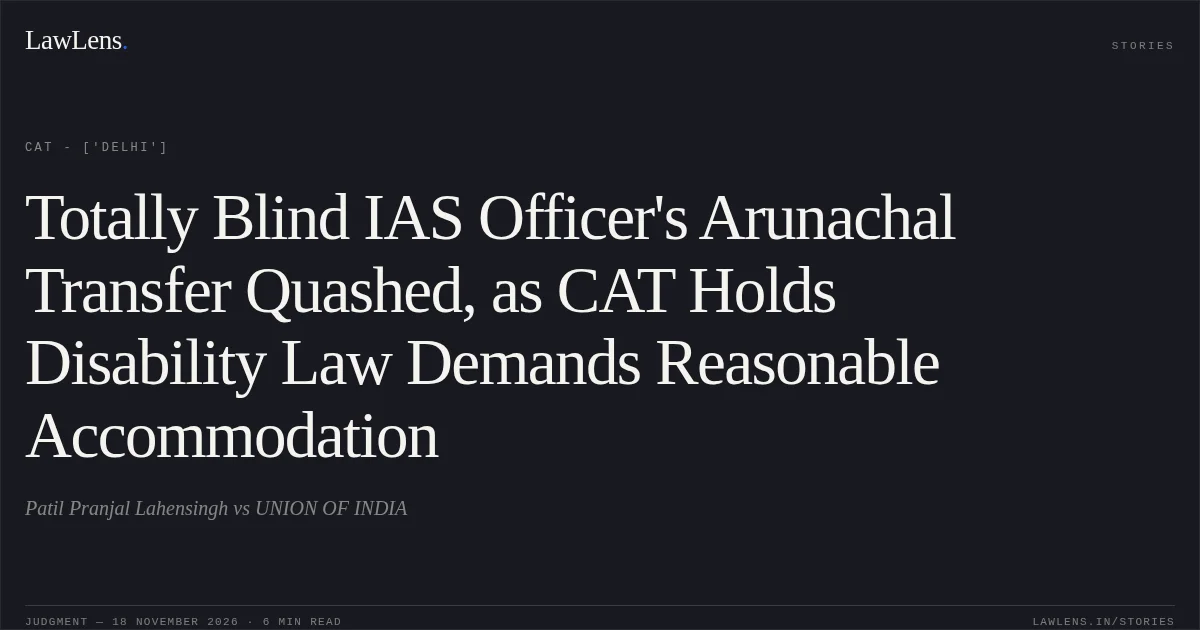
The applicant, an IAS officer of the 2017 batch, has 100% visual loss from absolute stage secondary glaucoma, anterior staphyloma and recurrent corneal erosions in both eyes, with no perception of light since childhood.
¶ 1Her inter-cadre transfer from Kerala to the AGMUT cadre was accepted on 21.05.2018 under the Physically Handicapped Policy dated 14.02.2014, and she joined the Delhi segment in early 2020 to access medical and social support.
¶ 1On 12.09.2024 the Ministry of Home Affairs transferred her to Arunachal Pradesh, a hard station, and a relieving order followed on 17.10.2024.
¶ 1Her sole caregiver, her grandmother, died on 10.09.2024, and she requires continuous specialised care at Sitaram Bhartia Institute, ICARE Eye Hospital and AIIMS.
¶ 1In O.A. No. 4127/2024, the Tribunal on 22.10.2024 directed a reasoned speaking order on her representation; the MHA rejected it on 06.11.2024.
¶ 1 · ¶ 5The respondents justified the transfer under the Transfer/Posting Guidelines for AGMUT officers, 2016 (the "Guidelines, 2016"), paras 7 and 17, asserting her nil Category B tenure and a deficit of senior-scale officers in Arunachal Pradesh.
¶ 5 · ¶ 6The applicant contended that the transfer breached Section 20 of the RPwD Act, 2016, the DoP&T OM dated 31.03.2014 and Article 14.
¶ 2 · ¶ 702Issues
i.1. Whether, while transferring an officer with a benchmark disability, the cadre controlling authority is bound by Section 20 of the RPwD Act, 2016 and DoP&T instructions on transfer of persons with disabilities, or whether the Guidelines, 2016 operate independently of them.
¶ 9(i)ii.2. Whether the applicant's transfer is a routine or rotational transfer within the meaning of those instructions.
¶ 9(ii)iii.3. Whether the respondents have established administrative constraints justifying departure from those instructions, and on whom the burden lies.
¶ 9(iii)iv.4. Whether the order dated 06.11.2024 reflects a genuine and individualised consideration of the applicant's case, as required by the duty of reasonable accommodation.
¶ 9(iv)v.5. Whether the applicant is precluded, by her acceptance of the AGMUT cadre in 2018, from claiming the protection sought.
¶ 9(v)03Law Applied
The Tribunal applied the general law that transfer is an incident of service and that courts interfere only for mala fides, incompetence, or violation of a statute or instruction having statutory force, as laid down in Shilpi Bose, S.L. Abbas and S.C. Saxena.
¶ 10R.S. Chaudhary does not defeat the application but does not advance the applicant's merits.
¶ 11The core statutory overlay is Section 20 of the RPwD Act, 2016, which prohibits discrimination in employment, mandates reasonable accommodation (s. 20(2)), bars denial of promotion merely on disability (s. 20(3)), and empowers the government to frame transfer policies (s. 20(5)); read with Section 3 (equality and non-discrimination), Section 2(y) (reasonable accommodation) and Rule 8(3)(c) of the RPwD Rules, 2017.
¶ 12DoP&T OM dated 31.03.2014 (Part H), reiterated on 02.02.2024, exempts persons with disabilities from rotational transfer "as far as possible" and gives preference in posting subject to administrative constraints; this is a means of discharging the s. 20(2) obligation.
¶ 13 · ¶ 14Ircon International Ltd. v. Bhavneet Singh, LPA 133/2024 (Del HC, 18.07.2024) holds that the employer bears the burden of proving administrative exigency, vague averments being insufficient, and that these OMs bind even CPSEs.
¶ 15DRDO v. Dr. Deepti Bhardwaj, W.P.(C) 12454/2026 (Del HC, 03.09.2026) holds that the OMs must be interpreted expansively and that the employer cannot cure a deficient transfer order by affidavit averments.
¶ 16Net Ram Yadav v. State of Rajasthan, (2022) 15 SCC 81 holds that treating unequals as equals violates Article 14 and that such instructions must be given purposive effect.
¶ 17Vikash Kumar v. UPSC, (2021) 5 SCC 370 and Ravinder Kumar Dhariwal v. Union of India, (2023) 2 SCC 209 require individualised reasonable accommodation.
¶ 17 · ¶ 25Justice Sunanda Bhandare Foundation v. Union of India requires the executive's approach to be liberal and relief-oriented.
¶ 18Provisions in the judgment · 3 · Linked ones open on LawLens
Rights of Persons with Disabilities Act, 2016. Section 20Section 3Section 2
04Reasoning
The Tribunal held that the Guidelines, 2016 are executive instructions that cannot override s. 20 of the RPwD Act. Paras 7 and 17 must therefore be exercised subject to s. 20 and Part H, so the power to post officers anywhere is not unguided where a benchmark-disabled officer is concerned.
¶ 20The transfer was a rotational transfer: the respondents' own case was that the applicant was due for a Category B tenure along with her batch, which is the class of movement Part H exempts.
¶ 21The respondents' justification fails on both counts. The absence of Category B tenure is the very rule from which exemption is claimed, and treating it as a constraint would nullify Part H.
¶ 23The alleged deficit in Arunachal Pradesh was a bare assertion, with no sanctioned or working strength, vacancy figures, or explanation of why only the one totally blind officer could fill it. The burden on this point was not discharged, following Ircon.
¶ 24The 06.11.2024 order merely restated policy and did not assess the applicant's individual needs, although the material (100% disability, continuous specialist care, the grandmother's death, and the Delhi-based support system) was specific and weighty.
¶ 25 · ¶ 26No material showed comparable ophthalmic care or support in Arunachal Pradesh, so applying the tenure rule to her without individual assessment was treatment of unequals as equals.
¶ 27The estoppel plea failed because a statutory right cannot be waived by a general transfer liability, and acceptance of cadre membership is not consent to disregard s. 20 and Part H.
¶ 28Shalu Pruthi was distinguished because there the disability was not established, whereas here it is certified and undisputed.
¶ 29Section 20(3) requires that the applicant not be prejudiced in her career for non-completion of hard-area tenure.
¶ 3005Holding
The Tribunal answered question (i) in the affirmative: the Guidelines, 2016 must be read subject to s. 20 of the RPwD Act and Part H of the OM dated 31.03.2014.
¶ 20Question (ii) was answered in favour of the applicant: the transfer was rotational.
¶ 21Question (iii) was answered against the respondents, who failed to discharge the burden of proving administrative constraints.
¶ 23 · ¶ 24Question (iv) was answered in favour of the applicant: the 06.11.2024 order was not an individualised reasonable-accommodation assessment and is unsustainable.
¶ 26 · ¶ 27Question (v) was answered against the respondents: the applicant is not estopped.
¶ 28The O.A. is allowed.
¶ 31The Tribunal ordered that: (a) the transfer order dated 12.09.2024 (as it relates to the applicant), the relieving order dated 17.10.2024, and the order dated 06.11.2024 are quashed; (b) the applicant is to be continued in or reposted to the NCT of Delhi segment within four weeks, with the intervening period regularised as not her fault; (c) any future posting outside Delhi requires a reasoned order passed after hearing her, assessing her current medical evidence and support needs, and examining accommodation in Delhi or another Category A segment; and (d) her non-completion of Category B tenure due to disability shall not be held against her for promotion, empanelment, central deputation or other service benefits. Pending MAs are disposed of, with no order as to costs.
¶ 31Original Court PDF
Patil Pranjal LahensinghvsUNION OF INDIA
Click to open original judgment
Original judgment, available to read, download and summarize on LawLens.in