Facts
The deceased employee, Pyare Lal, was a driver for the Delhi Transport Corporation (DTC)
Source reference: p. 2Between 1979 and 1991, he was repeatedly cautioned for unauthorized absences and once penalized with the stoppage of a salary increment
Source reference: p. 2In February 1993, he was charge-sheeted for being absent without permission for 22 days
Source reference: p. 2Despite multiple notices, he failed to join the domestic enquiry, which subsequently proved the charges
Source reference: p. 3He was removed from service on April 27, 1993
Source reference: p. 3The DTC filed an approval application under Section 33(2)(b) of the Industrial Disputes Act, 1947. The Industrial Tribunal dismissed the application, holding that since the absence was treated as "leave without pay," it did not constitute misconduct
Source reference: p. 4-5A learned Single Judge of the High Court set aside the Tribunal’s order, which led to this Letters Patent Appeal (LPA) by the employee's legal representatives
Source reference: p. 5Issues
1. Whether treating a period of unauthorized absence as "leave without pay" for administrative record-keeping absolves an employee of the charge of misconduct
Source reference: p. 11, para. 92. Whether the absence of specific dates in the charge sheet rendered the charges vague, thereby vitiating the disciplinary proceedings
Source reference: p. 9, para. 9Law Applied
Section 33(2)(b) of the Industrial Disputes Act, 1947, regarding the approval of a workman's discharge or dismissal during pending proceedings
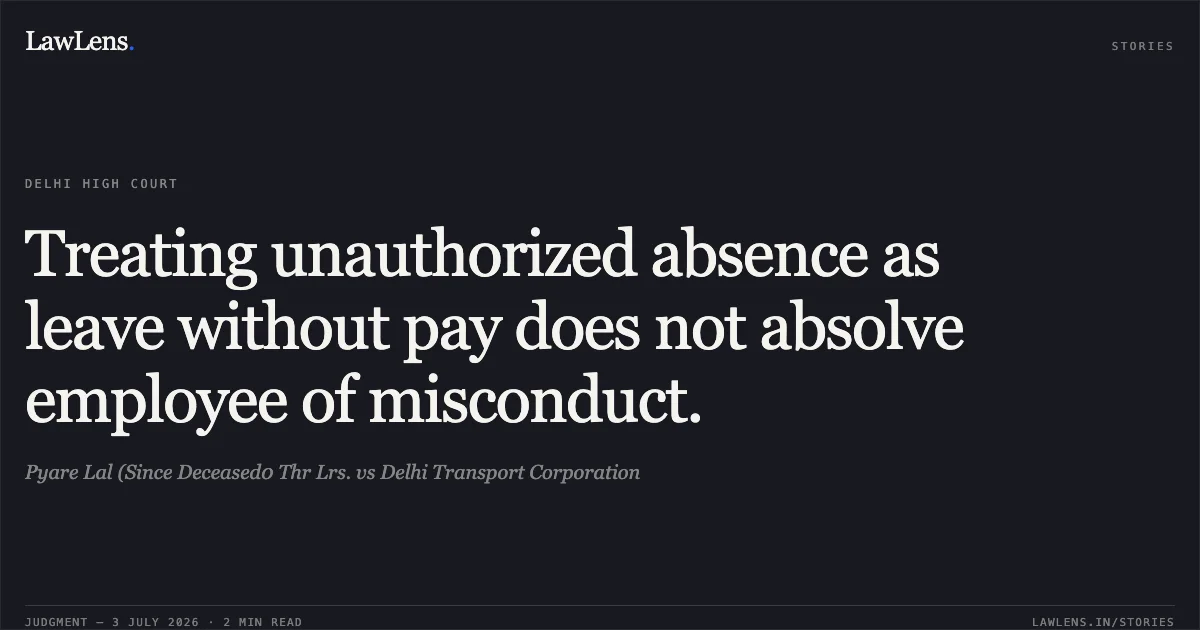
Source reference: p. 2State of Madhya Pradesh v. Harihar Gopal (1969) and Delhi Transport Corporation v. Sardar Singh (2004), which established that treating unauthorized absence as "leave without pay" is a mere accounting necessity to maintain service records and does not retrospectively authorize the absence or negate the underlying misconduct
Source reference: p. 8-9The principle that charges are not "vague" if the employee has sufficient notice of the case against him, supported by a detailed leave statement
Source reference: p. 9Reasoning
The Court observed that the Industrial Tribunal’s reasoning—that "leave without pay" regularized the conduct—was fundamentally flawed and contrary to established law
Source reference: p. 11, para. 9Citing Sardar Singh, the Court clarified that "treating as leave without pay is not the same as sanctioned or approved leave"
Source reference: p. 8, para. 7The Court found that the regularization was merely for the purpose of maintaining a correct record of service and did not obliterate the dismissal order
Source reference: p. 10, para. 10Regarding the vagueness of charges, the Court noted that while specific dates were not in the charge sheet itself, a leave statement was placed on record during the trial, providing the employee with sufficient notice of the allegations
Source reference: p. 9, para. 9Since the employee failed to participate in the inquiry despite multiple opportunities, the principles of natural justice were deemed satisfied
Source reference: p. 3, 5Holding
The Court dismissed the appeal and upheld the judgment of the learned Single Judge
It held that unauthorized absence remains a misconduct even if the employer treats the period as "leave without pay" for administrative purposes
Source reference: p. 11The Court answered the issues in the negative, confirming that the charges were not vague and the approval under Section 33(2)(b) of the Industrial Disputes Act was justified
Source reference: p. 11-12The final order set aside the Tribunal's decision and approved the employee's removal from service
Source reference: p. 10, para. 12Acts & Sections Cited
1 provisions across 1 statute referred to in this judgment. Each provision opens on LawLens.
Limitation Act, 19631
Original Court PDF
Pyare Lal (Since Deceased0 Thr Lrs.vsDelhi Transport Corporation
Click to open original judgment
Original judgment, available to read, download and summarize on LawLens.in