Facts
The Appellant, a music teacher, was accused of repeatedly committing aggravated penetrative sexual assault and carnal intercourse against the order of nature on his 11-year-old student (PW1) at her residence
Source reference: p. 2He allegedly threatened the victim with physical harm if she disclosed the incidents
Source reference: p. 2Following a FIS/FIR registered on 28.07.2016, the Appellant was charged under Sections 376, 377, and 506 IPC, and Sections 6 and 10 of the POCSO Act
Source reference: p. 2-3During the trial, the Appellant claimed false implication due to a dispute over outstanding tuition fees
Source reference: p. 4The Trial Court convicted him on 08.07.2019, sentencing him to 20 years of rigorous imprisonment for the offence under Section 376(2) IPC, alongside sentences for other counts to run concurrently
Source reference: p. 5-6The Appellant challenged the conviction but primarily sought a reduction in the quantum of sentence during arguments
Source reference: p. 6Issues
1. Whether the non-compliance with the mandatory hearing under Section 232 of the Cr.P.C. vitiated the trial proceedings
Source reference: p. 4, para. 72. Whether the Trial Court had the jurisdiction to impose a term-specific sentence of 20 years for an offence under Section 376(2) IPC committed in 2016
Source reference: p. 7, para. 143. Whether the quantum of sentence awarded to the Appellant warrants modification based on the nature of the offence and statutory limits
Source reference: p. 7, para. 13-15Law Applied
The court applied Section 374(2) of the Cr.P.C. regarding the right to appeal and Section 232/313(1)(b) Cr.P.C. regarding trial procedure
Source reference: p. 1, 4Section 376(2) of the IPC as it stood prior to the 2018 amendment, which prescribed a minimum of 10 years and a maximum of life imprisonment
Source reference: p. 7It relied on Moidu K. vs. State of Kerala (2009) to establish that non-compliance with Section 232 Cr.P.C. only vitiates proceedings if "serious and substantial prejudice" is proven
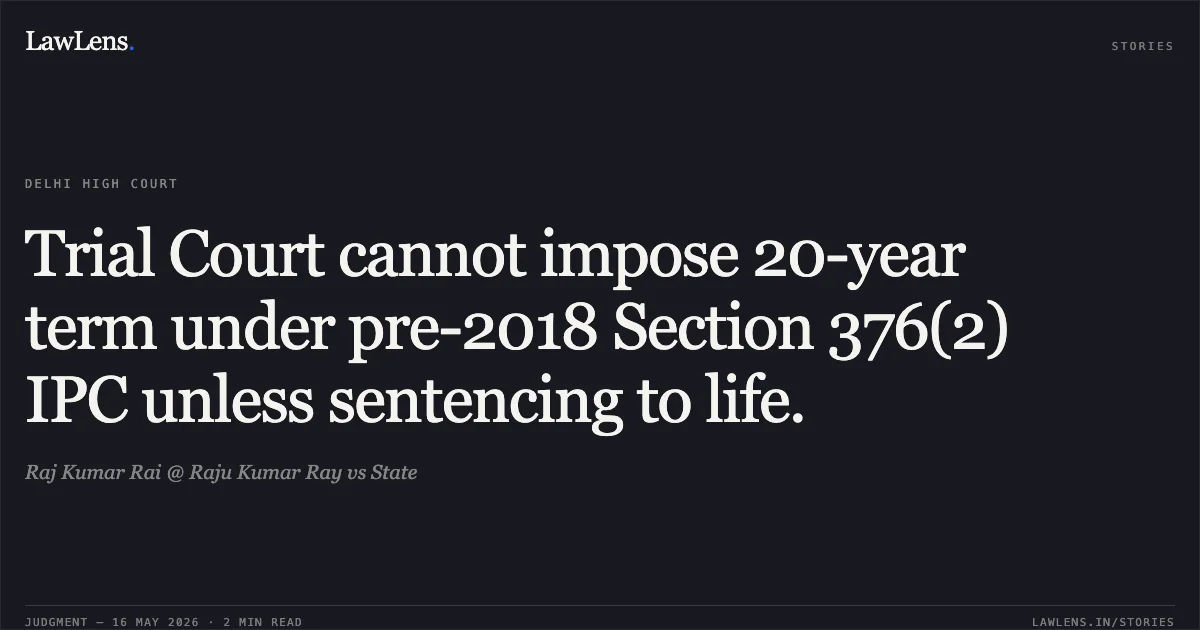
Source reference: p. 4-5Ravinder Singh v. The State Govt. of NCT of Delhi (2024), which held that while the High Court and Supreme Court can impose any term, a Trial Court cannot impose a term-specific sentence exceeding 14 years if it chooses not to award life imprisonment
Source reference: p. 7-8Reasoning
The High Court first observed that the lack of a hearing under Section 232 Cr.P.C. did not prejudice the accused, as he raised no such claim
Source reference: p. 4-5Analyzing the legality of the 20-year sentence, the court found the Trial Court erred; since the incident occurred in 2016 (pre-2018 amendment), the Trial Court could only award the minimum (10 years), life imprisonment, or a term not exceeding 14 years
Source reference: p. 7-8Highlighting the aggravating circumstances—the Appellant being in a position of trust as a teacher and the victim being a minor—the court determined that the 10-year minimum was insufficient
Source reference: p. 8The court exercised its appellate power to adjust the term to the maximum permissible for a Trial Court under that specific penal provision
Source reference: p. 8Holding
The Court held that the 20-year sentence was legally unsustainable under the pre-2018 IPC framework for a Trial Court
The Court partly allowed the appeal, confirming the conviction but modifying and reducing the substantive sentence for the offence under Section 376(2) IPC from 20 years to 14 years of rigorous imprisonment
Source reference: p. 8-9Acts & Sections Cited
3 provisions across 3 statutes referred to in this judgment. Linked provisions open on LawLens.
Code of Criminal Procedure, 19731
Indian Penal Code, 18601
Protection of Children from Sexual Offences Act, 20121
Original Court PDF
Raj Kumar Rai @ Raju Kumar RayvsState
Click to open original judgment
Original judgment, available to read, download and summarize on LawLens.in