01Facts
Following an advertisement issued on 21 December 2022, the appellants were selected through interviews for Anganwadi Worker and Helper positions, received engagement orders on 8 August 2023, and joined their posts
¶ 2, 16On 26 February 2024, the Child Development Project Officer (CDPO) cancelled their recruitment, citing “unavoidable reasons”
¶ 3The respondents relied on complaints that the appellants were non-local, demands that substitute workers receive priority, and directions to conduct a fresh selection
¶ 6–10The appellants’ writ petitions were dismissed as premature because no individual disengagement orders had been issued
¶ 12–13They appealed against that decision.
02Issues
i.Whether the writ petitions were premature because no individual disengagement orders had been issued, despite the CDPO’s proceeding cancelling the appellants’ recruitment
¶ 14–15ii.Whether the cancellation and direction for fresh engagement were lawful, given the applicable selection guidelines, the alleged local-residency objections, and the absence of notice and hearing to the appellants
¶ 18–2703Law Applied
The State’s Anganwadi engagement guidelines require vacancies to be advertised, prescribe eligibility and selection procedures, provide for a merit list, and allow an aggrieved person to appeal to the District Magistrate and Collector; they do not grant substitute workers priority.
¶ 20–23Administrative action affecting engagement must comply with Article 14 and the principles of natural justice, including notice and an opportunity to be heard.
¶ 26–27In Maniben Maganbhai Bhariya v. District Development Officer, Dahod, (2022) 16 SCC 343, the Supreme Court held that Anganwadi Workers and Helpers perform statutory duties under the Food Security Act, 2013 and the Right of Children to Free and Compulsory Education Act, 2009, and that their posts are statutory posts.
¶ 28The Court also relied on its Division Bench decision in State of Tripura v. Dhayarung Reang
¶ 29Provisions in the judgment · 1 · Linked ones open on LawLens
Right of Children to Free and Compulsory Education Act, 2009 Section 11
04Reasoning
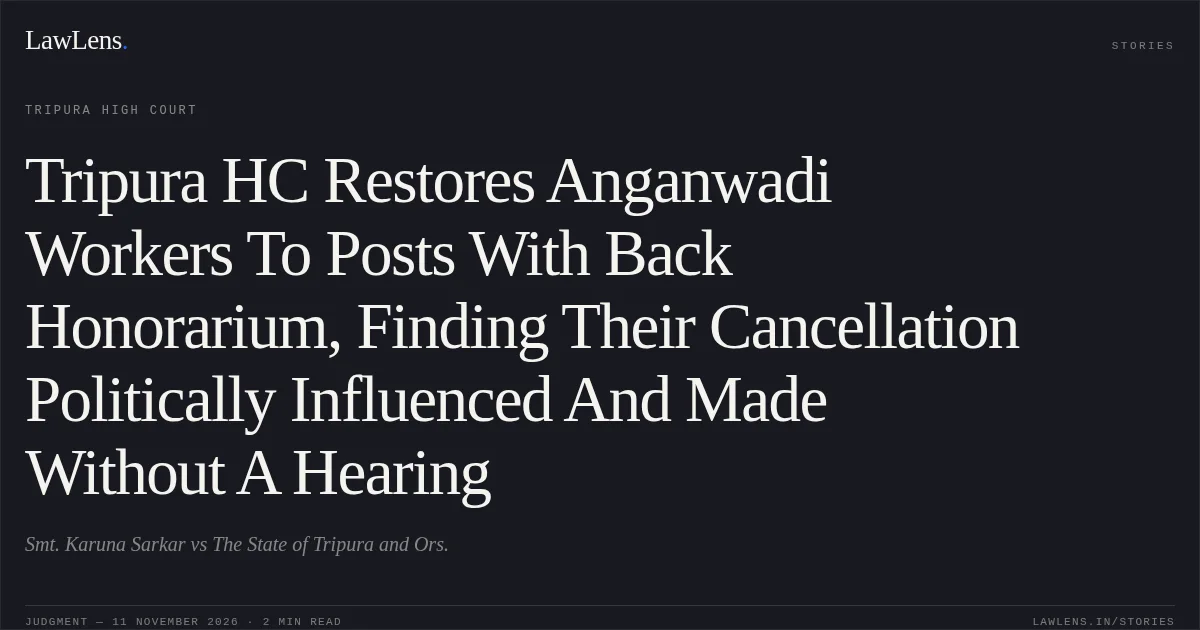
The Court held that the 26 February 2024 proceeding cancelling recruitment was itself an impugned order giving the appellants a cause of action; the absence of individual disengagement letters did not make their petitions premature.
¶ 14–16The respondents identified no guideline entitling substitute workers to preference, and produced no evidence that the persons who signed the locality resolution had applied and been wrongly rejected, or that any appeal under the guidelines had been filed by an aggrieved candidate.
¶ 21–24Although a residency inquiry had led to the direction for fresh engagement, its report was not produced and the appellants had not been given notice or an opportunity to respond.
¶ 25–27The Court therefore found the action arbitrary, contrary to Article 14 and natural justice, and influenced by political pressure; it also noted that the cancellation order’s stated reason differed from the explanation later advanced in the counter-affidavit.
¶ 27, 31–3205Holding
The appeals were allowed, and the single Judge’s common judgment was set aside.
¶ 34The writ petitions were allowed and the CDPO’s proceeding dated 26 February 2024 cancelling the appellants’ recruitment was quashed.
¶ 34The respondents were directed to permit the appellants to resume their respective posts, pay any unpaid honorarium from 26 February 2024 within eight weeks, continue future honorarium payments, and pay each appellant costs of ₹5,000 within eight weeks.
¶ 34Original Court PDF
Smt. Karuna SarkarvsThe State of Tripura and Ors.
Click to open original judgment
Original judgment, available to read, download and summarize on LawLens.in