01Facts
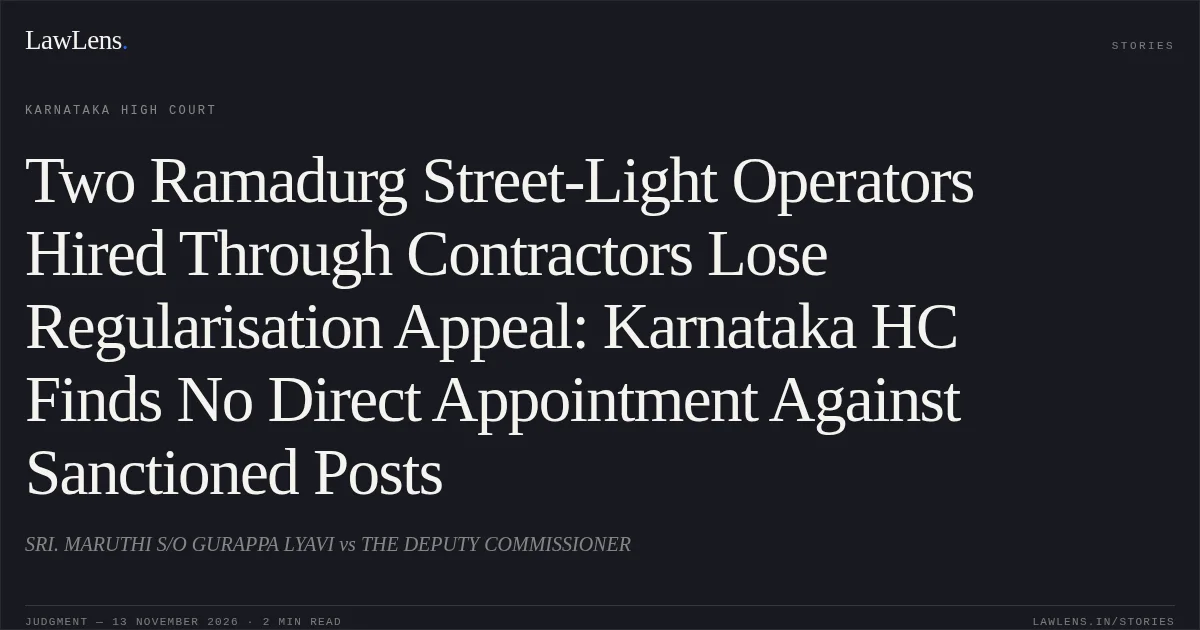
The appellants worked as street-light operators for the Town Municipal Council, Ramadurg, having been engaged through a contractor who obtained a manpower-supply contract through a tender process.
pp. 3–6After approximately ten years of service, they sought regularization. The Council rejected their request, stating that no rules provided for regularizing contract workers.
pp. 3–6A Single Judge dismissed their writ petition, holding that they had not been directly appointed against sanctioned posts and could pursue any wage or statutory-benefit claims before the appropriate forum.
pp. 3–6The appellants challenged that dismissal in this writ appeal.
pp. 7–802Issues
i.1. Whether workers engaged through a contractor to perform work for a Town Municipal Council were entitled to regularization on the basis of long service and the perennial nature of the work.
pp. 5–6ii.2. Whether the Single Judge’s dismissal of the writ petition warranted interference in the intra-court appeal.
pp. 7–803Law Applied
Under Secretary, State of Karnataka v. Umadevi (3), regularization is not a matter of right; the limited exception identified in paragraph 53 applies to irregularly appointed, duly qualified persons appointed by the State against sanctioned vacant posts who have served for ten years or more without the protection of interim orders.
p. 5Long service or the perennial nature of the work does not, by itself, establish a right to regularization where the workers were engaged through a contractor rather than directly appointed against sanctioned posts.
pp. 5–6The Court distinguished Bhola Nath v. State of Jharkhand, 2026 SCC OnLine SC 129, because the employee in that case had been appointed directly by a municipality and had served for over thirty years.
p. 7Claims concerning wages or statutory benefits may be pursued before the appropriate forum.
pp. 4–6Provisions in the judgment · 1 · Linked ones open on LawLens
KARNATAKA HIGH COURT ACT, 1961 Section 4
04Reasoning
The appellants’ engagement was through a contractor awarded a manpower-supply contract following a tender, and they were not directly appointed by the Council against sanctioned posts.
p. 3, 6Their length of service and the continuing nature of street-light maintenance therefore did not bring them within the limited Umadevi (3) exception or establish an entitlement to regularization.
pp. 5–7The Court found Bhola Nath distinguishable on its facts and saw no perversity or other basis to interfere with the Single Judge’s order.
pp. 7–805Holding
The High Court dismissed the writ appeal and left undisturbed the Single Judge’s dismissal of the claim for regularization.
p. 8It observed that, if the appellants’ services were terminated, they could approach the appropriate forum.
p. 8Original Court PDF
SRI. MARUTHI S/O GURAPPA LYAVIvsTHE DEPUTY COMMISSIONER
Click to open original judgment
Original judgment, available to read, download and summarize on LawLens.in